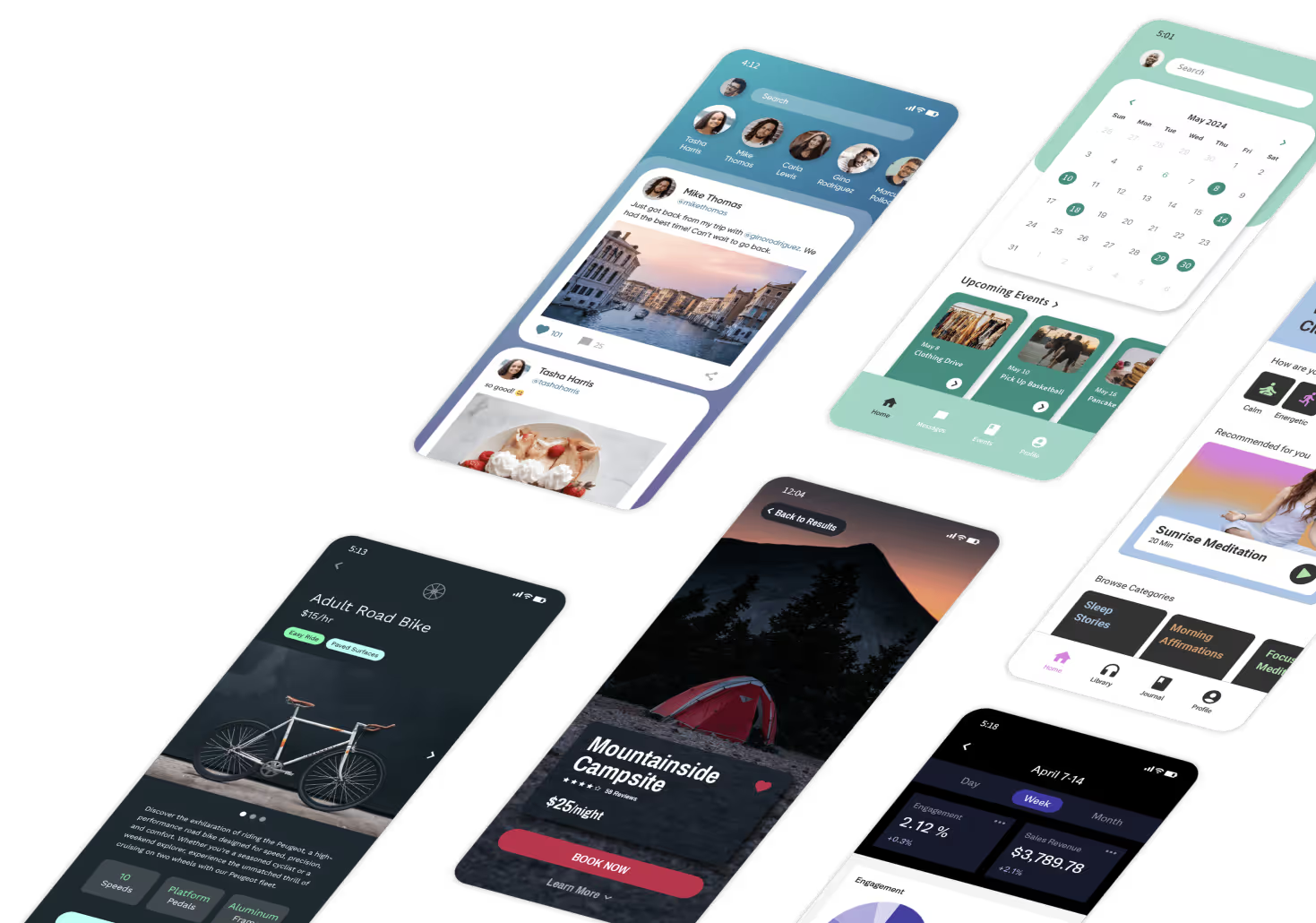
Ada, Adalo's AI builder, lets you describe what you want and generates your app. Magic Start creates complete app foundations from a description, while Magic Add adds features through natural language.
Comprehensive data compiled from extensive research across digital transformation, no-code adoption, and enterprise modernization trends
Key Takeaways
- Visual development platforms deliver proven ROI — Individual vendor case studies show returns ranging from 206% to 506%, with cross-platform builders like Adalo reducing development time by 30-50% through single-codebase deployment to web, iOS, and Android
- Citizen developers projected to outnumber professional developers 4:1 — Gartner's forecast indicates democratized development through visual builders will transform workforce dynamics, with 70% of new applications using no-code by 2026
- AI-powered app builders accelerate the shift further — Platforms combining visual development with AI assistance enable faster prototyping and iteration, with features like Magic Start generating complete app foundations from simple descriptions
- Legacy system maintenance consumes 70-80% of federal IT budgets — Modern platforms offer escape paths through API-based integration and gradual modernization, freeing resources for innovation
Global Adoption & Market Growth
70% of new applications will use low-code or no-code technologies by 2026. Gartner projects this massive shift from less than 25% in 2020, representing one of the fastest technology adoption curves in enterprise history. This acceleration reflects the convergence of developer shortages, growing application demand, and platform maturation.
Organizations embracing this shift can respond to market changes faster, while those maintaining traditional development approaches risk falling behind competitors who deliver solutions in weeks rather than months. Adalo is a no-code app builder for database-driven web apps and native iOS and Android apps—one version across all three platforms, published to the Apple App Store and Google Play. AI-powered app builders like Adalo amplify this advantage further—features like Magic Start generate complete app foundations from descriptions, compressing what used to take days of planning into minutes.
The low-code market is projected to reach $30-50 billion by 2028. Forrester's 2026 analysis shows the market at $13.2 billion in 2026, with potential to reach $50 billion by 2028 with AI acceleration. This 33% compound annual growth rate validates enterprise confidence in no-code platforms as critical infrastructure. The range reflects uncertainty around AI's impact, with the upper bound assuming AI-infused platforms drive explosive citizen development adoption.
87% of enterprise developers use low-code platforms for at least some work. Forrester's 2026 Developer Survey confirms this mainstream adoption within IT departments, showing visual development has evolved beyond citizen development. Professional developers leverage these platforms to accelerate delivery while maintaining governance standards.
This hybrid approach allows enterprises to balance speed with control, using visual builders for rapid prototyping and routine applications while reserving traditional coding for complex system integration.
60% of software development organizations will use enterprise low-code as their main platform by 2028. Gartner predicts this dramatic increase from just 10% in 2026, driven by digital transformation pressures and innovation demands. This six-fold increase in four years represents a fundamental shift in how enterprises approach application development.
Global Lighthouse Network manufacturers show 76% low-code/no-code adoption. McKinsey's research on World Economic Forum Global Lighthouse factories reveals high adoption among manufacturing leaders, though this represents best-in-class facilities. These industry leaders use visual builders to rapidly deploy operational improvements and respond to supply chain disruptions.
The drag-and-drop app builder market is valued at $2.5 billion, reaching $8.4 billion by 2032. The 14.5% compound annual growth rate demonstrates sustained enterprise demand for visual development approaches. This growth reflects recognition that visual interfaces dramatically reduce the learning curve for new developers.
Flutter is used by 46% of cross-platform framework developers. According to Statista's 2026 developer survey, Flutter leads among developers who specifically use cross-platform frameworks. This preference indicates growing focus on development efficiency and unified codebases.
22% of companies use low-code for UI customization. Organizations leverage visual development specifically to create consistent, branded user experiences across applications. This UI-focused adoption allows marketing and design teams to directly influence application appearance without developer bottlenecks.
70% of users learn low-code platforms within one month. This rapid onboarding contrasts sharply with the months or years required to master traditional programming languages. Adalo's visual builder has been described as "easy as PowerPoint," enabling organizations to quickly scale development capacity across business units.
37.6% CAGR is projected for intelligent developer technologies through 2028. IDC's forecast shows exceptional growth for the combined low-code, no-code, and AI-enhanced development market. This growth rate exceeds nearly all other technology categories, indicating fundamental market transformation.
Mobile Development Revolution
No-code platforms accelerate mobile app development significantly. Organizations report dramatic time savings when building mobile applications through visual interfaces versus traditional coding. This acceleration enables businesses to meet mobile-first customer expectations while managing limited development resources.
The speed advantage is particularly valuable for customer-facing applications where rapid iteration based on user feedback determines market success. Adalo, an AI-powered app builder, exemplifies this approach—one build publishes to web, iOS App Store, and Android Play Store from a single codebase, eliminating the need to maintain separate development tracks.
Cross-platform development approaches show meaningful cost savings. Organizations report substantial reductions in development expenses when using platforms that deploy to multiple channels from a single codebase. These savings come from eliminating duplicate development efforts for iOS, Android, and web platforms.
However, not all cross-platform solutions are equal. App wrappers—which package web apps for mobile distribution—often introduce performance issues at scale. Adalo's purpose-built architecture compiles to true native iOS and Android apps, maintaining performance even as user bases grow to millions of monthly active users.
72% of low-code applications are developed in under 3 months. Traditional development cycles typically spanning 6-12 months are being replaced by quarterly delivery cycles. This acceleration enables businesses to adapt to changing requirements and market conditions more effectively.
Cross-platform development saves 30-50% of development time. Research2guidance confirms that 50% of users report time savings over 30%, with 33% developing more than 50% faster. These time savings translate directly into cost reductions and faster time-to-market.
Mobile apps built with no-code enable faster iteration cycles. The ability to update and deploy changes quickly enables continuous improvement based on user feedback. This rapid iteration capability proves essential in mobile markets where user expectations evolve rapidly.
Elite DevOps teams deploy multiple times daily. DORA's State of DevOps research shows that elite performers deploy on demand, often multiple times per day. While this represents top-tier performance rather than industry averages, it demonstrates achievable velocity with modern tools.
Native mobile features are accessible through visual interfaces. Modern platforms provide access to device capabilities including camera, GPS, and push notifications without traditional coding requirements. This democratization of native features enables non-developers to create professional mobile applications.
Progressive web app development is accelerated with no-code. The ability to create mobile-responsive web applications that function like native apps expands deployment options. PWAs eliminate app store approval processes and enable instant updates across all users.
Reduced complexity in mobile app deployment. McKinsey discusses simplification trends as visual builders help manage app store submissions and platform requirements. Platforms handle certificates, provisioning profiles, and store compliance automatically.
Speed & Development Efficiency
Significant reduction in development time is reported with no-code. Various sources suggest improvements ranging from 50% to 90% in specific scenarios, though results vary by project complexity. The wide range reflects differences in application types, team experience, and platform capabilities.
Organizations typically see greatest time savings on standardized business applications rather than highly customized solutions. AI-assisted features accelerate this further—Magic Add lets users add features by describing what they want in natural language, eliminating the need to manually configure each component.
50% faster development is reported in Microsoft Power Apps case study. Forrester's TEI study of Microsoft Power Apps shows verified time savings for organizations using that specific platform. The study analyzed actual customer implementations to validate these efficiency gains.
26% faster time-to-market for applications is reported in some studies. Speed advantages translate directly into competitive benefits, particularly for customer-facing applications. Faster deployment enables organizations to capture market opportunities before competitors.
Prototypes are created faster using no-code tools. Rapid prototyping enables businesses to validate concepts before significant resource investment. Visual builders allow stakeholders to interact with functional prototypes rather than static mockups. This tangible validation reduces miscommunication and ensures alignment before full-scale development.
Development backlogs are potentially reduced with citizen development. The ability for business users to create their own applications helps alleviate IT bottlenecks. Citizen developers can address departmental needs without waiting for IT resources.
Automated testing improves development efficiency. Modern platforms increasingly include automated testing capabilities that reduce manual quality assurance requirements. Adalo's X-Ray feature identifies performance issues before they affect users, catching potential problems early in the development cycle.
Reusable components accelerate subsequent projects. Organizations build libraries of components that speed development of future applications. Each project contributes to a growing repository of tested, approved building blocks. This compound effect means development accelerates over time as component libraries mature.
API integrations are simplified through visual interfaces. Connecting to external services becomes accessible to non-technical users through pre-built connectors. Visual mapping tools eliminate the need to understand complex authentication and data transformation requirements.
Template-based development jumpstarts projects. Pre-built templates for common use cases reduce initial development time significantly. Templates provide proven architectures and design patterns that accelerate project initiation.
Collaborative development features improve team productivity. Real-time collaboration tools enable multiple team members to work simultaneously on applications. Version control and merge capabilities prevent conflicts while enabling parallel development.
Financial Returns & Cost Savings
OutSystems users report 506% ROI in vendor-commissioned study. Forrester's Total Economic Impact study specifically for OutSystems found these returns with $14.77 million net present value over three years. This analysis examined actual customer implementations and quantified both costs and benefits.
No-code platform costs vary widely by vendor and scale. Entry-level platforms start at hundreds of dollars annually, while enterprise implementations cost thousands to tens of thousands monthly. Understanding the full cost picture requires examining not just base pricing but also usage limits, record caps, and hidden charges.
| Platform | Starting Price | Key Limitations |
|---|---|---|
| Adalo | $36/month | Unlimited usage, unlimited database records on paid plans, unlimited app updates |
| Bubble | $59/month | Usage-based Workload Units, record limits, republishing limits |
| FlutterFlow | $70/month per user | Requires separate database setup and payment |
| Glide | $60/month | Limited app updates, data row limits, no app store publishing |
| Softr | $167/month | Record limits per app, no native app support |
| Thunkable | $59/month | Usage restrictions, responsive apps require custom pricing |
Adalo's pricing model eliminates bill shock. With no usage-based charges and unlimited database records on paid plans, organizations can budget accurately without worrying about unexpected costs as their apps scale. This contrasts with platforms like Bubble, where Workload Unit calculations can create unpredictable monthly bills.
Microsoft Power Apps shows 206% ROI in vendor study. Forrester's 2026 TEI study specifically for Microsoft documents these returns for their analyzed composite organization. The study showed payback in less than six months with cumulative benefits exceeding $31 million.
Reduced hiring needs potentially save on developer salaries. With U.S. Bureau of Labor Statistics showing median developer salary of $133,080, avoiding additional hires represents significant savings. Organizations can redirect these funds toward strategic initiatives rather than routine development.
4.01x higher ROI for cloud-based solutions versus on-premises. Nucleus Research confirms the general financial advantage of cloud-native platforms. Cloud deployment eliminates infrastructure costs while providing automatic scaling and updates.
Long-term savings compound as platform usage expands. Organizations typically see increasing returns as they expand no-code usage across departments. Initial investments in training and governance create foundations for broader adoption.
Reduced maintenance costs through platform management. Vendors handle infrastructure updates, security patches, and platform enhancements automatically. This eliminates the hidden costs of maintaining custom-developed applications over their lifecycle.
Faster time-to-value improves financial metrics. Quicker deployment means faster revenue generation or cost savings realization. This acceleration improves project NPV by bringing benefits forward in time.
Citizen Developer Empowerment
Gartner predicts citizen developers will outnumber professional developers 4:1. This 2021 forecast for 2026 represents a potential fundamental workforce shift. The prediction reflects growing platform accessibility and business demand for rapid application delivery.
While actual ratios vary by organization, the trend toward democratized development continues accelerating. Over 3 million apps have been created on Adalo alone, demonstrating the scale of citizen development adoption.
Gartner forecasted 80% of technology products built by non-IT professionals by 2026. This prediction suggested a dramatic shift from IT-centric to business-driven development. While actual 2026 measurements aren't yet available, organizations report increasing business-led development initiatives.
80% of low-code users are projected to be outside IT departments by 2026. Business users potentially becoming primary application creators would fundamentally restructure IT's role. IT transitions from builder to enabler, focusing on governance, security, and platform management.
83% of enterprise tech leaders have active citizen development programs. Widespread institutional support indicates citizen development has moved beyond experimentation to strategic initiative. Organizations invest in training, governance frameworks, and platform licenses to support business-led development.
65% of application development via no-code platforms by 2026 (Gartner forecast). This projection suggested no-code platforms would become the primary development method for many organizations. The forecast reflects platform maturation and growing business acceptance of citizen-developed applications.
Platform Comparison: Choosing the Right Builder
Not all no-code platforms serve the same use cases. Understanding the differences helps organizations select the right tool for their specific needs.
FlutterFlow targets technical users. As a low-code rather than no-code platform, FlutterFlow requires users to manage and set up their own external database—a significant learning curve, especially when optimizing for scale. Suboptimal database setup can create scalability problems, which has spawned an ecosystem of experts charging significant fees to help users chase performance. The builder's limited viewport (showing only 2 screens at once) slows development compared to platforms like Adalo, which can display up to 400 screens simultaneously on one canvas.
Glide excels at spreadsheet-based apps but limits creative freedom. Glide's template-focused approach enables fast building and publishing, but creates generic, simplistic apps with restricted customization. While Glide works well for spreadsheet-based applications, Adalo's SheetBridge feature offers similar convenience—turning a Google Sheet into an actual database—while providing full creative control over the app's design and functionality. Glide also doesn't support Apple App Store or Google Play Store publishing.
Bubble offers extensive customization but introduces complexity. Bubble's web and mobile wrapper offering provides deep customization options, but this flexibility often results in slower applications that struggle under increased load. Many Bubble users end up hiring experts to optimize performance. Claims of millions of MAU are typically only achievable with professional help. Additionally, Bubble's mobile solution wraps the web app rather than compiling to native code, meaning updates don't automatically sync across web, Android, and iOS deployments.
Softr and Thunkable serve specific niches. Softr focuses on spreadsheet-based web apps but doesn't support native mobile apps and starts at $167/month for PWA publishing. Thunkable offers AI-assisted app drafting but requires custom pricing beyond $189/month for responsive apps.
Adalo balances power with accessibility. Following the Adalo 3.0 infrastructure overhaul in late 2025, the platform is now 3-4x faster with modular infrastructure that scales to 1M+ monthly active users. With the right data relationship setups, apps can scale beyond this ceiling. Paid plans include unlimited database records and no usage-based charges—a significant advantage over platforms with record caps or unpredictable billing.
Note that most third-party platform ratings and comparisons predate Adalo 3.0's complete backend rebuild. Reviews citing performance concerns or scalability limitations likely reflect the previous architecture rather than current capabilities.
Legacy System Transformation
U.S. federal agencies spend 70-80% of IT budgets on legacy maintenance. The U.S. GAO reports federal agencies spend 80% on operations and maintenance, with some agencies reaching 90%. This massive allocation prevents investment in innovation and modernization initiatives.
While private sector percentages typically run lower, legacy maintenance still consumes disproportionate resources across industries.
U.S. federal legacy systems average $33.7 million annual cost. GAO's analysis of ten specific federal legacy systems shows $337 million total annual costs. These systems include critical infrastructure like tax processing and benefits management.
78.9% of federal civilian IT budgets go to maintenance. IDC research on federal spending patterns confirms this maintenance burden limits modernization capacity. The federal example illustrates the technical debt accumulated over decades of incremental system updates.
Global legacy system maintenance represents substantial spending. Various estimates suggest over $1 trillion globally on legacy maintenance across all sectors. This spending maintains existing capabilities without adding new value or addressing changing business needs.
Organizations report legacy systems hamper innovation capabilities. Legacy constraints prevent rapid response to market opportunities and customer needs. Inflexible architectures make simple changes expensive and risky, discouraging experimentation. Modern platforms offer escape paths from legacy constraints through API-based integration and gradual modernization approaches.
Sources Used
- AIMultiple - Low-Code Statistics
- Forrester - Low-Code Market Projections
- Forrester - State of Low-Code 2026
- Mendix - Gartner Magic Quadrant
- McKinsey - Tech at the Edge
- DataIntelo - Drag Drop App Builder Market
- Statista - Developer Statistics
- IDC - Low-Code Market Forecast
- research2guidance - Cross-Platform Development
- Google Cloud - State of DevOps
- Qvantel - Development Time Reduction
- Forrester TEI - Microsoft Power Apps
- OutSystems - 506% ROI Study
- Microsoft - Power Apps ROI
- U.S. Bureau of Labor Statistics - Developer Salaries
- Nucleus Research - Cloud ROI
- Impact Lab - Citizen Developer Ratio
- U.S. GAO - Legacy System Costs
- Nextgov - Federal Legacy Systems
- IDC Blog - Federal IT Spending
- Mechanical Orchard - Legacy Maintenance
FAQ
Why choose Adalo over other app building solutions?
Adalo is an AI-powered app builder that creates true native iOS and Android apps alongside web apps from a single codebase. Unlike web wrappers, it compiles to native code and publishes directly to both the Apple App Store and Google Play Store. With unlimited database records on paid plans, no usage-based charges, and infrastructure that scales to 1M+ monthly active users, Adalo handles the hardest parts of launching an app automatically.
What's the fastest way to build and publish an app to the App Store?
Adalo's drag-and-drop interface combined with AI-assisted features like Magic Start lets you generate complete app foundations from a simple description. The platform handles App Store submission requirements, certificates, and compliance automatically—what used to take months can be accomplished in weeks.
Which is more affordable, Adalo or Bubble?
Adalo starts at $36/month with unlimited usage and unlimited database records on paid plans. Bubble starts at $59/month but includes usage-based Workload Unit charges, record limits, and republishing restrictions that can create unpredictable monthly bills as your app scales.
Which is easier for beginners, Adalo or FlutterFlow?
Adalo is designed for non-technical users with a visual builder described as "easy as PowerPoint." FlutterFlow is a low-code platform targeting technical users who must also set up and manage their own external database—a significant learning curve that often requires hiring experts for optimization.
Is Adalo better than Glide for mobile apps?
For native mobile apps, yes. Glide doesn't support Apple App Store or Google Play Store publishing and restricts users to template-based designs. Adalo publishes true native apps to both stores while offering full creative control. Both platforms support spreadsheet-based data, but Adalo's SheetBridge provides this convenience without sacrificing customization.
Can I build apps that scale to millions of users?
Yes. Following Adalo 3.0's infrastructure overhaul in late 2025, the platform's modular architecture scales to 1M+ monthly active users with no upper ceiling. With proper data relationship setups, apps can scale beyond this. Over 3 million apps have been created on Adalo, processing millions of data requests daily.
How long does it take to learn a no-code platform?
Research shows 70% of users learn low-code platforms within one month. Adalo's visual interface accelerates this further—most users can build functional prototypes within days. The platform's AI features like Magic Add let you add functionality by describing what you want in plain language.
What kind of ROI can I expect from no-code development?
Vendor case studies show ROI ranging from 206% to 506% depending on platform and implementation. Organizations also report 50-90% reductions in development time and the ability to build applications in under 3 months rather than traditional 6-12 month cycles. Cross-platform builders like Adalo amplify savings by eliminating duplicate development for iOS, Android, and web.
Can citizen developers build enterprise-quality applications?
Yes. Gartner predicts citizen developers will outnumber professional developers 4:1, and 83% of enterprise tech leaders already have active citizen development programs. Modern platforms provide access to native mobile features, database functionality, and API integrations through visual interfaces, enabling business users to create professional applications independently.
How does no-code help with legacy system modernization?
Organizations often spend 70-80% of IT budgets maintaining legacy systems. No-code platforms offer escape paths through API-based integration and gradual modernization, allowing businesses to build modern applications that connect with existing systems without costly full replacements.