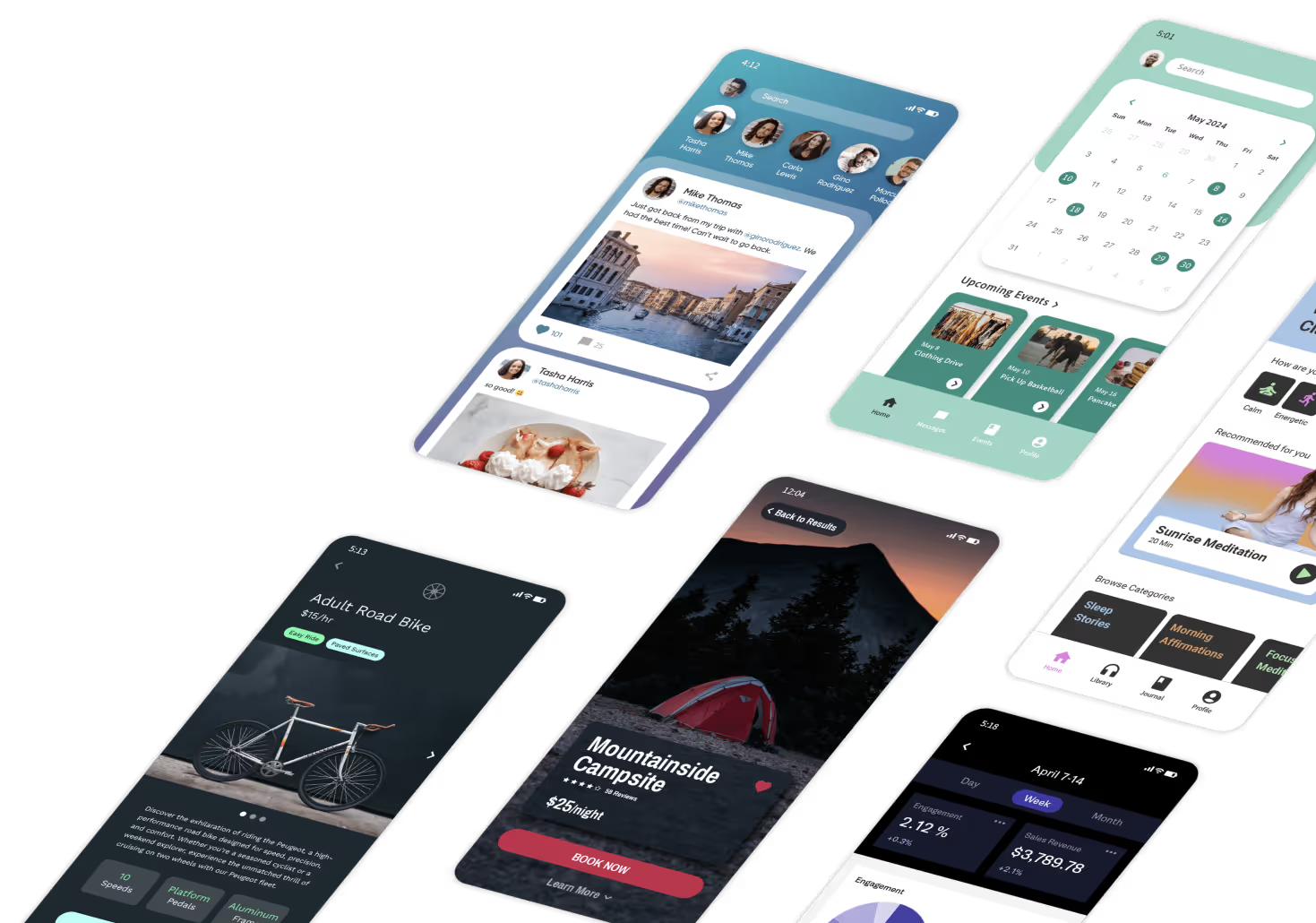
Creating a mobile app for your business requires significant investment, whether you choose traditional development or modern AI-powered solutions. Understanding the true costs involved can help you make an informed decision that aligns with your budget and timeline.
Ada, Adalo's AI builder, lets you describe what you want and generates your app. Magic Start creates complete app foundations from a description, while Magic Add adds features through natural language.
Adalo, a no-code app builder for database-driven web apps and native iOS and Android apps—one version across all three platforms, published to the Apple App Store and Google Play, is changing this equation dramatically. These visual development tools enable businesses to build professional mobile apps at a fraction of traditional costs.
Key Takeaways
- Traditional app development costs range from $10,000 to $500,000+ depending on complexity, with annual maintenance adding 15-20% to initial costs
- No-code platforms like Adalo offer subscription-based pricing from $36-$250 monthly, reducing development costs by 30-80%
- No-code development accelerates time to market by 75% or more compared to traditional approaches, with AI-assisted features like Magic Start generating complete app foundations in minutes
Understanding App Development Costs in 2026
The mobile app development landscape has evolved significantly, offering multiple pathways to bring your app idea to life. Each approach comes with distinct cost structures, timelines, and resource requirements that can dramatically impact your project's success.
Freelance Developer Rates by Experience
Freelance developers offer flexibility and potentially lower costs than agencies, but rates vary widely based on experience and location. Junior developers with 0-2 years experience typically charge $20-$40 per hour, with platform-specific rates ranging from $15-$20 for iOS to $15-$35 for Android development. Geographic variations show US developers at $60-$75 hourly, while Eastern European developers charge $30-$40 and Asian developers $15-$30.
Mid-level developers with 2-4 years experience command $40-$80 per hour on average, with premium platforms like Toptal charging $60-$100 hourly. These developers bring proven track records and can handle more complex features independently. Senior developers with 5+ years experience charge $80-$150+ per hour, with specialized skills in AI/ML or AR/VR commanding even higher rates.
Cross-platform developers using frameworks like React Native or Flutter generally charge 10-20% less than native developers while offering the advantage of maintaining a single codebase for both iOS and Android platforms.
Agency Pricing Structures
Development agencies provide comprehensive solutions but at premium prices. Simple apps cost $10,000-$60,000 through agencies, with average projects falling between $30,000-$50,000 and taking 2-4 months to complete. Medium complexity apps requiring features like payment processing, user authentication, and real-time updates range from $50,000-$150,000, averaging $80,000-$120,000 over 4-8 months.
Complex enterprise applications start at $120,000 and can exceed $500,000, with timelines extending 8-12+ months. US agencies typically charge $100-$200 per hour, while premium agencies specializing in healthcare or fintech command $200-$400+ hourly rates. Most agencies require initial deposits of $500-$5,000 and maintain minimum project sizes of $25,000-$50,000.
In-House Development Team Costs
Building an in-house team provides maximum control but requires substantial ongoing investment. Entry-level developers earn $65,000-$100,000 annually, while mid-level developers command $75,000-$120,000 and senior developers earn $120,000-$180,000+ on average. Geographic variations are significant, with US salaries averaging $129,349 for iOS and $106,537 for Android developers.
Beyond base salaries, employers must account for benefits and healthcare adding 20-30% to costs, equipment and software at $3,000-$5,000 per developer, office space at $1,200-$2,400 monthly per person, and training budgets of $2,000-$5,000 annually. The total employment cost typically reaches 1.4-1.6x the base salary.
A simple app project requires 2-3 developers, 1 designer, and 1 project manager, totaling $280,000-$420,000 annually. Medium complexity projects need 4-6 developers, 2 designers, 1-2 project managers, and QA specialists, costing $500,000-$800,000 yearly. Complex enterprise apps demand teams of 10+ professionals including DevOps engineers, costing over $1,000,000 annually.
The Hidden Costs Nobody Talks About
Beyond initial development, app owners face numerous ongoing expenses that can significantly impact total ownership costs. Understanding these hidden costs is crucial for accurate budget planning and avoiding financial surprises.
Ongoing Maintenance and Updates
App maintenance represents a significant ongoing expense, typically costing 15-20% of initial development costs annually. The first year often requires up to 50% of development costs as bugs are discovered and features refined. Monthly maintenance for basic upkeep ranges from $1,120-$2,150, while active development periods cost $5,000-$10,000 monthly.
Minor updates cost $50-$2,000 each, while major functional updates requiring 2-3 weeks of work range from $1,000-$2,000. OS compatibility updates alone cost approximately $10,000 annually as Apple and Google release new versions. Emergency fixes for critical bugs or security issues cost $1,000-$5,000 depending on severity and required response time.
Infrastructure and Hosting Expenses
Server and infrastructure costs scale with app complexity and user base. Basic apps cost $25-$70 monthly for hosting, while medium complexity applications require $100-$500 monthly. Enterprise apps with high traffic and data requirements spend $1,000-$5,000+ monthly, totaling $12,000-$60,000+ annually.
Additional infrastructure services add up quickly: file storage costs $5 monthly, server logging $7, error monitoring $15, push notifications $15, and email services $20. These basic services total approximately $100 monthly before considering scaling needs. API integration maintenance adds $5,000 yearly, while third-party service subscriptions average $4,000 annually.
Testing, Compliance, and Support Costs
Quality assurance represents another significant expense category. Manual testing costs $2,000-$10,000 per release, while automated testing setup requires $5,000-$15,000 initially. Device testing across multiple devices and OS versions costs $1,000-$3,000 monthly, and security testing runs $5,000-$20,000 annually.
App store fees include Apple's $99 annual developer account and Google's $25 one-time fee, plus 30% commission on all in-app purchases. Third-party payment processing adds 2.9-3.5% per transaction. Legal and compliance costs range from $5,000-$25,000 annually, while customer support systems require $15-$19 hourly per support representative.
Traditional Development Timelines Affect Your Bottom Line
Development timelines directly impact costs through extended resource allocation and delayed market entry. Understanding typical timeframes helps set realistic expectations and budget appropriately.
MVP to Market Timelines
Minimum Viable Products (MVPs) typically require 1-3 months for traditional development, with simple MVPs taking 6-8 weeks and complex MVPs with native features requiring 8-12 weeks. These timelines assume dedicated resources and clear requirements, with costs ranging from $5,000-$50,000.
The development process breaks down into distinct phases: planning and discovery takes 1-2 weeks, design and UX requires 2-4 weeks, development spans 8-24+ weeks depending on complexity, testing and QA needs 2-6 weeks, and deployment takes 1-2 weeks. Each phase requires different skill sets, often necessitating multiple team members working simultaneously.
Full App Development Cycles
Simple apps with basic functionality require 2-4 months of development and 3-5 months total including planning and testing. Medium complexity apps need 4-8 months of development within a 6-10 month project timeline. Complex apps demand 8-16 months of development time, with total projects extending 12-18+ months.
These extended timelines mean paying development teams for months or years before seeing revenue. Opportunity costs mount as competitors potentially enter the market first. Market conditions may change during lengthy development cycles, requiring costly pivots or feature changes mid-project.
The AI-Powered Alternative with Adalo
Adalo represents a paradigm shift in app development, offering visual development tools enhanced by AI that eliminate coding requirements while maintaining professional capabilities. With over 3 million apps created and the platform processing 20 million+ daily requests, Adalo has proven its ability to deliver production-ready applications at scale.
The platform's agnostic builder lets you publish the same app to the web, native iOS, and native Android—all without writing a line of code or rebuilding. For businesses focused on mass distribution through app store marketplaces, this single-codebase approach offers significant advantages over web wrappers or vibe-coding builders that require separate builds for each platform.
Adalo's Transparent Pricing Structure
Adalo offers straightforward monthly pricing that scales with your needs. The Starter Plan at $36/month includes 1 published app, custom domain publishing, and iOS and Android app store publishing. All paid plans now include unlimited database records and unlimited usage—no record caps, no usage-based charges, and no bill shock.
This pricing structure contrasts sharply with competitors. Bubble's comparable offering starts at $59/month but includes usage-based Workload Unit charges, limits on app re-publishing, and record restrictions that can create unpredictable costs. FlutterFlow starts at $70/month per user for app store publishing but doesn't include a database—users must source, set up, and pay for that separately. Glide starts at $60/month but limits data records and doesn't support App Store or Play Store publishing at all.
AI Features That Accelerate Development
Adalo's AI capabilities transform the development process. Magic Start generates complete app foundations from simple descriptions—tell it you need a booking app for a dog grooming business, and it creates your database structure, screens, and user flows automatically. What used to take days of planning happens in minutes.
Magic Add extends this capability throughout development. Describe a feature you want—"add a calendar view for appointments" or "create a payment checkout flow"—and the AI implements it. X-Ray proactively identifies performance issues before they affect users, highlighting optimization opportunities as you build.
The AI Builder, due for release in early 2026, will enable complete prompt-based app creation and editing, promising vibe-coding creation speed atop Adalo's battle-proven infrastructure.
Pre-Built Components Save Thousands
Adalo's component system eliminates the need for custom development of common features. Simple components include text, shapes, images, buttons, and webview elements. Form components provide text inputs, toggles, and complete forms for data collection. List components offer custom lists and tables for displaying dynamic data.
The component marketplace extends functionality with maps integration, charts and graphs, audio players, calendars, progress bars, star ratings, payment processing through Stripe, and Google AdMob integration. Each pre-built component would typically cost $1,000-$5,000 to develop from scratch, but comes included with your Adalo subscription.
Real Success Stories Prove the Value
Scholarcash, an education non-profit app, was built by non-technical founder Alessandro De La Torre in just 1 week and achieved over 20,000 iOS App Store downloads. The app helps students find scholarships to address the student loan crisis, demonstrating how quickly impactful solutions can reach users.
Counselora transformed from a months-long traditional development project to launching in "only a few weeks" with Adalo. The professional resources app now serves 750+ school counselors with 200+ resources. Moonifest, a wellness community app built by UX designer Sam Shaibani, grew to 38,000+ users and 32,000+ downloads after launching in January 2020, proving non-developers can create successful apps.
Comparing Development Approaches
Understanding the stark differences between traditional development and AI-powered platforms helps clarify which approach best serves your needs. The data reveals compelling advantages for most business applications.
Time to Market Advantages
Traditional MVP development requires 4-9 months for medium complexity projects, while platforms like Adalo enable development in days to weeks with 50-90% reduction in development time. No-code platforms deliver 10x faster development than traditional methods according to Forrester research, with 72% of users developing applications in 3 months or less versus 6-12 months traditionally.
Update and iteration speed shows even greater advantages. Traditional development requires weeks for simple changes with developer intervention, while visual platforms enable real-time updates through drag-and-drop interfaces. Organizations using citizen development report 71% sped up application development by at least 50%, with 29% seeing 2x or more improvement.
Total Cost Comparison
Initial development costs reveal dramatic differences. Traditional simple apps cost $20,000-$50,000 versus $1,500-$25,000 with no-code. Medium complexity apps traditionally cost $70,000-$100,000 compared to $30,000-$100,000 no-code. Complex apps requiring $200,000-$300,000+ traditionally can be built for significantly less, achieving 30-70% savings.
Ongoing costs favor no-code even more strongly. Traditional maintenance runs 15-20% of initial costs annually plus developer salaries of $80,000-$150,000/year and infrastructure costs of $2,000-$15,000/month. No-code platforms charge subscription fees of $432-$3,000 annually with the platform handling updates, security, and maintenance automatically.
Resource Requirements Analysis
Traditional development demands substantial teams: simple apps need 3-4 developers minimum, medium apps require 4-8 team members, and complex apps demand 8-15+ professionals. Each team member requires years of programming experience and specific language expertise.
No-code development typically requires just 1-3 people regardless of complexity. Often a single citizen developer handles end-to-end development with 70% of users learning platforms in 1 month or less. Adalo's visual builder has been described as "easy as PowerPoint," making it accessible to non-technical founders. No programming knowledge is required, addressing the developer shortage expected to reach 4 million by 2026.
How Adalo Compares to Other Platforms
The no-code landscape includes several options, each with distinct trade-offs. Understanding these differences helps you choose the right tool for your specific needs.
Adalo vs. Bubble
Bubble offers extensive customization for web applications, but this flexibility often results in slower applications that struggle under increased load. Bubble's mobile solution is a wrapper for web apps, introducing potential performance challenges at scale—and means one app version doesn't automatically update web, Android, and iOS deployments simultaneously.
Bubble starts at $59/month with usage-based Workload Unit charges that can create unpredictable bills. Adalo starts at $36/month with unlimited usage and no record caps. While Bubble claims support for millions of MAU, achieving this typically requires hiring experts to optimize performance—an ecosystem rich with consultants exists precisely because so many users need help.
Adalo vs. FlutterFlow
FlutterFlow is a low-code platform designed for technical users, not a true no-code solution. Users must set up and manage their own external database, which requires significant learning complexity. Suboptimal database setup can create serious scale problems, spawning an ecosystem of experts charging significant sums to chase scalability.
FlutterFlow's builder limits view to 2 screens at once, while Adalo can display up to 400 screens on one canvas for faster navigation. FlutterFlow pricing starts at $70/month per user for app store publishing—but still doesn't include a database, which users must source and pay for separately.
Adalo vs. Glide and Softr
Glide excels at spreadsheet-based apps with its template-focused approach, enabling fast builds but creating generic, simplistic apps with limited creative freedom. Glide starts at $60/month but limits data records and doesn't support App Store or Play Store publishing. For spreadsheet connectivity, Adalo's SheetBridge turns Google Sheets into an actual database without the restrictions.
Softr starts at $167/month for Progressive Web App publishing, still restricted by records per app. Like Glide, Softr doesn't support native iOS or Android app creation or app store publishing.
Making the Smart Choice for Your Business
The mobile app development landscape offers more options than ever, but the data clearly demonstrates AI-powered platforms provide compelling advantages for most business applications. With the low-code market growing from $26.9 billion in 2026 to projected $187 billion by 2030, this approach represents the future of app development.
When Traditional Development Makes Sense
Traditional development remains appropriate for highly complex, mission-critical systems requiring extensive customization, applications needing cutting-edge technology integration, systems with stringent performance requirements, projects requiring complete control over the code base, and applications needing extensive third-party integrations not supported by no-code platforms.
Why Adalo Leads the AI-Powered App Building Revolution
Adalo's platform combines powerful capabilities with unprecedented accessibility. The visual development environment means if you can make a slide deck, you can make an app. With comprehensive video tutorials and pre-built app templates, even complex apps become achievable.
Integration capabilities through Zapier connect to 5,000+ apps, while direct integrations with Stripe, Airtable, and other essential services provide enterprise functionality. The component marketplace offers specialized features from maps to payment processing, each saving thousands in development costs.
Adalo 3.0's completely overhauled backend infrastructure, launched in late 2025, delivers 3-4x faster performance with modular infrastructure that scales to 1M+ MAU with no upper ceiling. Most third-party ratings and comparisons predate this major update. With 99%+ average uptime and direct publishing to app stores, Adalo delivers professional results without professional developer costs.
FAQ
Why choose Adalo over other app building solutions?
Adalo is an AI-powered app builder that creates true native iOS and Android apps from a single codebase. Unlike web wrappers, it compiles to native code and publishes directly to both the Apple App Store and Google Play Store. With unlimited database records on paid plans, no usage-based charges, and AI features like Magic Start, it offers predictable costs and faster development than alternatives.
What's the fastest way to build and publish an app to the App Store?
Adalo's drag-and-drop interface combined with AI-assisted building enables you to go from idea to published app in days rather than months. Magic Start generates complete app foundations from descriptions, and Adalo handles the complex App Store submission process—certificates, provisioning profiles, and store guidelines—so you can focus on features and user experience.
How much can I save using no-code development compared to traditional app development?
No-code platforms like Adalo can reduce development costs by 30-80% compared to traditional approaches. While traditional simple apps cost $20,000-$50,000 and medium complexity apps run $70,000-$100,000, Adalo's subscription-based pricing starts at just $36/month with pre-built components that would typically cost $1,000-$5,000 each to develop from scratch.
Which is more affordable, Adalo or Bubble?
Adalo starts at $36/month with unlimited usage and unlimited database records. Bubble starts at $59/month but includes usage-based Workload Unit charges, limits on app re-publishing, and record restrictions that can create unpredictable costs. For predictable budgeting, Adalo offers clearer pricing.
Which is easier for beginners, Adalo or FlutterFlow?
Adalo is significantly easier for beginners. FlutterFlow is a low-code platform designed for technical users that requires setting up and managing an external database separately. Adalo's visual builder has been described as "easy as PowerPoint" and includes an integrated database with no setup required.
Is Adalo better than Glide for mobile apps?
For native mobile apps, yes. Glide creates template-based apps with limited creative freedom and doesn't support Apple App Store or Google Play Store publishing. Adalo builds true native iOS and Android apps that publish directly to both app stores from a single codebase.
What hidden costs should I consider when building a mobile app?
Beyond initial development, traditional apps incur annual maintenance costs of 15-20% of development costs, server hosting from $25-$5,000+ monthly, app store fees including Apple's 30% commission on purchases, and support costs averaging $15-$19 per hour. Adalo significantly reduces these ongoing expenses by handling updates, security, and maintenance automatically within your subscription.
How long does it take to build and launch an app with Adalo?
With Adalo, you can build and launch apps in days to weeks rather than the 4-9 months required for traditional development. Real success stories demonstrate this speed—Scholarcash was built in just 1 week and achieved over 20,000 downloads, while Counselora transformed from a months-long traditional project to launching in only a few weeks.
Can I migrate from Bubble to Adalo?
Yes, you can migrate from Bubble to Adalo. While there's no one-click migration, Adalo's visual builder and AI features like Magic Start make rebuilding straightforward. Many users find the transition worthwhile for Adalo's native mobile app compilation, predictable pricing without usage charges, and unlimited database records.
What features and integrations does Adalo support?
Adalo offers comprehensive pre-built components including forms, lists, maps, charts, calendars, payment processing through Stripe, and Google AdMob for monetization. Integration capabilities through Zapier connect to 5,000+ apps, while direct integrations with essential services like Airtable provide enterprise-level functionality without writing code.