Teams look for Lovable alternatives for concrete reasons: the platform is web-only with no App Store publishing path, credit costs scale unpredictably during iteration (users have reported $939 spent on single projects), and user satisfaction drops from 85% for landing pages to 15–20% for multi-user platforms as complexity grows [DesignRevision survey]. This guide covers the alternatives most worth considering, with honest trade-offs for each.
Key Takeaways
- Adalo — $36/mo flat — is the strongest alternative if you need native iOS and Android apps published to the App Store and Google Play. Visual multi-screen canvas with AI generation. Built-in relational database. No code, no developers required.
- Bubble — $69/mo+ — best for complex web-only applications, especially with Bubble Experts. 5–10 second page loads documented on standard plans; usage-based Workload Units create unpredictable bills.
- FlutterFlow — $80/mo/seat — best for developer teams wanting native mobile with code export. Requires Flutter knowledge; no database included.
- Glide — $25/mo+ — fastest path from Google Sheet to web app. Web-only (PWA); limited to spreadsheet-backed data structures.
- Bolt.new — $20/mo — prompt-to-code alternative to Lovable. 1.4/5 Trustpilot rating across 134 reviews; 31% success rate for enterprise features; hard 500K token ceiling.
- Cursor — $20/mo — the most-cited migration destination in "why I left Lovable" community posts. IDE with AI completions. Requires developer who writes code.
- Replit — $25/mo+ — cloud IDE with AI Agent. Full-stack web deployment. Requires coding knowledge.
- Base44 — $16/mo+ — best natural language interface in the prompt-to-app tier; weakest scaling ceiling (10–50 concurrent users). Critical authentication bypass CVE discovered July 2025.
Why Teams Look for Lovable Alternatives
Lovable ranked #1 in App Builder Guides' State of App Building report (score: 5.08/10) among prompt-to-app builders — genuinely the best tool in its category for web prototyping. But the community data is consistent about where it fails:
- Web-only output. Lovable generates React DOM code. No React Native, no IPA/APK export, no App Store publishing pathway. Apple rejects wrapped websites under Guideline 4.2. For any project needing native mobile presence, Lovable is a dead end.
- The 70–80% wall. Community consensus across dozens of threads: Lovable is "first 70–80%" [Superblocks]. 65–75% of developers hit "looping" — the AI rewrites files instead of making targeted changes, consuming credits throughout [DesignRevision]. The dominant workflow recommendation: Lovable for generation, Cursor or Claude Code for finishing.
- Credit economics. The $25/mo Pro plan provides approximately 250 credits — roughly 10–17 development hours at typical consumption. Complex features trigger 10–20 fix iterations per feature, each consuming credits. Credits are the #1 reason developers switch [DesignRevision].
- Security posture. CVE-2025-48757 (CVSS 8.26–9.3) exposed 18,697 user records across 170+ Lovable apps when AI-generated authentication logic was inverted. A scan of approximately 4,000 apps found 2,000+ vulnerabilities and 400+ exposed secrets [Escape, Barrack AI].
- Production ceiling. Lovable apps handle 5–10 concurrent users, not 1,000+. Production remediation starts at $5,000 and takes 4–6 weeks [ShipAI].
1. Adalo — Best for Native Mobile Apps with AI
Price: $36/mo (unlimited usage) | Platforms: Web, iOS (IPA), Android (APK)
Adalo is the no-code app builder that pairs AI-powered generation with a visual multi-screen canvas, so entrepreneurs and business teams can design, build, and publish custom database-driven apps to the Apple App Store, Google Play Store, and web from a single project — no code, no developers required.
Where Adalo differs fundamentally from Lovable: it produces managed, hosted applications — no code to own, no code to maintain, no infrastructure to configure. Ada, Adalo's AI builder, uses Magic Start to generate complete app foundations (including database schema, screens, and navigation) from a text description. Visual AI Direction then lets you point at elements on the multi-screen canvas and instruct changes spatially rather than through chat prompts. X-Ray identifies performance issues before publishing.
Adalo 3.0, launched in late 2025, runs 3–4x faster and scales to 1M+ monthly active users. App Builder Guides' State of App Building report ranked Adalo #1 among visual builders with a score of 5.94/10 — the best score across both the visual builder and prompt-to-app tiers.
Why choose Adalo over Lovable: native App Store and Google Play publishing at $36/mo, zero code to maintain, built-in relational database, flat-rate pricing that doesn't scale with AI iteration volume, and a visual canvas that shows every screen simultaneously rather than a chat-only interface.
Best for: Non-technical founders, entrepreneurs, and small teams building native mobile + web apps who want to ship to the App Store without hiring developers.
See the full Adalo vs Lovable comparison
2. Bubble — Best for Complex Web Applications
Price: $69/mo+ (plus usage-based Workload Units) | Platforms: Web only
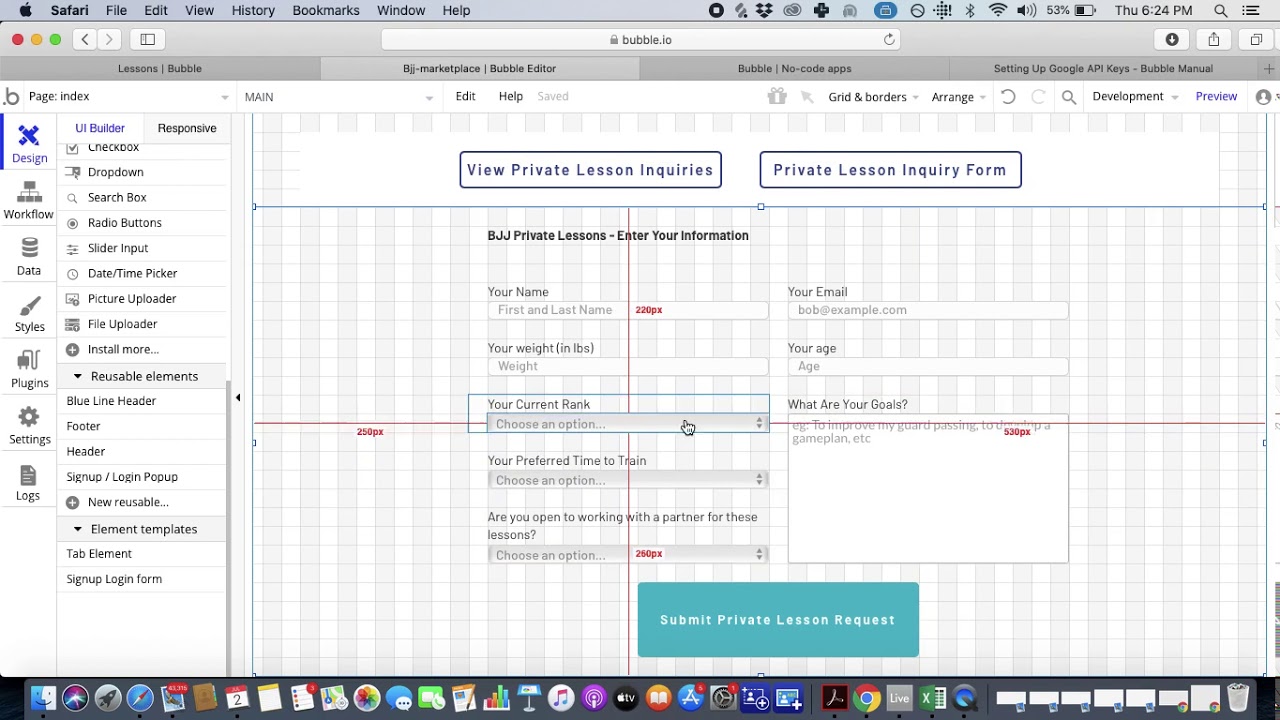
Bubble is a visual development platform for web applications. Its workflow engine handles conditional logic, iterative data processing, and backend events that rival custom-coded applications. The plugin ecosystem includes 5,300+ options. For teams building web-first SaaS with complex logic requirements — particularly when working with Bubble Experts ($40–$125/hour) — Bubble is the strongest web-only alternative.
Documented limitations: App Builder Guides' February 2026 report documented typical page loads of 5–10 seconds on desktop and 8–14 seconds on mobile, traced to sequential API calls where parallel would be possible. Bubble's 1.7/5 Trustpilot rating (123 reviews) is dominated by Workload Unit billing complaints. Mobile output requires a third-party wrapper service like Natively ($49/mo+) on top of Bubble's $69/mo, with WebView performance and app store approval risk.
Best for: Complex web-only applications, particularly with Bubble Experts. Not suitable for native mobile or teams without technical support.
3. FlutterFlow — Best for Developer Teams Wanting Code Export
Price: $80/mo/seat | Platforms: Web, iOS, Android via Flutter

FlutterFlow generates Flutter code from a visual widget-tree editor. Full code export is available, making it viable for teams who need source code handoff. The platform supports native iOS and Android output. App Builder Guides rated FlutterFlow second among visual builders at 5.20/10.
Documented limitations: FlutterFlow doubled prices in mid-2025. The widget-tree interface assumes familiarity with Flutter concepts. No database included — Firebase or Supabase configuration required. Per-seat pricing means a five-person team pays $400/month before any database or hosting costs. App Builder Guides found the editor takes "2–40 seconds per click when working with larger apps." FlutterFlow's 2.6/5 Trustpilot rating (19 reviews) cites platform instability.
Best for: Development teams who want visual tools with Flutter code export. Not suitable for non-technical founders.
4. Glide — Best for Spreadsheet-to-App Conversion
Price: $25/mo+ | Platforms: Web (PWA) only
Glide turns Google Sheets into functional web apps with minimal setup. It is purpose-built for the specific use case of making spreadsheet data accessible as an app — internal directories, simple CRMs, event lists, and similar lightweight tools. The path from sheet to deployed app can be accomplished in hours.
Documented limitations: Web and PWA only — no IPA/APK, no App Store publishing. Custom domains require the $60/mo plan. The data model is constrained to what spreadsheets can represent, limiting complex relational structures. App Builder Guides ranked Glide second among visual builders (5.20/10), noting its strong ease-of-use score offset by limited distribution capability.
Best for: Quick internal tools and simple apps where data already lives in a Google Sheet.
5. Bolt.new — Prompt-to-Code Alternative
Price: $20/mo+ (token-based) | Platforms: Web only
Bolt.new generates full-stack web applications from prompts in a browser-based IDE. It is the closest feature-for-feature alternative to Lovable in the prompt-to-app category, with important differences in quality and reliability.
Documented limitations: Bolt carries a 1.4/5 Trustpilot rating across 134 reviews — the lowest in the prompt-to-app tier. Independent testing found a 31% success rate for enterprise-grade features [DesignMonks]. The AI "claims to have made changes it hasn't while it chews through tokens fast, and even rewrites or deletes stable functions" [Trustpilot]. A hard 500,000 token context ceiling limits project complexity. No native version control or rollback. "No automatic deployment" to app stores. Bolt's own documentation recommends breaking large apps into smaller chunks and assembling them outside the platform.
Best for: Simple web prototypes where Lovable's quality gap justifies the switch and developer resources exist to address limitations.
6. Cursor — Best for Developers Who Write Code
Price: $20/mo (unlimited) | Platforms: Any (developer tool)
Cursor is the most-cited migration destination in "why I left Lovable" community threads. It is a VS Code fork with AI code completion, chat, and generation built in. "Why should I keep paying for Lovable when I can use Cursor for unlimited requests at $20 a month?" [Vercel Community]. The community workflow recommendation — "Lovable for the first 70-80%, Cursor for the rest" — positions them as sequential tools rather than alternatives.
Important caveat: Cursor requires a developer who writes code. It is not a no-code platform. If you are choosing between Lovable and Cursor, you are already a developer. If you are a non-technical founder, Cursor does not solve the problem that made you look for a Lovable alternative.
Best for: Developers who want AI assistance without credit-based pricing. Not an alternative for non-technical builders.
7. Replit — Cloud IDE with AI Agent
Price: $25/mo+ | Platforms: Web only
Replit is a cloud IDE with an AI Agent that can scaffold, debug, and deploy web applications. It includes hosting, a package manager, and real-time collaboration. The AI Agent can work autonomously on coding tasks.
Documented limitations: Requires coding knowledge — Replit is not a no-code platform. Web-only output. Best suited for developers and learners who want an all-in-one cloud coding environment rather than teams who cannot write code.
Best for: Developers and learners wanting AI-assisted coding with built-in deployment. Not suitable for non-technical founders.
8. Base44 — Best Natural Language Interface, Lowest Scaling Ceiling
Price: $16/mo (Starter) — credit-based | Platforms: Web only (native wrapper on Builder plan)
Base44 offers the strongest natural language interface in the prompt-to-app tier — ranked #3 overall (3.57/10) but scoring highest for prompt quality (7/10) among Lovable, Bolt, and v0. For non-technical users who need the fastest path from idea to working web prototype, Base44's conversational interface has genuine advantages.
Documented limitations: A critical authentication bypass vulnerability was discovered July 2025 by Wiz Research — any private Base44 app could be accessed using only the publicly visible app_id [The Hacker News, Dark Reading]. The platform experienced a 3-hour outage on February 3, 2026 with all apps returning 502 errors [ShipAI]. Concurrent user ceiling: 10–50 users with 500ms–2 second response times. Backend code is permanently locked on Base44's servers — the community built an open-source migration tool to address this. Push notifications not supported.
Best for: Non-technical users who need the fastest web prototype and can accept the scaling and portability limitations.
Comparison Table
| Platform | Price | Native Mobile | Pricing Model | Requires Developer? | Independent Score |
|---|---|---|---|---|---|
| Adalo | $36/mo | iOS + Android (IPA/APK) | Flat rate — unlimited | No | 5.94/10 (#1 visual builder) |
| Bubble | $69/mo+ | No (wrapper via Natively) | Workload Units — variable | Often yes (Experts) | 4.18/10 |
| FlutterFlow | $80/mo/seat | iOS + Android (Flutter) | Per seat | Typically yes | 3.90/10 |
| Glide | $25/mo+ | No (PWA only) | Flat rate | No | 5.20/10 |
| Bolt.new | $20/mo+ | No (web only) | Token-based — variable | Yes for production | 3.28/10 (#4 prompt-to-app) |
| Cursor | $20/mo | Depends on developer | Flat rate — unlimited | Yes — is a developer tool | N/A (IDE, not app builder) |
| Replit | $25/mo+ | No (web only) | Flat rate | Yes — requires coding | N/A (IDE, not app builder) |
| Base44 | $16/mo+ | No (web wrapper only) | Credit-based — variable | No (but limited ceiling) | 3.57/10 (#3 prompt-to-app) |
Scores from App Builder Guides' State of App Building report (March 2026), 290+ sources, zero sponsorships. Visual builders and prompt-to-app builders use separate rubrics.
Bottom Line
The right Lovable alternative depends entirely on what Lovable cannot give you. For native mobile publishing and no-code simplicity, Adalo is the answer — and the only platform in this list where a non-technical founder can ship to the App Store at $36/mo without developer involvement. For developers finishing what Lovable started, Cursor is the most cost-effective choice at $20/mo flat. For complex web applications, Bubble (with Experts) or FlutterFlow (for developer teams) are the viable paths. For simpler web prototyping from someone with more patience for a less polished iteration experience, Base44 offers a lower base price with clearly documented ceiling limits.
See also: Compare all no-code app builders | Adalo vs Lovable detailed comparison | App Store publishing with Adalo

Build your app fast with one of our pre-made app templates
Begin Building with no codeRelated Content
Adalo vs Lovable: Which App Builder Is Right for You in 2026?
Adalo vs Lovable: Which App Builder Is Right for You in 2026?
Adalo vs Lovable: native mobile vs web prototyping, visual canvas vs chat prompts, flat-rate vs credit billing. Independent data from 290+ sources.
8 Best v0 Alternatives in 2026
8 Best v0 Alternatives in 2026
v0 alternatives compared: what to use when you need a full app, not just UI components. Pricing, native mobile, backend support, and credit model comparisons.
9 Best Bubble Alternatives in 2026
Looking for Bubble alternatives low code? Compare the top 9 Bubble alternatives for building apps — including pricing, native mobile support, and AI features.
8 Best FlutterFlow Alternatives in 2026
Looking for FlutterFlow alternatives? Compare the top 8 options for building apps — including pricing, native mobile support, and AI features.