
The most common reason teams look for v0 alternatives is discovering what v0 does not cover. For a SaaS app with authentication, payments, and role-based access control, independent analysis found that "v0 handles maybe 30% of the work" [Atoms.dev]. There is no backend, no database, no authentication, no native mobile output. Vercel acknowledged this gap explicitly when rebuilding v0 in February 2026 to address "the 90% problem" [VentureBeat]. This guide covers the tools that cover the remaining 70–90%, depending on what you are building.
Key Takeaways
- Adalo — $36/mo flat — covers the complete stack: database, authentication, UI, native iOS/Android, App Store publishing, and zero code to maintain. Best option if you need a complete app rather than a collection of React components.
- Lovable — $20/mo+ — full-stack prompt-to-app builder (React + Supabase). Covers more ground than v0 but introduces credit pricing, a 70–80% completion wall, and a documented CVE that exposed 18,697 user records. Ranked #1 in the prompt-to-app tier (5.08/10) by App Builder Guides.
- Bubble — $69/mo+ — complete web application platform including backend, database, and workflow engine. Stronger for production web apps than any prompt-to-code tool, with documented 5–10 second page loads on standard plans.
- Cursor — $20/mo unlimited — the flat-rate alternative for developers who found v0's credit pricing unsustainable. Pure developer tool — no benefit for non-technical users.
- FlutterFlow — $80/mo/seat — visual builder for native mobile with Flutter code export. Requires developer knowledge; no database included.
- Bolt.new — $20/mo token-based — generates full-stack web apps vs v0's frontend-only output. Lower quality rating (1.4/5 Trustpilot, 3.28/10 independent score) but covers more of the stack.
- Webflow — $23/mo+ — purpose-built for marketing sites and CMS-driven content. Strong visual editing; no native mobile, database-light.
- Replit — $25/mo+ — cloud IDE with AI Agent for developers. Covers full-stack but requires coding knowledge.
Why Teams Look for v0 Alternatives
Three developments have driven the v0 user exodus, each documented in Vercel's own community forums:
The May 2025 pricing shift. Vercel replaced unlimited messages ($20/mo) with credit-based tokens. Ten or more Vercel Community threads followed, with titles including "From Affordable to Abusive: What Happened to V0?," "New Pricing Model is a Scam!," "Credits Gone Fast, Errors Cost More Than Dev Hire," and "I'd need to spend around $1,000 a month to continue working in v0." Credits are charged for AI errors — "Vercel v0 can make mistakes — and I get billed for every single one" [Medium].
Quality decline. Community threads titled "V0 From Best to Trash in Just 2 Weeks," "V0 was sooo good, now its just terrible," and "Feedback on the New V0 Update — Deeply Disappointed" document a regression from v0's early output quality. Vercel's February 2026 rebuild of v0 — explicitly to address "the 90% problem" — confirmed the platform was not covering enough of the real application stack.
Data loss incidents. Seven or more documented community threads: 270 deployed projects going offline after account suspension; a paid account migrated to v0.app with all data deleted and the account reset to free tier; project files deleted after enabling GitHub integration; an entire project deleted after attempting to delete a single message. "Conversations getting deleted, messages disappearing, deployments being erased" [Vercel Community].
1. Adalo — Best for Complete Apps Without Code
Price: $36/mo (unlimited usage) | Platforms: Web, iOS (IPA), Android (APK)
Adalo is the no-code app builder that pairs AI-powered generation with a visual multi-screen canvas, so entrepreneurs and business teams can design, build, and publish custom database-driven apps to the Apple App Store, Google Play Store, and web from a single project — no code, no developers required.
Where v0 generates the frontend 30% of an application, Adalo produces the complete stack: database schema, authentication, UI with every screen on one canvas, backend logic, and native iOS and Android builds — all managed by the platform, none requiring developer involvement.
Ada, Adalo's AI builder, uses Magic Start to generate complete app foundations from a description (including database schema and navigation), Magic Add to add features through natural language, and Visual AI Direction to let you point at elements and instruct changes spatially. Adalo 3.0 scales to 1M+ monthly active users. App Builder Guides ranked Adalo #1 among visual builders (5.94/10).
The pricing comparison is direct: Adalo charges $36/mo flat regardless of AI interaction volume. v0 charges credits per generation including failed ones — a mechanism that users documented consuming $30 in 2 days or $1,000/month at production usage rates.
Best for: Anyone who needs a complete application — database, authentication, UI, and native mobile — rather than a collection of frontend components to assemble manually.
See the full Adalo vs v0 comparison
2. Lovable — Best Full-Stack Alternative for Web Prototyping
Price: $20/mo+ (credit-based) | Platforms: Web only
Lovable is the most capable prompt-to-app builder for web development — ranked #1 in the prompt-to-app tier (5.08/10) by App Builder Guides. Unlike v0, Lovable generates a complete React + Supabase full-stack application, not just frontend components. It covers authentication, database, and deployment in a single workflow.
Key differences from v0: Full-stack generation vs. frontend only; stronger initial output quality; Git integration and code export; higher credit costs for complex iteration; same web-only limitation with no native mobile output.
Known limitations: CVE-2025-48757 exposed 18,697 user records across 170+ Lovable apps when AI-generated authentication logic was inverted. User satisfaction drops from 85% for landing pages to 15–20% for multi-user platforms as complexity grows. The dominant community workflow: Lovable for initial generation, Cursor for the remaining 20–30% [DesignRevision].
Best for: Web prototyping and MVP validation where the full-stack gap from v0 is the primary problem. Still requires developer resources for production deployment.
3. Bubble — Best Web App Platform for Production
Price: $69/mo+ (plus Workload Units) | Platforms: Web only
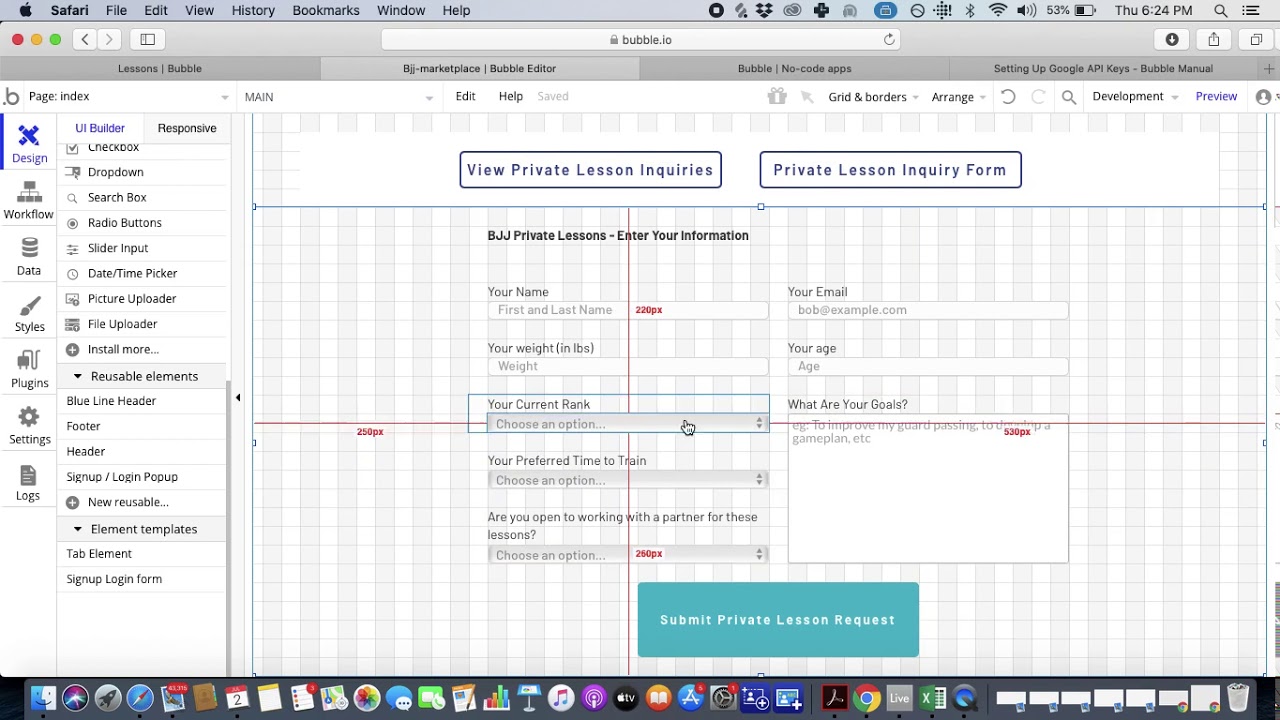
Bubble is a visual development platform for production web applications. Its workflow engine handles conditional logic, API integrations, and backend events. The 5,300+ plugin ecosystem extends capabilities significantly. For teams who know they are building a web application and need a complete, manageable platform, Bubble is the most capable web-only alternative to any prompt-to-code tool.
Documented limitations: App Builder Guides documented typical page loads of 5–10 seconds on desktop and 8–14 seconds on mobile, traced to sequential API calls in the backend architecture. Bubble's 1.7/5 Trustpilot rating (123 reviews) cites unpredictable Workload Unit billing. Most serious projects require Bubble Experts ($40–$125/hour) to configure effectively.
Best for: Teams committed to a web-only product that need production reliability over speed of initial generation.
4. Cursor — Best for Developers Who Found v0's Credits Unsustainable
Price: $20/mo (unlimited) | Platforms: Any (developer tool)
Cursor is the migration destination most cited by v0 users who left over pricing: "Why should I keep paying for Vercel when I can use Cursor for unlimited requests at $20 a month?" [Vercel Community]. It is a VS Code fork with AI code completion, chat-based generation, and codebase context — the developer-tool equivalent of what v0 tried to be for frontend generation, but covering the full stack and at a flat rate.
Important caveat: Cursor requires a developer who writes code. It is not an alternative for non-technical founders. If v0 worked for your use case except for the pricing model, Cursor is a direct upgrade. If v0 did not work because you lack backend development skills, Cursor does not close that gap.
Best for: Frontend and full-stack developers who used v0 for component generation and want unlimited usage at a flat rate.
5. FlutterFlow — Best for Native Mobile with Code Export
Price: $80/mo/seat | Platforms: Web, iOS, Android via Flutter

FlutterFlow generates Flutter code from a visual widget-tree editor. It is the strongest code-output option for teams who need native iOS and Android with the ability to hand off source code to developers.
Documented limitations: Per-seat pricing means a five-person team pays $400/month before database or hosting costs. No database included — Firebase or Supabase required. The widget-tree interface requires familiarity with Flutter concepts. FlutterFlow doubled prices in mid-2025. App Builder Guides documented the editor taking "2–40 seconds per click when working with larger apps."
Best for: Developer teams who want visual tools for native mobile with Flutter code export. Not suitable for non-technical founders.
6. Bolt.new — Full-Stack Alternative to v0's Frontend-Only Output
Price: $20/mo+ (token-based) | Platforms: Web only
Bolt generates full-stack web applications rather than just UI components, addressing v0's most significant gap. Both use token-based pricing with similar base rates.
Documented limitations: 1.4/5 Trustpilot rating across 134 reviews — the lowest in the prompt-to-app tier. Independent testing found a 31% success rate for enterprise-grade features [DesignMonks]. The AI "claims to have made changes it hasn't while it chews through tokens fast, and even rewrites or deletes stable functions when you only ask it to change something minor" [Trustpilot]. Hard 500,000 token context ceiling. No native version control or rollback.
Best for: Teams where full-stack generation is the primary requirement and they can tolerate Bolt's reliability profile. A step up from v0's 30% coverage; a step down from Lovable in quality.
7. Webflow — Best for Marketing Sites and CMS Content
Price: $23/mo+ | Platforms: Web only
Webflow is a visual website builder purpose-built for marketing pages, landing pages, and CMS-driven content sites. Its CSS-level visual editor gives designers pixel-level control. Webflow is not a general app builder — it lacks the database infrastructure and application logic needed for user-authenticated apps.
Documented limitations: No native mobile output. Limited application-layer database capabilities. Per-site pricing can scale quickly across multiple projects. Better suited for content-driven sites than product applications with user data.
Best for: Marketing teams building websites and content-driven pages. Not suitable for database-driven applications or native mobile.
8. Replit — Cloud IDE with AI Agent
Price: $25/mo+ | Platforms: Web only
Replit is a cloud IDE with an AI Agent that scaffolds, debugs, and deploys web applications. It includes integrated hosting, a package manager, and collaborative coding features. Unlike v0, Replit generates server-side logic and can handle authentication and database connections within the platform.
Documented limitations: Requires coding knowledge — Replit is not a no-code platform. Web-only. The AI Agent requires developer oversight for anything beyond standard CRUD applications.
Best for: Developers and learners who want an all-in-one cloud development environment with AI assistance and built-in deployment.
Comparison Table
| Platform | Price | Native Mobile | Backend/DB | Pricing Model | Requires Code? |
|---|---|---|---|---|---|
| Adalo | $36/mo | iOS + Android (IPA/APK) | Built-in relational DB | Flat rate | No |
| Lovable | $20/mo+ | No | External Supabase | Credit-based | No (last 20-30% does) |
| Bubble | $69/mo+ | No (wrapper) | Built-in (capped) | Workload Units | Complex projects need Experts |
| Cursor | $20/mo | Developer-dependent | Developer-configured | Flat rate — unlimited | Yes — IDE only |
| FlutterFlow | $80/mo/seat | iOS + Android (Flutter) | External required | Per seat | Typically yes |
| Bolt.new | $20/mo+ | No | External Supabase | Token-based | Yes for production |
| Webflow | $23/mo+ | No | CMS only (no app DB) | Flat rate | No |
| Replit | $25/mo+ | No | Developer-configured | Flat rate | Yes |
Bottom Line
v0's 30% coverage of a real application stack is the defining problem this list addresses. The alternatives fall into three distinct categories: complete no-code platforms (Adalo) that cover the entire stack without developer involvement; prompt-to-app tools (Lovable, Bolt) that cover more ground than v0 but still require developer completion; and developer tools (Cursor, Replit) that give developers a better environment than v0 at flat-rate pricing. For non-technical founders, only Adalo closes the gap entirely.
See also: Compare all no-code app builders | Adalo vs v0 detailed comparison | Best Lovable alternatives in 2026

Build your app fast with one of our pre-made app templates
Begin Building with no codeRelated Content
8 Best Lovable Alternatives in 2026
8 Best Lovable Alternatives in 2026
Lovable alternatives compared: native mobile support, pricing models, and production readiness. Independent data from 290+ sources — no sponsored rankings.
Adalo vs v0 by Vercel: Which Is Right for You in 2026?
Adalo vs v0 by Vercel: Which Is Right for You in 2026?
Adalo vs v0 by Vercel: native mobile app builder vs React UI generator. Pricing, native output, credit model, data loss incidents, and who each serves.
9 Best Bubble Alternatives in 2026
Looking for Bubble alternatives low code? Compare the top 9 Bubble alternatives for building apps — including pricing, native mobile support, and AI features.
8 Best FlutterFlow Alternatives in 2026
Looking for FlutterFlow alternatives? Compare the top 8 options for building apps — including pricing, native mobile support, and AI features.