Adalo and Lovable represent two genuinely different approaches to building apps — one designed to publish native apps to the App Store and Google Play, the other optimised for generating web prototypes from text prompts. The right choice depends on where you need your app to run and whether you can maintain code after the AI generates it.
Key Takeaways
- Adalo is a no-code app builder that pairs AI-powered generation with a visual multi-screen canvas, so entrepreneurs and business teams can design, build, and publish custom database-driven apps to the Apple App Store, Google Play Store, and web from a single project — no code, no developers required. $36/mo flat with unlimited usage and a built-in relational database.
- Lovable is a prompt-led web app builder that generates React + Supabase applications from natural language. Ranked #1 in the prompt-to-app tier by App Builder Guides' State of App Building report (score: 5.08/10) — the best web prototyping tool in the category, with documented limits when taken beyond MVP stage.
- Native mobile: Adalo compiles true IPA and APK binaries. Lovable is web-only; React Native is not supported, and Apple rejects wrapped websites under Guideline 4.2.
- Pricing risk: Adalo charges a flat rate. Lovable's credit system means costs scale with iteration — users have reported burning 400 credits in under an hour and spending $939 total on a single project.
- Production ceiling: Independent research documents Lovable apps handling 5–10 concurrent users with 3–5 second load times before production remediation costing $5,000+ and 4–6 weeks. Adalo 3.0 scales to 1M+ monthly active users.
Quick Comparison
| Feature | Adalo | Lovable |
|---|---|---|
| Category | No-code app builder — visual canvas | Prompt-led web app builder |
| Starting Price | $36/mo — unlimited usage, no caps | $20/mo — credit-based, costs scale with iteration |
| Native Mobile | True iOS (IPA) + Android (APK) — direct App Store publishing | Web only — no React Native, no IPA/APK export |
| Built-in Database | Yes — relational (per-app Postgres), unlimited records on paid plans | No — requires external Supabase setup |
| Building Interface | Visual multi-screen canvas — see all screens at once, point to direct AI | Chat prompt with preview pane — no spatial editing |
| AI Features | Ada: Magic Start, Magic Add, X-Ray, Visual AI Direction | Prompt-to-app generation (React + Supabase) |
| Code Output | No code — platform-managed infrastructure | React + Supabase code — you own and maintain it |
| Scale Ceiling | 1M+ monthly active users (Adalo 3.0, late 2025) | 5–10 concurrent users before production remediation required |
| Best For | Native mobile apps, non-technical builders, production-ready deployment | Web prototypes, MVP validation, developer-led projects |
What Is Adalo?
Adalo is the no-code app builder that pairs AI-powered generation with a visual multi-screen canvas, so entrepreneurs and business teams can design, build, and publish custom database-driven apps to the Apple App Store, Google Play Store, and web from a single project — no code, no developers required.
The platform's distinguishing characteristic is the multi-screen canvas: every screen of your app visible simultaneously, with the ability to point at elements and direct the AI to make changes visually rather than through a chat window. Ada, Adalo's AI builder, combines Magic Start (generates a complete app foundation from a description), Magic Add (adds features via natural language), and X-Ray (identifies performance bottlenecks before publishing).
Adalo 3.0, launched in late 2025, introduced a modular architecture running 3–4x faster than its predecessor, scaling to 1M+ monthly active users. The built-in relational database (per-app Postgres) requires no external configuration — 500 records on the free plan, unlimited on paid plans. For teams migrating from spreadsheet workflows, SheetBridge enables Google Sheets to function as a relational database within Adalo.
At $36/month, the Starter plan includes native iOS and Android publishing, the full AI toolkit, and zero usage caps — no per-user, per-action, or per-record fees.
What Is Lovable?
Lovable is a prompt-led web app builder that generates full-stack React + Supabase applications from natural language descriptions. Founded in 2024, the platform grew to over 1.8 million users within its first year and ranks #1 among prompt-to-app builders in App Builder Guides' State of App Building report (score: 5.08/10 across seven weighted dimensions).
Lovable's core strength is speed of initial generation. Senior engineers who reviewed its output called it "very clean" — a legitimately strong first-generation experience that can produce a working web app interface in minutes. The platform integrates with Supabase for backend storage, GitHub for version control, and Vercel for deployment.
Where Lovable has documented limitations:
- Web-only output. Lovable generates standard React DOM code. "You can do only web apps" — no React Native support, no IPA or APK export, no App Store publishing pathway. Apple rejects wrapped websites under Guideline 4.2 [Natively].
- The iteration wall. 65–75% of developers experience "looping" — the AI rewrites entire files instead of making targeted changes, creating cascading failures that drain credits without resolving the underlying issue [DesignRevision survey]. Community consensus: Lovable is a "first 70–80%" tool, start here and finish in a developer environment.
- Credit economics. The $25/mo Pro plan provides approximately 250 credits — roughly 10–17 hours of active development at 15–25 credits per hour [DesignRevision]. Users have documented burning 400 credits in under an hour during complex iteration sessions. Credit costs are the #1 stated reason developers switch platforms.
- Security posture. CVE-2025-48757 exposed 18,697 user records across 170+ Lovable apps when the AI inverted authentication logic, blocking legitimate users while allowing anonymous access. A broader scan of approximately 4,000 Lovable apps found 2,000+ vulnerabilities and 400+ exposed secrets [Escape/Barrack AI]. Lovable's own CISO acknowledged: "We're not yet where we want to be in terms of security."
- Production ceiling. Lovable prototypes handle 5–10 concurrent users, not 1,000+. Load times run 3–5 seconds versus the sub-1-second threshold for production mobile web experiences. Production remediation starts at $5,000 and takes 4–6 weeks [ShipAI].
User satisfaction by project complexity, per DesignRevision's developer survey: 85%+ for landing pages and simple prototypes, 40% for SaaS with payments, 15–20% for multi-user platforms.
The Fundamental Split: What Type of App Are You Building?
The comparison between Adalo and Lovable is not primarily about which AI is smarter or which interface is prettier — it is about the type of software each platform is designed to produce.
Lovable produces React + Supabase web applications. The output is code you own, code you or a developer must maintain, and code that runs in a browser. There is no path from Lovable to the Apple App Store or Google Play Store without a complete rebuild. For web prototyping and MVP validation with developer resources available for the final 20–30%, Lovable is the best tool in its tier.
Adalo produces managed, hosted applications that run as native iOS apps, native Android apps, and web apps — all from a single project, without a single line of code written or maintained by the user. The trade-off is that you do not own the underlying code (code export is available on Adalo Blue enterprise plans). For non-technical founders who need to ship to app stores, or for teams that want zero ongoing code maintenance, Adalo is purpose-built for that workflow.
The decision tree is short: if you need native App Store presence, Adalo. If you need a web prototype fast and have developer resources to finish it, Lovable.
Pricing: Flat Rate vs Credit Burn
| Cost Factor | Adalo | Lovable |
|---|---|---|
| Monthly subscription | $36/mo (Starter) — billed annually | $20/mo (Pro, ~250 credits) |
| Database | Included — unlimited records | External Supabase — additional cost at scale |
| App store developer accounts | Apple $99/yr + Google $25 one-time | Not applicable (web only) |
| Iteration cost | None — flat rate regardless of AI interactions | Credits deducted per interaction, including failed fixes |
| Production remediation | Not required — platform handles scaling | $5,000+ and 4–6 weeks for production-ready deployment [ShipAI] |
| Predictability | Fully predictable — same cost each month | Described as "unpredictable" and "like a slot machine" [DesignRevision] |
Annual total cost of ownership at the publishing tier: Adalo $432 (Starter) + $99 (Apple) + $25 (Google, one-time) = approximately $556 in year one. Lovable $240/yr (Pro) plus any additional credits, Supabase costs at scale, and no native distribution pathway. For teams who need both web and native app store presence, Lovable requires a parallel investment in native development that Adalo eliminates entirely.
AI Building: Visual Canvas vs Chat Prompts
The difference in building experience is more significant than a feature list suggests. Lovable's interaction model is entirely through a chat window: you describe what you want, the AI generates or modifies code, and you see the result in a preview pane. There is no spatial element — you cannot point at a button and say "change this." You describe in words, and the AI attempts to interpret the instruction within its current context window.
Adalo's multi-screen canvas shows every screen of your app simultaneously. Visual AI Direction lets you select an element and instruct the AI directly — "make this list filterable by category," pointing at the list — which eliminates the ambiguity inherent in describing UI changes through text. When Ada (Magic Start) generates the initial app, you see the complete structure at once: every screen, every navigation path, every data collection visible on a single canvas.
This spatial approach matters most during iteration. Lovable's documented failure mode is the error loop: 65–75% of developers hit a point where the AI cannot fix what it broke without breaking something else, consuming credits throughout [DesignRevision]. Adalo's visual model reduces this because the scope of each instruction is spatially bounded — you point at what you want changed, and the AI acts on that element rather than attempting to reinterpret the entire project state from a text description.
Security: A Critical Differentiator for Production Apps
For apps that handle user data — authentication, payments, personal information — the security architecture of the underlying platform matters. Lovable's approach has been tested under real conditions, with documented results.
CVE-2025-48757 (CVSS 8.26–9.3): 170+ Lovable apps were found vulnerable, with 18,697 user records exposed in a single app. The root cause was authentication logic inversion — the AI blocked legitimate users while granting anonymous access. The vulnerability affected 10.3% of apps scanned. A separate audit of approximately 4,000 Lovable apps found 2,000+ vulnerabilities, 400+ exposed secrets (API keys and tokens), and 175 instances of exposed PII including medical records and payment data [Escape, Barrack AI]. Lovable's two-tier architecture (browser → Supabase, no application server) means all Supabase services are publicly addressable, with no private network layer [ML6].
Adalo's platform-managed model handles authentication infrastructure at the platform level, with a built-in users collection and access control that does not rely on AI-generated security logic. The risk profile is different: you trade control over the security implementation for reduced surface area of AI-generated authentication mistakes.
Independent Research Scores
App Builder Guides' State of App Building report (March 2026) analysed 290+ unique sources across 14 platforms with zero platform sponsorships, scoring platforms on independent criteria using separate rubrics for visual builders and prompt-to-app builders.
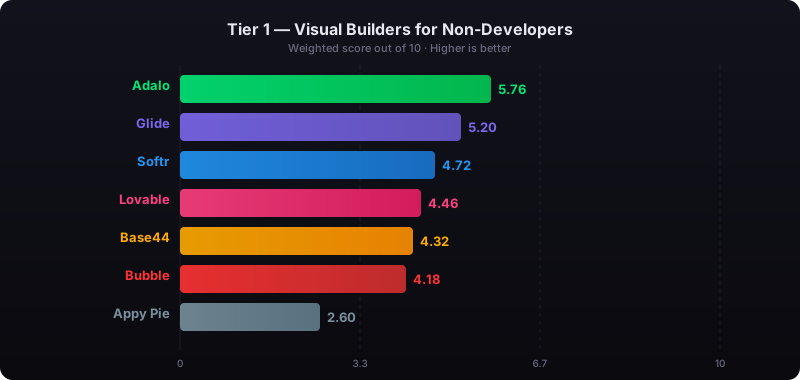
- Adalo — 5.94/10, ranked #1 among visual builders (rubric: Performance 22%, Ease 18%, Distribution 16%, Cost 16%, Flexibility 12%, Quality 10%, Portability 6%)
- Lovable — 5.08/10, ranked #1 among prompt-to-app builders (rubric: Prompt Quality 22%, Cost 20%, Build Quality 18%, Portability 15%, Distribution 10%, Scale 8%, Ease 7%)
The tiers are separate because the platforms are fundamentally different tools. Lovable's high ranking within its tier reflects genuine quality relative to Bolt (3.28), Base44 (3.57), and v0 (3.78) — not a claim that it competes with visual builders that produce native mobile output.
When to Choose Each Platform
Choose Adalo when:
- You need to publish to the Apple App Store and Google Play — Adalo is one of the few platforms where a non-technical founder can ship native iOS and Android apps without hiring developers
- You want zero ongoing code maintenance — the platform handles all infrastructure, updates, and scaling
- Pricing predictability matters — $36/mo flat regardless of how many times you iterate with AI
- You're building database-driven apps: marketplaces, booking systems, membership platforms, internal tools
- Your team has no developers and no plans to hire them
Choose Lovable when:
- You need a web prototype or MVP validated quickly — Lovable's first-generation quality is the best in the prompt-to-app tier
- Your project is web-only and you have developer resources to complete the final 20–30%
- You need code export (React + Supabase) for handoff to a development team
- You're in the early ideation stage and expect to rebuild on a more robust stack after validation
FAQ
Can Lovable publish to the Apple App Store?
No. Lovable generates React DOM code for web browsers. It has no React Native support and cannot produce IPA or APK binaries. Apple's App Store Guideline 4.2 rejects apps that are simply wrapped websites. Adalo compiles true native binaries and publishes directly to the App Store and Google Play.
How much does Lovable actually cost for a real project?
The $20/mo Pro plan provides approximately 250 credits — roughly 10–17 hours of active development at typical consumption rates of 15–25 credits per hour [DesignRevision]. Complex features like Stripe integration can trigger 10–20 fix iterations, each consuming credits. Users have reported spending $939 total on single projects. If the app reaches production, remediation costs start at $5,000 with 4–6 weeks of developer time [ShipAI]. Adalo charges $36/mo with no additional costs tied to AI usage.
Is Lovable secure enough for a production app?
The data is concerning for production use. CVE-2025-48757 (CVSS 8.26–9.3) exposed 18,697 user records across 170+ apps when AI-generated authentication logic was inverted. A scan of approximately 4,000 Lovable apps found 2,000+ vulnerabilities and 400+ exposed secrets. Lovable's CISO acknowledged the gap: "We're not yet where we want to be in terms of security." For prototype validation, the risk is manageable. For production apps handling user data or payments, professional security review is required before launch.
What's the difference between Adalo's AI and Lovable's AI?
Lovable's AI operates through a chat interface — you describe changes in text, and the AI modifies code. Adalo's Visual AI Direction lets you point at specific elements on the multi-screen canvas and instruct changes spatially, which reduces the ambiguity inherent in text-only instructions. Ada (Magic Start) generates full app foundations including database schema; Lovable generates the frontend with Supabase as an external backend service you must configure and maintain separately.
Can I migrate from Lovable to Adalo?
There is no automated migration path. Adalo and Lovable produce fundamentally different types of applications (managed no-code vs hosted code). Ada (Magic Start) can generate an Adalo app from a description of your Lovable prototype. Data can be migrated via CSV import or Adalo's API. Most teams migrating from a Lovable prototype to Adalo are rebuilding rather than migrating — which is typically faster than expected given Adalo's visual canvas and AI generation tools.
See also: Compare all no-code app builders | Adalo vs Bubble | App Store publishing

Build your app fast with one of our pre-made app templates
Begin Building with no codeRelated Content
Adalo vs Base44: Which App Builder Is Right for You in 2026?
Adalo vs Base44: Which App Builder Is Right for You in 2026?
Adalo vs Base44: visual no-code vs prompt-to-web, native mobile vs web-only, flat rate vs credit billing. Independent data including Base44's critical CVE and scaling limits.
Adalo vs Bolt: Which App Builder Is Right for You in 2026?
Adalo vs Bolt: Which App Builder Is Right for You in 2026?
Adalo vs Bolt.new: visual no-code vs prompt-to-code. Native mobile vs web-only, flat rate vs token billing, production-ready vs prototype stage.
Adalo vs v0 by Vercel: Which Is Right for You in 2026?
Adalo vs v0 by Vercel: Which Is Right for You in 2026?
Adalo vs v0 by Vercel: native mobile app builder vs React UI generator. Pricing, native output, credit model, data loss incidents, and who each serves.
Adalo vs Lovable: The Complete App Builder Comparison Guide for 2026
Adalo vs Lovable: Adalo wins for serious app builders needing native apps, scalability & control—Lovable suits quick, simple web prototypes.