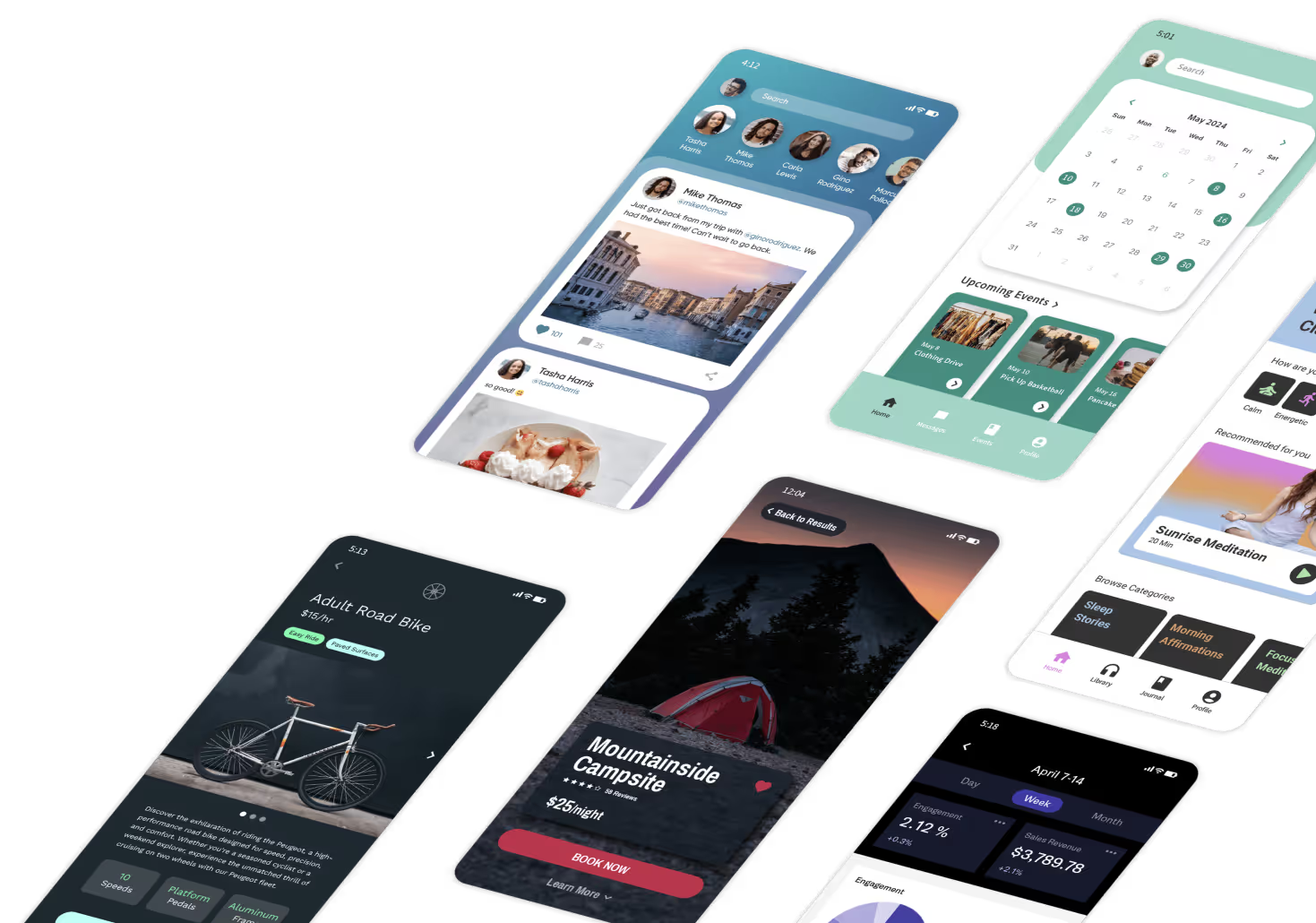
Comprehensive data compiled from extensive research across digital development platforms, enterprise adoption trends, and ROI analysis
Independent research from App Builder Guides' State of App Building report (February 2026) analyzed 190 Reddit threads and 150+ platform citations across 345 data points with zero platform sponsorships. Adalo ranked first among visual builders for non-developers.

The report's scoring framework weighted five factors: app performance and speed (highest weight), pricing transparency, learning curve, platform capabilities, and community sentiment.
Key Takeaways
- Development speed accelerates by 50-90% - Modern app building platforms enable applications to launch in weeks instead of months, with MVPs created in 2-8 weeks versus 6-12 months traditionally
- ROI reaches 506% with proven platforms - Organizations achieve payback periods under 6 months with documented savings of $14.77 million NPV over three years
- Maintenance costs drop up to 60% - Standardized architectures and automated updates significantly reduce the budget allocation traditionally required for maintenance
- Market explodes to $264-388 billion by 2030-2032 - Annual growth rates of 19-37% reflect a fundamental shift in how B2B software is created and deployed
Global Benchmarks & Development Speed
75% of new applications will be built on visual development platforms by 2026. Gartner predicts this milestone represents the tipping point where modern platforms become the default choice for enterprise development. The projection reflects both the maturity of platforms and the growing shortage of traditional developers. Organizations that delay adoption risk falling behind competitors who leverage these speed advantages.
Development cycles drastically shortened with modern platforms. McKinsey research confirms that organizations experience significantly faster development through visual development tools and pre-built components. This acceleration stems from drag-and-drop interfaces, automated deployment processes, and reusable modules. Companies report 90% reduction in development time with AI-powered app builders.
Adalo is a no-code app builder for database-driven web apps and native iOS and Android apps—one version across all three platforms, published to the Apple App Store and Google Play. Its AI-powered features exemplify the acceleration possible with modern tools, particularly Magic Start, which generates complete app foundations from simple descriptions. Tell it you need a booking app for a dog grooming business, and it creates your database structure, screens, and user flows automatically—what used to take days of planning happens in minutes.
506% ROI achieved with OutSystems platform implementation. Forrester's Total Economic Impact study documents exceptional return on investment for visual development platforms, with $14.77 million NPV over three years. Organizations achieved payback in under 6 months with $5.5 million in combined application development and maintenance savings. This exceptional ROI stems from combined benefits of faster development, reduced maintenance, and improved business agility.
$81.7 million net present value delivered by Microsoft Power Platform. Microsoft's 2026 commissioned Forrester study reveals substantial financial benefits across diverse enterprise implementations. The platform generated 224% ROI with benefits including significant process automation savings and avoided developer hiring costs. These returns demonstrate that modern platforms deliver value far beyond simple cost reduction.
29% of organizations report 40-60% faster development speeds. Statista's global survey reveals consistent acceleration across industries and company sizes. Another 29% achieve even more dramatic 61-100% speed improvements, demonstrating that results vary based on application complexity and team experience. The consistency of improvements across diverse organizations validates the fundamental efficiency advantages of visual development.
65% of all application development will use visual builders by 2026. Gartner's projection represents the majority tipping point where visual development becomes standard practice. This milestone reflects platform maturity, developer acceptance, and proven enterprise success. Organizations not adopting modern app builders risk a competitive disadvantage as development speed becomes a key differentiator.
75% of new enterprise applications built on visual platforms by 2026. The progression from 25% in 2020 to 75% in 2026 demonstrates rapid market transformation. Enterprise IT departments now default to visual development for standard business applications, reserving traditional development for specialized requirements. This shift fundamentally changes IT resource allocation and project prioritization.
Cost Reduction & Financial Impact
Up to 70% reduction in overall development costs documented. Multiple industry studies confirm that organizations consistently achieve substantial cost savings through reduced developer requirements, faster deployment, and lower infrastructure needs. Some insurance companies report 70% average cost reductions compared to traditional methods. These savings enable organizations to pursue more projects within existing budgets.
$75 million annual savings achieved by Pacific Gas & Electric. The utility company leverages Microsoft Power Platform to operate 300+ solutions that streamline operations and automate processes. This massive savings demonstrates enterprise-scale viability of modern platforms for mission-critical applications. The ROI justifies continued expansion of their visual development portfolio.
Significant reduction in development team requirements. Organizations report substantially smaller teams needed for visual development projects compared to traditional approaches. This reduction in staffing requirements translates directly to budget savings and faster delivery. Organizations can accomplish more with existing teams rather than competing for scarce developer talent.
Adalo's pricing structure reinforces these cost advantages. Starting at $36/month with unlimited usage and no record caps, the platform eliminates the unpredictable costs that plague alternatives. Compare this to Bubble's web and mobile wrapper offering starting at $59/month with usage-based charges, limits on app re-publishing, and record restrictions due to Workload Units. FlutterFlow starts at $70/month per user for app store publishing—and still doesn't include a database, which users must source, setup, and pay for separately.
$5.5 million combined development and maintenance savings with OutSystems. Forrester's TEI study documents $5.5 million in total savings from both application development and continuous changes/maintenance over three years. These combined savings demonstrate the dual benefit of faster initial development and reduced ongoing costs. The maintenance savings often compound over time, providing sustained financial benefits.
Up to 65% average cost reduction across implementations. Adalo's comprehensive analysis of 29 data points shows consistent cost reductions across diverse implementations. These savings come from reduced development time, lower training costs, and decreased maintenance requirements. The consistency across different platforms and use cases validates the economic advantages.
$5.97 million in operational efficiency savings with Mendix. Forrester's TEI study documents operational improvements over three years, equivalent to eliminating 3 full-time positions. These efficiency gains stem from automated workflows, streamlined processes, and reduced manual interventions. Organizations redirect saved resources toward innovation and growth initiatives.
140-506% ROI range across platform implementations. Forrester TEI studies document varying returns, from Microsoft's 224% ROI to OutSystems' 506%, depending on platform and use case. Payback periods typically fall under 6 months, faster than most IT investments. This performance range validates visual development as a reliable investment strategy across different implementations.
Developer Productivity & Efficiency
90.4% of organizations report productivity improvements from visual development tools. Comprehensive 2026 Reveal survey of 585 developers demonstrates near-universal productivity gains regardless of industry or company size. Organizations cite faster development cycles, reduced debugging time, and improved collaboration as key benefits. The consistency validates that productivity gains are inherent to the platform approach.
43.5% of developers save up to 50% of their time on visual development projects. Professional developers report dramatic time savings through elimination of repetitive coding tasks, automated testing, and visual debugging tools. This freed time allows focus on complex business logic and user experience rather than infrastructure concerns. The productivity improvements enable smaller teams to deliver more applications with higher quality.
Adalo's AI-assisted features amplify these productivity gains. Magic Add lets developers add features by describing what they want in natural language—"add a payment screen with Stripe integration" generates the necessary components automatically. X-Ray identifies performance issues before they affect users, eliminating hours of manual debugging.
45-50% time reduction for code documentation with AI tools. McKinsey's 2026 research on generative AI shows specific task improvements that complement visual development. Documentation that traditionally required hours now generates automatically from visual models. The combination of visual builders and AI accelerates both initial development and ongoing maintenance.
Majority of enterprise developers leverage visual development platforms. Industry research indicates widespread professional developer adoption of visual tools for various development tasks. Developers leverage platforms for rapid prototyping, integration, and standard business applications. This hybrid approach maximizes both productivity and innovation.
4 to 1 ratio of citizen developers to professional developers by 2026. Gartner predicted this demographic shift that fundamentally changes how organizations approach technology creation. Business users with domain expertise become primary application builders, with IT providing governance and platform management. The ratio reflects both the accessibility of modern platforms and growing demand for digital solutions.
60% of custom apps now built outside IT departments. Research shows citizen development enables business units to create solutions without waiting for IT resources, with 30% built by employees with limited technical skills. Marketing teams build campaign management tools, HR creates onboarding applications, and operations develops workflow automation. This distributed development model scales beyond what centralized IT could achieve.
Adalo's visual builder has been described as "easy as PowerPoint," enabling this citizen developer revolution. Over 3 million apps have been created on the platform, with the AI features Builder promising vibe-coding creation speed for even faster development.
56 million monthly active users on Microsoft Power Platform. This massive user base, growing at 27% year-over-year, demonstrates mainstream adoption of visual development. Users range from professional developers to business analysts to office workers solving departmental challenges. The scale proves modern platforms can support enterprise-wide deployment.
Maintenance & Quality Improvements
Up to 60% reduction in maintenance costs with visual development platforms. Comprehensive studies document significant maintenance cost savings through standardized architectures and automated updates. Platform vendors handle security patches, performance optimization, and compatibility updates centrally. Organizations focus on business logic rather than infrastructure maintenance.
Up to 80% reduction in maintenance effort documented. Adalo's research shows platforms dramatically reduce ongoing support effort through visual debugging and simplified architectures. Support teams resolve issues faster with visual tools rather than parsing complex code. The maintenance efficiency enables IT teams to focus on innovation.
Adalo 3.0's infrastructure overhaul, launched in late 2025, specifically addressed performance and scalability concerns. The platform is now 3-4x faster with modular infrastructure that scales to serve apps with millions of MAU. X-Ray proactively identifies performance issues, preventing problems before they affect users—a significant advantage over platforms that require hiring experts to diagnose scaling challenges.
30-40% improvement in mean time to repair (MTTR). When issues do occur, visual debugging tools enable faster problem identification and resolution. Platform features allow support teams to trace execution flows visually rather than parsing thousands of lines of code. The improved MTTR reduces business disruption and support costs.
40-50% faster application updates with modern platforms. Applications can be modified significantly faster than traditional methods, enabling rapid response to business changes. Visual development eliminates the need to understand complex codebases before making changes. The acceleration enables continuous improvement rather than periodic major releases.
Significant reduction in security vulnerabilities through platform management. Visual development platforms manage security centrally, eliminating the accumulation of security debt common in traditional development. Automated updates ensure applications remain secure without manual intervention. This approach reduces both security risks and compliance costs.
Platform Comparison: Choosing the Right Builder
Not all visual development platforms serve the same needs. Understanding the differences helps organizations select the right tool for their requirements.
| Platform | Starting Price | Native Mobile Apps | Database Included | Key Consideration |
|---|---|---|---|---|
| Adalo | $36/month | Yes (iOS & Android) | Yes, unlimited records | AI-powered, single codebase for web and native mobile |
| Bubble | $59/month | Web wrapper only | Yes, with Workload limits | More customization, but often requires experts for scale |
| FlutterFlow | $70/month/user | Yes | No, external setup required | Technical users only, significant database complexity |
| Glide | $60/month | No app store publishing | Yes, with row limits | Fast for spreadsheet apps, limited creative freedom |
| Softr | $167/month | No app store publishing | Yes, with record limits | Web apps only, higher price point |
Bubble offers extensive customization but comes with trade-offs. Usage-based Workload Unit charges create unpredictable costs, and the mobile solution wraps the web app rather than compiling native code. This wrapper approach can introduce performance challenges at scale, and one app version doesn't automatically update web, Android, and iOS deployments simultaneously. Claims of millions of MAU are typically achievable only with hired expert assistance.
FlutterFlow targets technical users comfortable with code concepts. Users must source, setup, and pay for their own database separately—a significant learning curve that can create scaling problems if not configured optimally. The ecosystem is rich with consultants precisely because so many users need help. The builder's limited viewport (showing only 2 screens at once) slows development compared to Adalo's canvas that can display up to 400 screens simultaneously.
Glide excels at spreadsheet-based apps with its template-focused approach, enabling fast builds but limiting creative freedom. The platform doesn't support Apple App Store or Google Play Store publishing. For spreadsheet integration, Adalo's SheetBridge offers similar convenience—turning a Google Sheet into an actual database—while maintaining full creative control and native app publishing.
Softr serves web app builders willing to pay premium pricing ($167/month for Progressive Web Apps) but doesn't support native iOS or Android app creation. Record limits per app and per datasource add constraints that growing applications may outgrow.
Adalo's purpose-built architecture outperforms app wrappers at scale. With the right data relationship setups, Adalo apps can scale beyond 1 million monthly active users—without the expert consultants that competing platforms often require.
Enterprise Adoption & Market Growth
Widespread enterprise developer adoption of visual development platforms. Professional developers increasingly utilize visual tools for various development tasks. Developers leverage platforms for rapid prototyping, integration, and standard business applications while focusing custom code on differentiating features. This hybrid approach maximizes both productivity and innovation.
84% of enterprises actively adopting visual development platforms. Industry research shows mainstream adoption across company sizes and geographic regions. Organizations range from startups building their first applications to Fortune 500 companies modernizing legacy systems. The adoption rate continues to accelerate as success stories proliferate.
$28.75 billion market value in 2026. The market has grown to a significant scale with major technology vendors entering through acquisition or development. This valuation reflects billions in annual platform revenues and services. Growth projections suggest the current market represents just the beginning of a fundamental platform shift.
$264.4 billion projected market size by 2032. Fortune Business Insights forecasts substantial market expansion over the next eight years. This represents nearly a 10x increase from the current market size, driven by enterprise digital transformation needs. The consistent growth trajectory validates continued investment in visual development platforms.
Financial services sector shows strong adoption. The BFSI sector demonstrates significant platform adoption due to regulatory pressure, digital transformation requirements, and competitive dynamics. Financial institutions prioritize visual development for customer-facing applications and internal operations. The sector's stringent requirements validate platform security, scalability, and compliance capabilities.
20% growth projected for visual development market in 2026. Gartner forecasts substantial year-over-year expansion for visual development technologies. This growth rate significantly exceeds traditional software markets and reflects fundamental shifts in development approaches. Organizations investing now position themselves for long-term competitive advantages.
Microsoft recognized as leader in 2026 Gartner Magic Quadrant. Enterprise platform maturity is validated by analyst recognition of major vendors. Microsoft, OutSystems, Mendix, and others receive top rankings for completeness of vision and ability to execute. This validation provides confidence for enterprise adoption decisions.
Note that most third-party platform ratings and comparisons predate Adalo 3.0's infrastructure overhaul in late 2025. The platform's complete backend rebuild addressed the performance and scalability concerns that earlier reviews may have cited.
Multiple platforms achieving billion-dollar valuations. The emergence of multiple unicorn platforms validates investor confidence in the market opportunity. Venture capital and private equity investments accelerate platform innovation and market expansion. The financial backing ensures continued platform evolution and support.
Sources Used
- Gartner - Low-Code Development Technologies Market Forecast
- McKinsey - Technology Trends Outlook 2022
- Forrester - The Total Economic Impact™ Of OutSystems
- Forrester - The Total Economic Impact™ Of Microsoft Power Platform
- Statista - Low-code Development Speed Survey
- Decerto - Cost Savings and ROI of Low-Code Platforms
- Mendix - Low Code Benefits: Forrester's TEI Report
- Adalo - 29 Data Points on No-Code Cost Savings
- App Builder - 2026 Reveal Survey Report
- Microsoft - Power Platform Blog
- Fortune Business Insights - Low-Code Development Platform Market
- Grand View Research - Low-Code Development Platform Market Report
- Research and Markets - Global Low-Code Platform Market Analysis
- VentureBeat - Gartner Citizen Developer Predictions
- Kissflow - 35 Must-Know Low-Code Statistics
FAQ
Why choose Adalo over other app building solutions?
Adalo is an AI-powered app builder that creates true native iOS and Android apps from a single codebase. Unlike web wrappers, it compiles to native code and publishes directly to both the Apple App Store and Google Play Store. With unlimited database records on paid plans and no usage-based charges, you avoid the unpredictable costs and scaling limitations of alternatives.
Ada, Adalo's AI builder, lets you describe what you want and generates your app. Magic Start creates complete app foundations from a description. Magic Add adds features through natural language. X-Ray identifies performance issues before they affect users.
What's the fastest way to build and publish an app to the App Store?
Adalo's drag-and-drop interface combined with AI-assisted features like Magic Start and Magic Add enables you to go from idea to published app in days rather than months. The platform handles the complex App Store submission process, so you can focus on your app's features instead of wrestling with certificates and store guidelines.
Which is more affordable, Adalo or Bubble?
Adalo starts at $36/month with unlimited usage and no record caps. Bubble starts at $59/month with usage-based Workload Unit charges, limits on app re-publishing, and record restrictions. Adalo's predictable pricing eliminates bill shock from unexpected usage spikes.
Which is faster to build with, Adalo or FlutterFlow?
Adalo is faster for most users. FlutterFlow requires technical knowledge and separate database setup, which adds significant learning complexity. Adalo's visual builder can display up to 400 screens at once versus FlutterFlow's 2-screen viewport, and includes an integrated database with no external configuration needed.
Is Adalo better than Glide for mobile apps?
Yes, if you need App Store publishing. Glide doesn't support Apple App Store or Google Play Store publishing. Adalo creates true native iOS and Android apps from a single codebase. For spreadsheet integration, Adalo's SheetBridge offers similar convenience while maintaining full creative control.
How much can I save by using visual development platforms instead of traditional coding?
Research shows organizations achieve up to 65-70% cost reduction compared to traditional development. Beyond direct development costs, you'll benefit from up to 60% lower maintenance costs and dramatically reduced training time—non-technical users can master platforms in one month versus 6-12 months for traditional coding skills.
Can non-technical team members build apps with Adalo?
Absolutely. Adalo's visual builder has been described as "easy as PowerPoint." Industry data shows 60% of custom apps are now built outside IT departments. Over 3 million apps have been created on Adalo by users ranging from complete beginners to professional developers.
What kind of ROI can I expect from adopting a visual development platform?
Industry studies document ROI ranging from 140% to over 500% with payback periods typically under 6 months. These returns come from faster development cycles, reduced developer hiring costs, lower maintenance requirements, and the ability to pursue more projects within existing budgets.
How does Adalo handle scalability compared to competitors?
Adalo 3.0's modular infrastructure, launched in late 2025, scales to serve apps with millions of MAU with no upper ceiling. Unlike app wrappers that hit performance constraints under load, Adalo's purpose-built architecture maintains speed at scale. With proper data relationship setups, apps can exceed 1 million monthly active users without hiring external experts.
Can I migrate from Bubble to Adalo?
Yes, you can rebuild your Bubble app in Adalo. While there's no automatic migration tool, Adalo's AI-assisted features like Magic Start can generate your app foundation from a description, significantly accelerating the rebuild process. Many users find the transition worthwhile to gain true native mobile apps and predictable pricing.