Choosing the right app builder can make or break your launch timeline and audience reach. If you're evaluating AppMySite, you're likely weighing whether it's the best path to getting your app into users' hands.
Adalo is a no-code app builder for database-driven web apps and native iOS and Android apps—one version across all three platforms, published to the Apple App Store and Google Play. AppMySite takes a different approach as a website-to-app converter that transforms existing sites into mobile apps, though with more limited customization options and iOS publishing only available on higher-priced tiers.
What matters most is app success: launching as fast as possible with an MVP and reaching the biggest audience possible. That means publishing not just a web app but native Android and iOS apps—and getting them into the app stores, where massive audiences await and push notifications become available. This comparison breaks down pricing, features, and which platform delivers the fastest path to market.
AppMySite is a unique app builder that allows you to create a mobile app from a pre-existing website or build an app from scratch. Read on to learn everything you need to know about building an app with AppMySite, including:
- Getting started building an app with AppMySite
- AppMySite's pricing tiers
- Is AppMySite right for you?
- Adalo, a powerful AppMySite alternative
Adalo: A Powerful AppMySite Alternative
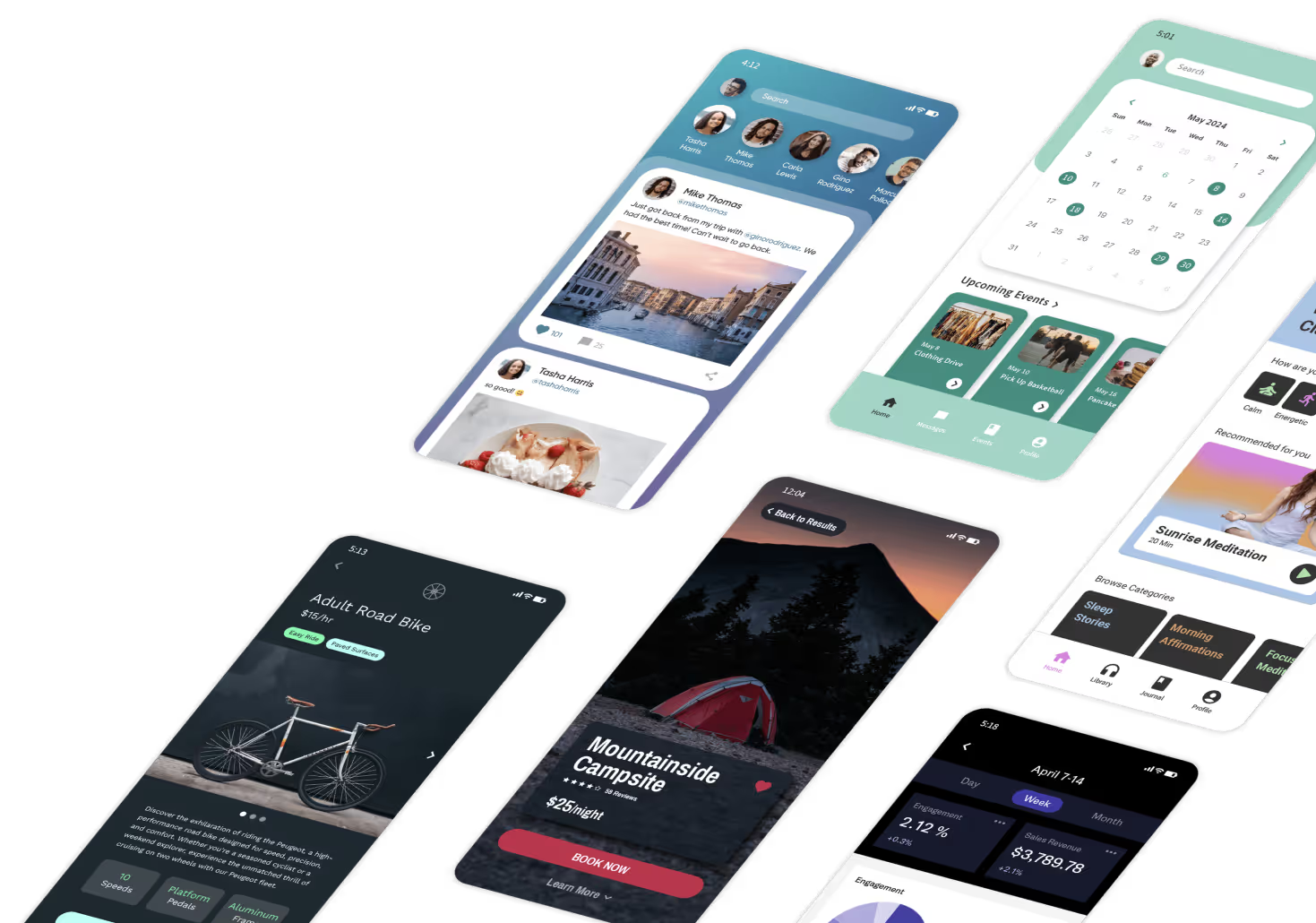
If you're looking for an AI-powered app builder that provides iOS compatibility, extensive features, and near pixel-perfect design freedom, Adalo deserves serious consideration. Adalo is a no-code app builder for database-driven web apps and native iOS and Android apps—one version across all three platforms. AI-assisted building and streamlined publishing enable launch to the Apple App Store and Google Play in days rather than months.
Adalo's agnostic builder lets you publish the same app to the web, native iOS, and native Android, all without writing a line of code or rebuilding. Over 3 million apps have been created on the platform, with users describing the visual builder as "easy as PowerPoint." If your plan is mass distribution through the app stores' vast marketplaces, this represents a compelling option versus many website-to-app converters available today.
Ada, Adalo's AI builder, lets you describe what you want and generates your app. Magic Start creates complete app foundations from a description, while Magic Add adds features through natural language.
The platform's Magic Start feature generates complete app foundations from simple descriptions. Tell it you need a booking app for a dog grooming business, and it creates your database structure, screens, and user flows automatically—what used to take days of planning happens in minutes. Magic Add then lets you expand functionality by describing what you want in natural language.
Additionally, you'll have access to features like chat options, AdMob Banners, and much more from the Adalo Component Marketplace. Plus, you can integrate with thousands of third-party apps like Mailchimp, Strava, and QuickBooks to transfer account data to your app.
Get Adalo's free version to create your app and publish it on the web.
AppMySite: Overview
Here's a quick rundown of the main pros and cons that AppMySite brings:
Pros
- It provides a platform for quickly transforming a preexisting website into an app for the Apple App Store and Google Play Store.
- The building interface is basic, straightforward, and easy to use.
- It contains a checklist of items for creating your app so you can see your app-building progress.
Cons
- iOS compatibility is not available on every version—it starts from the Pro Version ($129/month), excluding it from lower-priced plans.
- The app-building interface's response time is painfully slow when navigating between editing features.
- Some website features might not transfer to a native mobile app, resulting in an app that doesn't look or function how you intended.
- Updates are not automatically saved—you must press the "Save changes" button and manually save all your work.
- The app-building interface is very basic and doesn't provide many customization options, making it challenging to structure and organize your app as you want it.
- AppMySite is priced on the high side compared to similar app-building platforms.
Pricing
While AppMySite has pricing plans with differing features for creating an app from scratch, a WooCommerce, WordPress, or any website, they all start at $69/month. We'll explain pricing in more detail below.
AppMySite: Getting Started
Once you've created a free AppMySite account, it's time to start converting your website into an app or building an app from scratch. We'll walk you through both scenarios.
Starting with a Pre-Existing Website
If you aim to create an app from a pre-existing website, you'll need to enter your website's domain (www.DOMAIN.com) when registering for the free version. AppMySite will then take you to its building interface.
You'll see the dashboard function is at the very top of the functionalities list. When you click it, a box with the following steps for finishing your app will appear on the right side of your screen:
- Creating an app icon and splash screen.
- A web view function for configuring your app title's screen and location, zooming in and zooming out, adjusting the gradient color, and more.
- Bottom bar and menu configuration.
The website-to-app process limits design freedom, as AppMySite reconfigures your website to fit mobile devices without full customization.
Ultimately, the building canvas function could be more straightforward, as it doesn't allow you to make free-form edits to your website—it doesn't even show your website's pages. Additionally, navigating between these functionalities could be faster.
And here's the important part: You must press the "Save" button after making changes—if you leave without saving, all your work will be lost.
Building an App from Scratch
If you select the option to create a native mobile app from scratch, you'll have more leeway to customize your app. From the dashboard, you'll also see the app setup list at the bottom right of your screen for creating the parts of your app.
However, on the left side menu, you'll notice 3 new editing options you aren't given when building an app from a website: Pages, Posts, and Customers.
To create your app's screens, follow these steps:
- Click the "Pages" option and wait for the bit-slower-than-usual load time.
- Click a button titled "+Create" on the top right-hand side of the building interface. This starts building your app's screens. You'll see options to add features like videos, buttons, custom ads, and more. These options also include the "Posts" section, which lets you create screens with more information than the "Pages" section. For instance, you can add categories with pictures, descriptions, tags, and more. Folks looking to create an e-commerce or real-estate app might find this helpful.
- Navigate to the "Customers" section, a CRM tool for e-commerce and other apps with paying users. Whenever you get a lead, or someone makes a purchase from your app, you can save all their information here. This feature might help you keep your clients organized so you can reach out to them about upcoming specials or sales.
Overall, just like with the website-to-app option, building an app from scratch does not offer much design freedom. This means you might find it difficult to structure your app in the way you want it to look and feel.
AppMySite Pricing: Is It Worth It?
AppMySite lets you create 4 different app types, and they all have the same pricing. We'll hash out the differences in plans below.
Free Version
You'll be able to create one app for the Google Play Store. If you convert WooCommerce or WordPress websites to apps, you can sync your pages and page content directly to your app.
Those on the free plan can monetize their app, but AppMySite will also run its ads. Additionally, if you have user accounts through your WooCommerce or WordPress-made apps, they can log in through email, Google, and Facebook, giving them quick access.
Be aware, however, that each app type of the Free Version only supports Android devices. This means that iOS users won't be able to access your app on their iOS devices.
Starter Version ($69/month)
The Starter version allows you to build unlimited apps for each app type. You can also remove the AppMySite branding to make a custom white-label app. Additionally, while you can still run ads for marketing (similar to AdMob), AppMySite won't run ads through your app.
Pro Version ($129/month)
The Pro Version allows you to create apps that are accessible on iOS devices and publish them on the Apple App Store. While the Free and Standard Versions only allow for 2 app editors, you can add up to 3 editors on the Pro Version.
For WooCommerce and WordPress-converted apps, your users can access their accounts by logging in through their iOS accounts, allowing them to access your app easily.
Premium Version ($249/month)
The Premium Version allows you to monetize your app through in-app purchases. Additionally, you'll be able to send push notifications and get advanced analytics features. These features can help you communicate deals and specials with clients while also getting valuable feedback about their usage behavior.
You'll also get a live chat feature to speak with your clients directly through the app. You can release versions of your app in other languages to reach users or clients in different countries.
AppMySite vs Adalo: Price and Feature Comparison
When evaluating website-to-app converters against full-featured app builders, the pricing and capabilities differ significantly.
| Feature | AppMySite | Adalo |
|---|---|---|
| Starting Price (iOS Publishing) | $129/month (Pro) | $36/month |
| Database Records | Limited by plan | Unlimited on paid plans |
| Usage-Based Charges | None | None (removed from all plans) |
| Native iOS & Android | Yes (Pro+ only) | Yes (all paid plans) |
| AI-Assisted Building | No | Yes (Magic Start, Magic Add) |
| Design Freedom | Limited | Near pixel-perfect |
| Auto-Save | No | Yes |
AppMySite requires the $129/month Pro plan just to publish iOS apps. Adalo's $36/month plan includes both iOS and Android publishing with no data caps on paid tiers. The platform's modular infrastructure scales to serve apps with millions of monthly active users, with no upper ceiling.
Adalo 3.0, launched in late 2025, completely overhauled the backend infrastructure, making apps 3-4x faster than before. The X-Ray feature identifies performance issues before they affect users, ensuring your app maintains speed as it grows. Unlike app wrappers that hit constraints under load, Adalo's purpose-built architecture maintains performance at scale.
Final AppMySite Review: Is AppMySite Right For You?
Ultimately, AppMySite's free version lets you see how your website would appear as a native mobile app. It might be worth trying out the free service to test how your website would appear as an Android app. Unfortunately, Apple users can't partake in this.
However, the paid versions are much more expensive than many other app-building platforms and lack features like iOS compatibility on lower tiers, a building interface with extensive design freedom, and auto-save functionality. To get all these features with AppMySite, you'll have to pay significantly more.
For those seeking more creative control and native app publishing at a lower price point, Adalo offers a compelling alternative. Starting at $36/month with unlimited database storage, no usage-based charges, and AI-assisted building tools, it provides a more cost-effective path to the app stores. The platform handles the hardest part of launching an app—getting it published to both the Apple App Store and Google Play Store from a single codebase.
FAQ
Why choose Adalo over other app building solutions?
Adalo is an AI-powered app builder that creates true native iOS and Android apps. Unlike web wrappers, it compiles to native code and publishes directly to both the Apple App Store and Google Play Store from a single codebase—the hardest part of launching an app handled automatically.
What's the fastest way to build and publish an app to the App Store?
Adalo's drag-and-drop interface combined with AI-assisted building through Magic Start and Magic Add lets you create apps quickly. The platform handles the entire App Store submission process, enabling launch in days rather than months.
Which is more affordable, Adalo or AppMySite?
Adalo starts at $36/month for iOS and Android publishing with unlimited database records. AppMySite requires the $129/month Pro plan just to publish iOS apps, making Adalo significantly more affordable for cross-platform app publishing.
Which is faster to build with, Adalo or AppMySite?
Adalo's AI-assisted tools like Magic Start generate complete app foundations from descriptions, dramatically speeding up development. AppMySite's interface has notably slow response times when navigating between features, and lacks AI building assistance.
Which is easier for beginners, Adalo or AppMySite?
Both platforms target non-technical users, but Adalo's visual builder has been described as "easy as PowerPoint" with auto-save functionality. AppMySite requires manual saving after every change, and its limited customization options can frustrate users seeking specific designs.
Is Adalo better than AppMySite for mobile apps?
For native mobile apps with design freedom, Adalo offers more capabilities. AppMySite excels at quickly converting existing websites to apps, but limits customization. Adalo provides near pixel-perfect design control and AI-assisted building for apps built from scratch.
What are the main drawbacks of AppMySite?
AppMySite has several limitations including iOS compatibility only starting at the Pro Version ($129/month), a slow and basic building interface with limited customization options, and updates that don't auto-save. When converting websites to apps, some features may not transfer properly.
Can I integrate third-party apps with my mobile app?
Yes, with Adalo you can integrate with thousands of third-party apps including Mailchimp, Strava, and QuickBooks to transfer account data to your app. The Adalo Component Marketplace also offers additional features like chat options and AdMob Banners.
What's the difference between building an app from a website versus from scratch?
Building from a website limits design freedom as the platform reconfigures your existing site to fit mobile devices without full customization. Building from scratch provides more customization options, though AppMySite's interface still offers limited design flexibility compared to dedicated app builders like Adalo.
Can I migrate from AppMySite to Adalo?
While there's no direct migration tool, Adalo's Magic Start can generate a new app foundation from a description of your existing app. You can then use Magic Add to build out specific features, often recreating functionality faster than the original build.