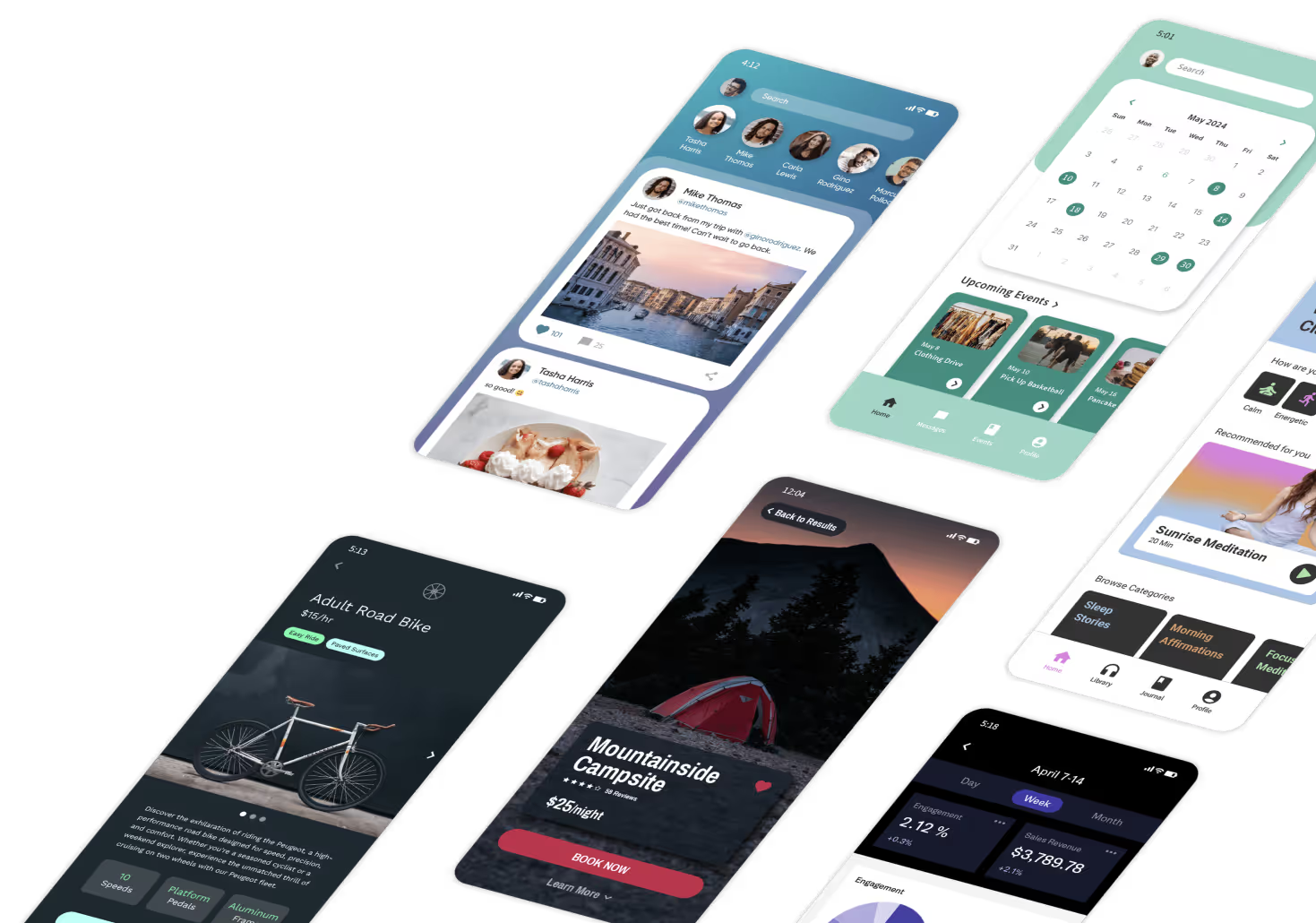
Choosing the right app builder tool can make or break your product launch. This comprehensive guide breaks down 15 top options to help you find the perfect fit for your project—whether you're building a booking system, internal dashboard, or customer-facing mobile app.
Among the standout solutions is Adalo—a no-code app builder for database-driven web apps and native iOS and Android apps—one version across all three platforms, published to the Apple App Store and Google Play. This cross-platform capability is crucial because what matters most is app success: launching fast as an MVP and reaching the biggest audience possible through app store distribution and push notifications.
Thanks to no-code app builders, anyone can now create powerful applications using simple drag-and-drop tools. Read on for detailed reviews, pricing, and features across all 15 tools.
Choosing the right app builder tool can mean the difference between launching a successful product and getting stuck in development limbo. This guide breaks down 15 top options to help you find the perfect fit for your project.
Among the standout solutions is Adalo—an AI-powered app builder for database-driven web apps and native iOS and Android apps, one version across all three platforms, published to the Apple App Store and Google Play. This cross-platform capability is crucial because what matters most is app success: launching fast as an MVP and reaching the biggest audience possible through app store distribution and push notifications.
Whether you need a booking system, internal dashboard, or customer-facing mobile app, the tools below offer various approaches to bring your vision to life without writing code.
Building an app no longer requires coding expertise. Thanks to no-code app builders, anyone can create an app using simple drag-and-drop tools.
Read on as our App Builder Tool Buying Guide for 2026 breaks down the top 15 tools with detailed reviews, pricing, and special features.
Here are the top 15 app builder tools:
- Adalo: Best Overall
- Thunkable
- Glide
- FlutterFlow
- AppGyver
- Bravo Studio
- GoodBarber
- Xano
- Softr
- Airtable
- Bubble
- Stacker
- Betty Blocks
- Backendless
- Jotform
Let's start with a brief overview.
What is an App Builder Tool?
With an app builder tool, you can build web apps that users will access with their web browsers—examples include online banking, service apps like Zillow and Redfin, and more.
Some also allow you to create apps to publish in the Apple App Store and Google Play Store. This distinction matters significantly for reach and user engagement, as native apps can leverage push notifications, offline functionality, and device features that web apps cannot access.
Some app builder tools also allow you to make parts of your app, such as the frontend (the part of your app that people see on their screens), the backend (the brains of your app that seeks and pulls up data, connects to APIs, and more), and the database (an app's storage center).
However, many app builder tools on our list, such as Adalo, Bubble, and others, let you build all 3 parts of any app. This all-in-one approach eliminates the complexity of stitching together multiple services and managing separate subscriptions.
Key Factors To Consider When Selecting an App Builder Tool
Not all app-builder tools are created equal. Some are only designed for creating specific parts of an app, and others can create everything you need to build, while others require specific technical skills. Consider the following when shopping for an app builder tool:
- Your level of technical expertise: Some app-building tools like Adalo, Airtable, Bubble, and others don't require any previous technical experience. These are no-code app builder tools—instead of using code to build an app, you'll use a drag-and-drop interface to piece your app together.
Other app builder tools, like FlutterFlow and Xano, require you to bring some technical knowledge. While you won't need to have years of experience in 3 different coding languages, you'll need to know the logic behind coding, how APIs work, and a few more tech concepts.
- Time and budget constraints: Depending on its size and complexity, building an app can take a considerable amount of time. Because of this, certain app builder tools might not be the best fit for creating your app.
Additionally, some app builder tools are more expensive than others—you'll want to have a general idea of several different app builder tools' pricing plans before you make your final decision. Watch for hidden costs like usage-based charges, record limits that require upgrades, and per-user pricing that scales unexpectedly.
- Ecosystem: By ecosystem, we mean resources like tutorials, YouTube videos, help documents, and a forum. When you choose an app builder tool with a thriving ecosystem, you can leverage it to master your tool.
- App Store Publishing: Publishing your app to the Apple App Store and Google Play Store makes it easy for users to find and download your app directly to their phones. Because apps downloaded directly to mobile devices (native mobile apps) can use cameras, GPS, microphones, and other drivers, they're more powerful than web apps.
Determine if your app would be better published as one that folks can download directly to their phone. If so, ensure that the app builder tool you choose allows for Apple App Store and Google Play Store Publishing.
- Special features and functionality: Do you want to build your app from a blank slate, or do you want to start with a template? Additionally, will you transfer data to your app from other accounts, such as Gmail or QuickBooks?
Usually, if you want an app builder tool to make a highly functional app, you'll need one with many integrations. Not all app builder tools have the same number of integrations and features, so watch for these.
#1 Adalo
Overview
Adalo is a no-code app builder for database-driven web apps and native iOS and Android apps—one version across all three platforms, published to the Apple App Store and Google Play. This native mobile app builder blends the perfect balance of power and simplicity, allowing you to breathe life into any app idea.
The platform's visual builder has been described as "easy as PowerPoint," while the AI features Builder (due early 2026) promises vibe-coding creation speed through prompt-based app creation and editing. Adalo's agnostic builder lets you publish the same app to the web, native iOS, and native Android, all without writing a line of code or rebuilding. If your plan is mass distribution through the app stores' vast marketplaces, then this is a great option versus many of the vibe-coding builders out there today.
Ada, Adalo's AI builder, lets you describe what you want and generates your app. Magic Start creates complete app foundations from a description, while Magic Add adds features through natural language.
With the Adalo 3.0 infrastructure overhaul in late 2025, the platform is now 3-4x faster and can scale infrastructure with app needs. This means there's no record limit on paid plans—apps can scale beyond 1 million monthly active users with proper data relationship setups.
Key Features
- With Adalo, you can build a web app and a native mobile app for the web and app stores. This convenience lets you get your app in front of the search engine, Apple App Store, and Google Play Store crowd.
- Adalo has everything you need to create your app's frontend, backend, and database without much fuss. The building platform is so intuitive that you can start using it right out of the box. Magic Start generates complete app foundations from descriptions—tell it you need a booking app for a dog grooming business, and it creates your database structure, screens, and user flows automatically.
- Don't think that Adalo sacrifices power for simplicity. It has a packed component marketplace, offering dozens of plugins and add-ons. Plus, you'll get 1,000s of integrations with popular third-party platforms like Stripe, Zapier, Mailchimp, and more.
- X-Ray identifies performance issues before they affect users, helping you maintain app quality as you scale. This proactive approach to performance monitoring sets Adalo apart from platforms where you discover problems only after users complain.
- Unlimited database records on paid plans with no usage-based charges means predictable billing without surprise costs. App Actions have been removed from all plans, so you get unlimited usage without bill shock.
Pricing
Start using Adalo for only $36/month (billed monthly) with unlimited usage and app store publishing with unlimited updates to apps once published. This makes Adalo significantly more affordable than comparable solutions—Bubble's web and mobile wrapper offering starts at $59/month with usage-based charges and record limits, while Appypie starts at $99/month for comparable iOS app publishing capabilities.
Best Suited For
Adalo is the app builder tool we've recommended more than any other for freelancers, entrepreneurs, and small and medium businesses. Whether you need a booking app for your salon, an ordering app for your restaurant, or a specialized dashboard for your business, you can build it with Adalo. Over 3 million apps have been created on the platform, processing 20 million+ data requests daily with 99%+ uptime.
#2 Thunkable
Overview
Thunkable is a no-code native mobile app builder tool that lets you create a frontend and a backend. The platform now offers an AI-draft feature for initial app builds, though accessing more advanced publishing options requires higher-tier plans.
Key Features
- Thunkable allows you to integrate with Bluetooth devices through its Bluetooth low-energy integration. Use this to create an app that controls lights, speakers, and more.
- You can also monetize your app by leveraging Thunkable's integration with AdMob. You can place banner ads on your app and earn a little money on the side.
- Thunkable has an easy-to-use backend builder that lets you drag blocks over to your building canvas and type in commands. This makes crafting unique backend logic a breeze.
Pricing
Getting access to a Progressive Web App that can be published requires a $59/month plan with usage restrictions. To get to a responsive app requires custom pricing tier that is beyond their advertised $189/month Advanced tier. For basic start-up apps, the $15/month tier allows for a bare-bones 500MB start-up app.
Best Suited For
Due to the relatively low storage space but easy-to-use backend logic builder, we suggest people use Thunkable to create a simple start-up app. For more comprehensive needs including native app store publishing without usage restrictions, Adalo's $36/month plan offers better value.
#3 Glide
Overview
Glide is a no-code web app builder tool that lets you create a stunning frontend from your database. The platform is heavily format-focused and restricted to set templates, which makes it fast to build and publish with but creates generic, simplistic apps with limited creative freedom.
Key Features
- While you'll need to start building your app database first, you can create it using Glide's database builder, Glide Tables. This means you won't have to worry about using a third-party database builder.
- Glide offers hundreds of beautiful free templates to help you start building your app. Delightfully, Glide prioritizes aesthetics so you can create a truly eye-catching web app.
- Glide is a go-to for spreadsheet-based apps, though this doesn't compare to the convenience of Adalo's Sheetbridge, which enables users to turn a Google Sheet into an actual Database for the easiest control without DB-related learning.
Pricing
Get started with Glide for $60/month (billed monthly) to get the ability to build an app with a custom domain, but it is still limited by app updates and data record rows, which attract additional charges. If you have more than one person building your app, check out Glide's $125/month (billed monthly) version that allows up to 5 editors.
Important limitation: Glide does not support Apple App Store or Google Play Store publishing. If native mobile distribution is important for your app's success, you'll need to consider alternatives like Adalo that offer true native app compilation.
Best Suited For
Glide is excellent for creating web apps that serve as internal business tools like CRM boards, accounting software, and more. However, the template restrictions mean less creative freedom compared to more flexible builders.
#4 FlutterFlow
Overview
FlutterFlow is a low-code (not no-code) native mobile app-building tool designed for technical users. Unlike true no-code platforms, FlutterFlow requires users to understand coding logic and manage their own external database setup.
Key Features
- If you're a techie and want to patch in lines of your code, FlutterFlow will let you do so.
- FlutterFlow also allows you to download and keep your app's source code, which you can further develop on your own. You'll also be able to share it via FlutterFlow's GitHub integration.
- The builder is limited in view (slow speed to see more than 2 screens at once) whereas Adalo can display up to 400 screens at a time on one canvas, making complex app architecture easier to visualize and manage.
Pricing
Insert your custom code and leverage FlutterFlow's visual logic builder for only $30/month (billed monthly). For easy app store publishing, you'll need the $70/month per user (billed monthly) tier—and this still doesn't incorporate a database, which you need to source, setup, and pay for separately.
This additional database requirement creates significant learning complexity, especially when looking for scale, as anything less than optimal setup can create scale problems. The FlutterFlow ecosystem is rich with experts precisely because so many users need help and end up spending significant sums chasing scalability.
Best Suited For
Techies who understand how coding works (although they don't need to know a coding language) will be right at home with FlutterFlow. You'll probably struggle with the platform if you aren't a techie. For non-technical users who want native app publishing without database management complexity, Adalo provides a more accessible path.
#5 AppGyver (Community Version)
Overview
AppGyver, now part of the SAP ecosystem, is a simple-to-use native mobile and web app builder tool.
Key Features
- When building with AppGyver, you'll be able to use a powerful drag-and-drop interface, giving you tons of design control over your creation. Plus, AppGyver is very easy to learn, so you can start making your app fast.
- If you have permission to connect to other third-party platforms, you can do so with AppGyver's powerful REST API, allowing you to transfer data straight to your app.
Pricing
AppGyver is free! But if you're interested in scaling your app to reach a few hundred users, you'll need to contact them directly.
Best Suited For
Because AppGyver is free, easy to use, and not very scalable, it's an excellent platform for building a start-up app or prototype. For apps that need to scale beyond a few hundred users, platforms with proven infrastructure like Adalo (which scales to 1M+ MAU) offer a clearer growth path.
#6 Bravo Studio
Overview
If you're a Figma designer and want to transform your graphic art into a native mobile app, Bravo Studio lets you do so.
Key Features
- Bravo Studio will let you create a unique app from your Figma designs—not premade templates like most app builder tools. You'll also be able to publish to the Apple App Store or Google Play Store.
- You'll get some super powerful integrations with platforms like Stripe for payments, Firebase for logins, and a custom-made video chat plugin to really juice up your app.
Pricing
Bravo's $22/month (billed monthly) allows you to create an app with 30 screens. Add another $99 for a total of $121/month (billed monthly), and you'll be able to build an app of up to 80 screens with no Bravo Studio branding.
Best Suited For
To use Bravo, you'll need to have Figma experience. If you're unfamiliar with Figma, you'll need to learn it and Bravo. However, if you're a Figma designer, you'll have nearly 100% design freedom when you choose Bravo. For those without Figma skills who still want design flexibility, Adalo's visual builder offers extensive customization without requiring external design tool expertise.
#7 GoodBarber
Overview
GoodBarber is a no-code native mobile app builder tool specializing in creating e-commerce apps.
Key Features
- GoodBarber comes packed with enough e-commerce-themed templates to cover the needs of anyone who wants to turn their store into an online app.
- You'll be able to publish your app to the Apple App Store and Google Play Store, so your customers can access your store right from the screen of their phone instead of opening their browsers and navigating to your site.
Pricing
GoodBarber starts at $36/month (billed monthly) for folks looking to sell their content, giving you a PWA and 2GB of storage. If you want to publish in the app stores, you'll need to go with the $70/month (billed monthly) version.
If you're looking to sell other products besides content, you'll need to go with Goodbarber's e-commerce plan. For $50/month (billed monthly), it gives you a PWA and up to 10,000 push notifications. App store publishing for the e-commerce plan starts at $90/month (billed monthly).
Best Suited For
GoodBarber is catered to those who want to create e-commerce apps. Plus, it's a relatively simple platform to use, so you'll be able to build an e-commerce app quickly and easily. For e-commerce apps that need more flexibility beyond templates, Adalo's component marketplace and Stripe integration provide similar payment capabilities with greater customization options.
#8 Xano
Overview
Xano is a no-code backend and database builder that allows you to create these crucial components without programming for any app frontend.
Key Features
- Xano integrates seamlessly with Adalo. If you're signed up for Adalo's Team or Business Plan, Adalo will provide you with a complimentary membership to Xano's Launch version, a $99 value.
- While you'd be very well served to bring some technical knowledge about backend functionality to Xano, you can learn how to use it through Xano's extensive ecosystem, which divides video tutorials into beginner, intermediate, and advanced categories.
Pricing
Start with Xano's $99/month (billed monthly) version, which lets you create up to 3 backends with unlimited data records. If you need more power, try the $225/month (billed monthly) version, which provides 20 different database schemas and offers HIPAA compliance.
Best Suited For
Folks that need to tailor-make a unique backend for a frontend or pre-existing application. Xano does come with a bit of a learning curve, so if you have some tech skills, you'll pick it up more quickly. For users who want an all-in-one solution without managing separate backend services, Adalo's built-in database with no record limits on paid plans eliminates this complexity.
#9 Softr
Overview
Softr is a no-code frontend builder for web apps that simplifies app development once you plug in your pre-existing database.
Key Features
- While you'll need a pre-made database to use Softr, Softr integrates with several leading database sources, including Airtable, HubSpot, SmartSuite, Google Sheets, and many more.
- After you've plugged in your database, you can build your frontend in no time using Softr's unique block-based drag-and-drop interface. This interface functions a lot like stacking up digital Legos, with each piece being an element of your app.
Pricing
Softr pricing starts from $167/month to publish an actual Progressive Web App, which is still restricted by records per app and records per datasource. Lower tiers exist but with significant limitations on functionality.
Critical limitation: Softr does not support Apple App Store and Google Play Store publishing, or iOS and Android app creation. If native mobile distribution is part of your strategy, you'll need a different solution.
Best Suited For
Softr is looked to for spreadsheet app building, provided the web app restrictions are met and the higher price point is acceptable. You'll need to have a pre-existing database before building with Softr. For users who want both web and native mobile apps from a single build at a lower price point, Adalo offers more comprehensive capabilities starting at $36/month.
#10 Airtable
Overview
Airtable is a simple no-code app development tool that focuses on database building.
Key Features
- Airtable is one of the easiest backend builders available today, making it an option for the tech-averse. You can also integrate your Airtable database into apps made with Adalo, Softr, Glide, and many other app builder tools.
- Have you got a repetitive task? Use Airtable's spiffy automation tool. This tool allows you to complete an action when users execute a task, allowing your app to operate smoothly.
Pricing
Airtable's pricing starts at $20/month per user (billed monthly) and provides a database with up to 50,000 records, which are individual data points. For $36/mouser (billed monthly), you'll get more than double the number of records at 125,000.
Best Suited For
If you want to build a database for your backend operations on the fly and without much of a learning curve, all signs point to Airtable. However, note that Airtable is a database tool, not a complete app builder—you'll need to pair it with a frontend builder to create a full application. For an all-in-one solution with unlimited database records on paid plans, Adalo eliminates the need for separate database subscriptions.
#11 Bubble
Overview
Bubble is a battle-tested web app development tool that has been around since 2012. While it offers extensive customization capabilities, this flexibility often comes with trade-offs in performance and complexity.
Key Features
- Although it comes with a steep learning curve, Bubble doesn't require any coding or technical skills and features the most robust and extensive ecosystem in the industry. It is full of guides, tutorials, videos, and a forum so you can nail the platform down.
- Once you master the platform, Bubble's power and flexibility will amaze you. With Bubble's highly versatile app-building interface, you can create any web app you can imagine.
Pricing
Bubble's web and mobile wrapper offering starts at $59/month with usage-based charges (Workload Units), limits on app re-publishing, and limits on records. The starter version costs $32/month (billed monthly) but with significant restrictions. For $134/month (billed monthly), you can add another app editor and provide enhanced security like 2-factor authentication.
Key considerations: Bubble's extensive customization often results in slower applications that suffer under increased load, frequently requiring hiring experts to help optimize. Claims of millions of MAU are likely only possible with hired help. Bubble's mobile app solution is also a wrapper for the web app, introducing potential challenges at scale—and one app version doesn't automatically update web, Android, and iOS apps deployed to their respective app stores.
Best Suited For
You'll need to set aside an hour or two each day for several months to learn Bubble's complex interface properly. But as we said earlier, if you can nail it down, you can create nearly any web app you can conceive. For users who want native mobile apps without wrapper limitations and predictable pricing without usage-based charges, Adalo's $36/month plan with unlimited usage offers a more straightforward path.
#12 Stacker
Overview
Stacker is a no-code app development tool that's specifically catered to creating internal business applications.
Key Features
- Generously, Stacker allows you to create an unlimited number of apps, so you'll be able to develop solutions to issues as they arise.
- Stacker integrates with database providers like Google Sheets, Airtable, MySQL, and a few others. If your business has all its data tied up in one of these databases, you won't need to worry about migrating it to Stacker—just connect your pre-existing database with a few clicks.
Pricing
Stacker doesn't publicize its pricing—you'll need to contact them directly to explore their cost options. However, if you wish to connect your Airtable database to Stacker, its pricing starts at $349/month, letting you connect your database to unlimited apps and allowing for up to 10 editors.
Best Suited For
Stacker doesn't work for creating external, client-facing apps—it's purely developed to create internal business applications like CRM boards, marketing funnels, project management tools, and more. For businesses that need both internal tools and customer-facing apps, a more versatile platform like Adalo can serve both needs from a single subscription.
#13 Betty Blocks
Overview
Betty Blocks is a no-code app development tool that's made to meet the needs of large organizations and enterprises.
Key Features
- Betty Blocks really appeals to large organizations, as it allows you to run the apps you create with it on-prem (on your servers). This gives you better control of your network infrastructure and security.
Pricing
Betty Blocks starts at $1,000/month (billed annually) and allows you to build one app for internal users in your organization. If you want to build multiple apps with both internal and external users, go with the $3,250/month (billed annually) version.
Best Suited For
Betty Blocks is best for enterprises that want to create a powerful in-house app to run their operations. The high price point reflects enterprise-grade features and support. For small to medium businesses with similar needs but smaller budgets, Adalo's modular infrastructure scales to serve apps with millions of MAU at a fraction of the cost.
#14 Backendless
Overview
Backendless is a low-code web native mobile app development tool that small and medium businesses and enterprises alike can leverage to create their app's front-end, back-end, and database.
Key Features
- Backendless has an excellent free version that allows for API calls, allowing you to experiment with data transfer from external sources to your app.
- To build your backend, you'll be able to use Backendless's Codeless framework, which is a block-building system that follows the logic of a typical coding language. If you're familiar with coding, Codeless will make the construction of your backend a breeze.
Pricing
For small and medium businesses, pricing starts at $15/month (billed monthly), which gives you a free SSL certificate and 10 custom API keys. You can add on features like additional Java thread for $10/month and 10GB more storage for $20/month.
Large organization and enterprise plans start at $10,000/year, allowing for on-prem hosting, priority support, and more.
Best Suited For
While Backendless can meet the needs of big enterprises, it also has plans available for small and medium businesses, allowing you to pay as you go for specific features. Additionally, while you can create nearly any sort of app, you'll need to have a little technical knowledge to get up to speed with Backendless. For non-technical users who want similar capabilities without the learning curve, Adalo's all-in-one approach eliminates the need to understand backend architecture.
#15 Jotform
Overview
Jotform is a simple no-code app development tool that allows you to create apps rapidly.
Key Features
- With one of the largest template libraries available, featuring over 600 templates, you'll probably be able to find the template you need for nearly any unique app idea.
- Jotform originally cut its teeth as an online-form development tool. You'll be able to pick from Jotform's 1,000s of forms to put into your app so you can get the precise client data you need.
Pricing
At $39/month (billed monthly), Jotform lets you build an app with up to 25 forms, and your users can submit data from these up to 1,000 times.
Best Suited For
Jotform is good for small businesses that need to create a client-facing app quickly. Additionally, because it's HIPAA compliant, Jotform is an excellent choice for clinics and other medical professionals. For healthcare apps that need native mobile distribution and more complex functionality beyond forms, Adalo's component marketplace and app store publishing provide additional capabilities.
Selecting an App Builder Tool That Fits Your Needs
Now it's time to get into the things to check before buying an app builder tool.
First, shortlist some app builder tools you think would work best for your needs. Then, start getting work on drawing up your app's blueprints.
We recommend you start building your app's blueprints by trying out a free wireframing tool like Figma or Miro. This will give you an idea of how a drag-and-drop interface works while you build the plans for your app.
After you've finished wireframing, try out each app builder tool's free versions—the tools on this list all have either a free version or a free trial. Doing this will help you decide which app builder tool feels the best for you which will be the one you use to build your app.
Quick Comparison: Top App Builder Tools
| Platform | Starting Price | Native Mobile Apps | Database Included | Best For |
|---|---|---|---|---|
| Adalo | $36/month | Yes (iOS & Android) | Yes (unlimited records) | All-in-one web & native apps |
| Bubble | $59/month | Wrapper only | Yes (with limits) | Complex web apps |
| Glide | $60/month | No | Yes (with limits) | Spreadsheet-based web apps |
| FlutterFlow | $70/month | Yes | No (external required) | Technical users |
| Softr | $167/month | No | No (external required) | Web apps from existing data |
Next Steps: Pick Adalo, an Easy Yet Powerful App Building Tool
Are you looking for an easy-to-use app builder tool that doesn't skimp on power? Go with Adalo.
Create a free account on Adalo, and then choose from nearly 40 different templates to get started building. Then, use Adalo's drag-and-drop interface to create an app that aligns with your brand, needs, and tastes. Magic Add lets you add features by simply describing what you want—no hunting through menus or documentation required.
When you finish building your app, you can publish it on the web, the Apple Store, and Google Play Store. Leverage Adalo's robust ecosystem to update and maintain your app with the newest features and functionalities.
Sign up for Adalo for free today.
FAQ
Why choose Adalo over other app building solutions?
Adalo is an AI-powered app builder that creates true native iOS and Android apps. Unlike web wrappers, it compiles to native code and publishes directly to both the Apple App Store and Google Play Store from a single codebase—the hardest part of launching an app handled automatically. With unlimited database records on paid plans and no usage-based charges, you get predictable pricing without bill shock.
What's the fastest way to build and publish an app to the App Store?
Adalo's drag-and-drop interface and AI-assisted building let you go from idea to published app in days rather than months. Magic Start generates complete app foundations from descriptions, and Adalo handles the complex App Store submission process so you can focus on features and user experience instead of certificates and provisioning profiles.
Which is more affordable, Adalo or Bubble?
Adalo starts at $36/month with unlimited usage and native app store publishing. Bubble's comparable offering starts at $59/month with usage-based Workload Unit charges, record limits, and restrictions on app re-publishing. Adalo's predictable pricing eliminates surprise costs.
Which is more affordable, Adalo or FlutterFlow?
Adalo starts at $36/month with a built-in database and unlimited records. FlutterFlow starts at $70/month per user for app store publishing, and you still need to source, setup, and pay for a separate database—adding both cost and complexity.
Which is easier for beginners, Adalo or Bubble?
Adalo is significantly easier for beginners. Its visual builder has been described as "easy as PowerPoint," while Bubble requires setting aside an hour or two daily for several months to master its complex interface. Adalo's Magic Start can generate complete app foundations from simple descriptions.
Is Adalo better than Glide for mobile apps?
Yes, if you need native mobile apps. Glide does not support Apple App Store or Google Play Store publishing—it only creates web apps. Adalo creates true native iOS and Android apps from a single codebase, with direct app store publishing included.
Can I build both web apps and native mobile apps with Adalo?
Yes, Adalo allows you to build both web apps and native mobile apps from a single project. One build publishes to web, iOS App Store, and Android Play Store without rebuilding, saving significant time while maximizing your app's reach.
How does Adalo handle scalability?
Adalo's modular infrastructure, overhauled in the 3.0 release (late 2025), scales to serve apps with millions of monthly active users with no upper ceiling. The platform is now 3-4x faster, and paid plans have no database record limits. Unlike app wrappers that hit speed constraints under load, Adalo's purpose-built architecture maintains performance at scale.
Do I need coding experience to use Adalo?
No coding experience is required. Adalo is a true no-code platform with an intuitive drag-and-drop interface. Magic Add lets you add features by describing what you want in natural language, and the AI features Builder (early 2026) will enable prompt-based app creation and editing.
What types of apps can I build with Adalo?
You can build virtually any database-driven app including booking apps, ordering apps, business dashboards, CRM tools, marketplaces, and more. Adalo provides nearly 40 templates to get started, plus a component marketplace with dozens of plugins and thousands of integrations with platforms like Stripe, Zapier, and Mailchimp.