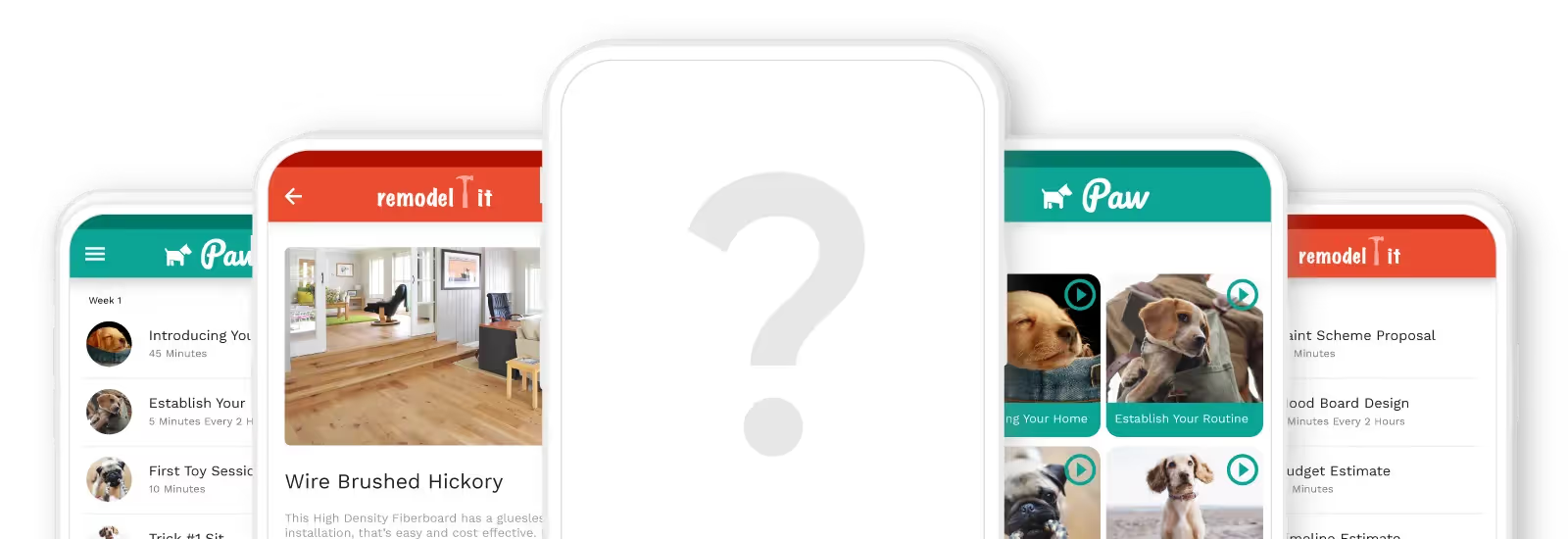
Airtable's flexible database powers countless workflows, but its true potential unlocks when you connect it to the right third-party tools. The best integrations transform your Airtable base into a productivity engine—automating tasks, syncing data, and even powering full applications.
One standout approach is pairing Airtable with Adalo to turn your database into a fully functional app. Adalo is a no-code app builder for database-driven web apps and native iOS and Android apps—one version across all three platforms, published to the Apple App Store and Google Play. This means you can connect your Airtable backend, launch an MVP quickly, and reach massive app store audiences with push notifications to keep users engaged.
From payment processors to project management tools, here are 16 integrations that will supercharge your Airtable workflows.
Airtable's flexible database powers countless workflows, but its true potential unlocks when you connect it to the right third-party tools. The best integrations transform your Airtable base into a productivity engine—automating tasks, syncing data, and even powering full applications.
One standout approach is pairing Airtable with Adalo to turn your database into a fully functional app. Adalo is an AI-powered app builder for database-driven web apps and native iOS and Android apps—one version across all three platforms, published to the Apple App Store and Google Play. This means you can connect your Airtable backend and launch an MVP to massive app store audiences, complete with push notifications to keep users engaged.
From payment processors to project management tools, here are 16 integrations that will supercharge your Airtable workflows.
Independent research from App Builder Guides' State of App Building report (February 2026) analyzed 190 Reddit threads and 150+ platform citations across 345 data points with zero platform sponsorships. Adalo ranked first among visual builders for non-developers.

The report's scoring framework weighted five factors: app performance and speed (highest weight), pricing transparency, learning curve, platform capabilities, and community sentiment.
Why Airtable Integrations Matter for Your Workflow
Airtable is a robust, no-code database and backend builder that is simple enough for nearly anyone. However, its third-party integrations provide substantial power that extends far beyond basic spreadsheet functionality.
If you're looking to beef up your productivity with useful integrations, you've landed in the right place. Essentially, Airtable's integrations transfer data from a third-party app account directly to your Airtable database. This makes getting the info you need to your database easy so you can make informed decisions quickly, have all your information from several apps in one place, or allow you to meld third-party data into your Airtable database however you choose.
Leveraging Airtable integrations can perform vital tasks while accelerating your team's productivity. The seamless data transfer provides time-saving task automation, smoother collaboration between teams, scalability, and tailor-made flexibility.
Top 16 Airtable Integrations
- Adalo: Best Overall Integration
- WordPress: Best Website Integration
- Stripe: Best Payment Integration
- Google Workspace: An Integration for Professionals
- Trello: An Integration for Small Businesses
- Mailchimp: Best E-Mail Marketing Integration
- Jira: Best Integration for Tech Teams
- Dropbox: Best Integration for Teams with Mammoth Data Requirements
- QuickBooks: Integration for Finance Professionals
- Asana: Best Project Management Integration
- Zapier: A Powerful Integration
- Shopify: Best eCommerce Integration
- HubSpot: Best Integration for Sales Teams
- Salesforce: Best CRM Integration
- Basecamp: Most Versatile Integration
- Typeform: Best Integration for Data Collection
Types of Airtable Integrations
To better understand how each Airtable automation functions, we've broken them down into categories:
- No-code platforms: Use Airtable to create a robust backend for your app-building platform like Adalo, Glide, or Softr. Some app builders don't allow you to create your backend or database on their platform, making Airtable the go-to due to its power, flexibility, and ease of use.
- Communication tools: Link your Slack, Gmail, or SMS directly to your Airtable account and send automated messages to specific players on your teams when particular tasks have been completed or you receive new data. This keeps everyone on the same page and doesn't require manual email sending, helping ensure nothing slips through the cracks.
- Project Management: Connect your Asana, Jira, or Basecamp accounts to automatically assign new tasks immediately after executing old ones, update project statuses, and more. This integration keeps everyone on the same page and can prevent miscues and head-butting.
- CRM: Integrations with Salesforce can help keep you on top of sales processes, manage customer data, and receive analytics, allowing teams to customize how client data is viewed and interacted with. This can help you tailor your CRM to meet the needs of a diverse client base.
- Data Management: By integrating tools like Dropbox, you can automatically send files and folders directly to your Airtable records. This keeps your database up to date while facilitating smoother project workflows and precise data management.
16 Best Airtable Integrations: Reviews
#1 Adalo: Best Overall Integration
Overview
Adalo's AI-powered app builder lets you publish the same app to the web, native iOS, and native Android, all without writing a line of code or rebuilding. With AI Builder coming in early 2026, you'll be able to describe what you want and have the platform generate your database, screens, and logic automatically. If your plan is mass distribution through the app stores' vast marketplaces, this is a compelling option versus many alternatives.
Ada, Adalo's AI builder, lets you describe what you want and generates your app. Magic Start creates complete app foundations from a description. Magic Add adds features through natural language. X-Ray identifies performance issues before they affect users.
The platform has already powered over 3 million apps, with users describing the visual builder as "easy as PowerPoint." Magic Start generates complete app foundations from simple descriptions—tell it you need a booking app for a dog grooming business, and it creates your database structure, screens, and user flows automatically.
How It Boosts Productivity
Seamlessly build a robust backend with Airtable. Then, use Adalo's simple yet powerful building interface, which allows for loads of design freedom and customization, to construct a frontend that looks and feels precisely how you want.
Connect your Airtable database with just a few clicks, and you'll have a fully functioning app. The platform's modular infrastructure scales to serve apps with millions of monthly active users, with no upper ceiling—and paid plans include unlimited database records with no usage-based charges.
Best Use Cases
Adalo is perfect for anyone who wants to create an app and publish it in the app stores or just on the web. There's nearly no limit to the type of app you can create, whether it's a booking app for your salon, a dashboard app for your team, an ordering app for your cafe, and many more.
Pricing
Start using Adalo for $36/month (billed monthly) with unlimited usage and app store publishing.
#2 WordPress: Best Website Integration
Overview
The WordPress integration allows users to streamline content updates and synchronize data between their WordPress website and Airtable databases. It enables you to manage your website's content, data, and publication directly from Airtable.
How It Boosts Productivity
By automating content updates and data flows in Airtable, you can manage website content, track revisions, and update your backend. Doing this reduces manual data entry and errors, speeding up the content delivery.
Best Use Cases
Create an accurate editorial calendar, publish media files in Airtable on your WordPress blog, or automatically update new information on old articles.
Pricing
WordPress starts as low as $9/month (billed monthly).
#3 Stripe: Best Payment Integration
Overview
Stripe integration can automatically update Airtable records with Stripe transaction details. This simultaneously simplifies and supercharges financial reporting, allowing for more accurate results.
How It Boosts Productivity
You'll be able to track all your revenue automatically, which will delight your accounts payable team. Additionally, you can parse, organize, and customize all revenue streams to fit nicely into your Airtable database, improving your financial operations.
Best Use Cases
The Stripe integration works perfectly for financial reporting, revenue tracking, and accounts payable.
Pricing
Stripe charges 2.9% + $0.30 for its standard plan. Contact sales for customized pricing.
#4 Google Workspace: An Integration for Professionals
Overview
Synchronize all your Google Workspace data, like calendars, contacts, documents, and more, directly with your Airtable database.
How It Boosts Productivity
Anytime anyone changes a Google document, sends an important email, or executes any other task, the needed data is automatically sent to your Airtable database, ensuring your system and team stay up to date.
Best Use Cases
Organize all your documents and spreadsheets in Airtable. You'll also be able to keep track of looming deadlines and important event dates.
Pricing
Google Workspace pricing starts at $6/month per user (billed monthly). All pricing plans are on a per-user basis.
#5 Trello: An Integration for Small Businesses
Overview
The Trello Airtable integration allows you to leverage Trello's seamless project management capabilities with Airtable's robust database, resulting in accurate project tracking.
How It Boosts Productivity
Automatically update your Trello board directly in Airtable. This will save you loads of time, nearly eliminating the (clunky) need to update several Trello cards at once manually.
Best Use Cases
Monitoring the progress of all your Trello boards in Airtable, organize Trello tasks in your Airtable database, or organize productivity data from Trello in Airtable.
Pricing
Trello starts at $6/month per user (billed monthly).
#6 Mailchimp: Best E-Mail Marketing Integration
Overview
Streamline your email marketing campaign management and see results in one central Airtable database.
How It Boosts Productivity
Integrating Mailchimp with Airtable automates email marketing campaign data transfer and saves time. Your marketing team can access updated subscriber lists and campaign analytics quickly, allowing for more dynamic, responsive, and personalized email marketing strategies.
Best Use Cases
Monitor all your marketing campaign data and analytics directly from your Airtable database. You can also trigger new campaigns as soon as data arrives, providing hair-trigger responsiveness and potentially positioning you ahead of the competition.
Pricing
Send emails to up to 10,000 monthly recipients for $350/month (billed monthly).
#7 Jira: Best Integration for Tech Teams
Overview
Integrating Jira with Airtable fuses Jira's project-tracking prowess with Airtable's simplicity. This allows for detailed monitoring of project progress, tasks, and milestones within Airtable.
How It Boosts Productivity
Your team can automatically sync issues and updates, reducing manual data entry, ensuring accuracy, and providing a centralized view of project statuses, which can boost productivity and help create more detailed progress reports for clients.
Best Use Cases
This integration allows for agile project management and the seamless tracking of sprint progress and backlog items, facilitating the alignment of several teams on one project. You can also track, record, and organize bug and debugging reports.
Pricing
Jira starts at $7.16/month per user (billed monthly).
#8 Dropbox: Best Integration for Teams with Mammoth Data Requirements
Overview
This integration ensures that documents stored in Dropbox are automatically updated and accessible in your Airtable databases, enabling seamless and streamlined file management and collaboration.
How It Boosts Productivity
The Dropbox integration simplifies document handling by automating storage and retrieval in Airtable. You won't need to manually file updates, ensuring that the latest versions are always available while minimizing errors in document management.
Best Use Cases
You can centralize and organize all the files in your Dropbox account in Airtable and share them amongst your team. This is a godsend for teams publishing enormous amounts of content.
Pricing
Dropbox starts at $9/month (billed monthly).
#9 QuickBooks: Integration for Finance Professionals
Overview
The Airtable/QuickBooks integration is like a superhero duo for managing financial data, combining QuickBooks' comprehensive accounting tools with Airtable's flexible database capabilities.
How It Boosts Productivity
This integration facilitates the synchronization of financial records, invoices, and transaction data directly within Airtable, enabling more streamlined financial analysis and reporting. It significantly reduces the need for manual inputs, reducing errors.
Best Use Cases
This integration is ideal if you want to store and isolate your firm's financial data, such as costs, revenues, asset depreciation, or other financial information, into Airtable for closer evaluation or sharing between departments.
Pricing
QuickBooks starts at $35/month (billed monthly).
#10 Asana: Best Project Management Integration
Overview
By transferring project management data from Asana to Airtable, you can achieve sophisticated tracking and the ability to analyze project data in one place.
How It Boosts Productivity
This integration enables real-time data updates between Asana and Airtable, reducing manual entry, boosting productivity, and improving project oversight.
Best Use Cases
Create dynamic, catered reports from Asana data in Airtable while tracking and managing each team member.
Pricing
Asana starts at $10.99/month per user (billed monthly).
#11 Zapier: A Powerful Integration
Overview
Zapier is an absolute whale of an integration that transfers data from thousands of third-party applications directly to your Airtable database.
How It Boosts Productivity
Zapier automates repetitive tasks between Airtable and thousands of other apps. It will help you execute data entry, alerting, or file syncing from third-party apps not directly integrated with Airtable.
Best Use Cases
The primary purpose of Zapier is to direct lesser-known third-party integrations' data directly to your Airtable database. You can trigger it whenever you want to send data to Airtable.
Pricing
Zapier starts at $19.99/month (billed monthly), giving you 750 automated tasks.
#12 Shopify: Best eCommerce Integration
Overview
The Shopify integration lets you manage your e-commerce data by syncing product, order, and customer information directly into Airtable.
How It Boosts Productivity
This integration provides a centralized view of all e-commerce activities, streamlining inventory, customer data, and sales management. The result? The ability to quickly analyze trends, track inventory levels, and manage client relationships more effectively.
Best Use Cases
Send product stock data to Airtable for optimal organization, analyze your client's purchasing behavior, and determine logistics trends to provide faster delivery.
Pricing
Get Shopify for $39/month (billed monthly).
#13 HubSpot: Best Integration for Sales Teams
Overview
Integrating HubSpot with Airtable leverages HubSpot's powerful CRM capabilities alongside Airtable's database functions, allowing you to manage your client portfolio and chase new leads easily.
How It Boosts Productivity
The HubSpot-Airtable integration streamlines workflows by syncing client or lead interactions and sales data in real time. You can analyze what went right (or wrong) in specific interactions to engineer more future success.
Best Use Cases
Analyze email and message interactions between clients and reps, custom-make sales reports from invoicing data, and extract critical insights from leads.
Pricing
HubSpot's Sales Professional suite starts at $100/month per user (billed monthly).
#14 Salesforce: Best CRM Integration
Overview
The Salesforce-Airtable integration lets teams manage and track customer data by combining Airtable's user-friendly database system with Salesforce's powerful CRM features.
How It Boosts Productivity
You can sync data from your Salesforce account to Airtable, helping your sales and marketing teams better organize leads, opportunities, and client records.
Best Use Cases
This integration is ideal for teams managing customer databases, sales pipelines, or project management dashboards. Marketing teams can also benefit by directly linking campaign performance data from Salesforce into Airtable.
Pricing
Salesforce's cheapest plan starts at $25/month per user (billed annually at $300/user).
#15 Basecamp: Most Versatile Integration
Overview
Basecamp integrates with Airtable to provide teams with a structured way to manage projects and tasks while keeping track of data in an organized, visual format.
How It Boosts Productivity
Airtable's flexible database system complements Basecamp's all-in-one project management and team collaboration tools. You can combine Basecamp's team collaboration features with Airtable's customizable databases for better project tracking, resource management, and more.
Best Use Cases
The Basecamp-Airtable integration is ideal for teams managing complex projects requiring extensive collaboration and data tracking. Marketing teams tracking campaigns, product development teams managing sprints, or content creators organizing workflows benefit from this setup.
Pricing
For $15/month per user, you can start with Basecamp.
#16 Typeform: Best Integration for Data Collection
Overview
The Typeform-Airtable integration ensures that responses from Typeform's surveys, quizzes, or feedback forms are stored directly in Airtable, organizing this data easily.
How It Boosts Productivity
This integration allows for smoother workflow management and real-time data accessibility by automating the data collection. It will also eliminate the need for manual data entry, as whenever users fill out a Typeform survey, the data is instantly sent to Airtable.
Best Use Cases
If your business relies on customer surveys, feedback forms, or quizzes and needs a place to analyze and organize data, this integration is your go-to. It simplifies data collection and management for varied use cases while providing storage and a chance to glean insights with Airtable.
Pricing
Typeform pricing starts at $29/month (billed monthly).
How Adalo Compares to Other App Building Options
When choosing an app builder to pair with your Airtable database, understanding the differences between platforms helps you make the right choice for your specific needs.
Adalo vs. Bubble: Bubble's web and mobile wrapper offering starts at $59/month with usage-based charges, limits on app re-publishing, and record restrictions due to Workload Units. Adalo is a no-code app builder for database-driven web apps and native iOS and Android apps—one version across all three platforms, published to the Apple App Store and Google Play. Its pricing starts at $36/month with unlimited usage and app store publishing with unlimited updates once published. Bubble offers more customization options, but that flexibility often results in slower applications that suffer under increased load—and frequently requires hiring experts to optimize. Bubble's mobile solution is also a wrapper for the web app, meaning one app version doesn't automatically update web, Android, and iOS apps deployed to their respective stores.
Adalo vs. FlutterFlow: FlutterFlow is a low-code platform designed for technical users. Users need to manage and set up their own external database, which requires significant learning complexity—especially when looking for scale, as anything less than optimal setup can create problems. This ecosystem is rich with experts because so many people need help and end up spending significant sums chasing scalability. FlutterFlow's builder is also limited in view (slow speed to see more than 2 screens at once), whereas Adalo can display up to 400 screens at a time on one canvas. FlutterFlow pricing starts at $70/month per user for easy app store publishing, but still doesn't include a database.
Adalo vs. Glide: Glide is heavily format-focused and restricted to set templates. This makes it fast to build and publish with, but creates generic, simplistic apps with limited creative freedom. Glide is a go-to for spreadsheet-based apps, but that doesn't compare to the convenience of Adalo's SheetBridge, which enables users to turn a Google Sheet into an actual database for the easiest control without database-related learning. Glide pricing starts at $60/month to get custom domain capability, but remains limited by app updates and data record rows that attract additional charges. Glide does not support Apple App Store or Google Play Store publishing.
Adalo vs. Softr: Softr pricing starts from $167/month to publish a Progressive Web App, which is still restricted by records per app and records per datasource. Softr does not support Apple App Store and Google Play Store publishing, or native iOS and Android app creation. Softr is looked to for spreadsheet app building, provided the web app restrictions are met and the higher price point is acceptable.
Next Steps: Use Airtable with Adalo
If you want to create an app from your Airtable database, look no further than Adalo. Adalo is an AI-powered app builder for database-driven web apps and native iOS and Android apps—one version across all three platforms, published to the Apple App Store and Google Play. You'll get the best of both worlds: You can plug in most of the integrations you'll get from Airtable, and you can then create the rest of your app using Adalo's intuitive visual builder.
With the Adalo 3.0 infrastructure overhaul launched in late 2025, apps now run 3-4x faster with modular infrastructure that scales with your needs. Paid plans include no data caps and no usage-based charges—meaning no bill shock as your app grows. The platform processes over 20 million data requests daily with 99%+ uptime.
Just like with Airtable, you won't need any coding or technical experience to use Adalo—it's so simple, and you can start building your app right after signing up. Get the free version and see how easy Adalo is.
FAQ
Why choose Adalo over other app building solutions?
Adalo is an AI-powered app builder that creates true native iOS and Android apps. Unlike web wrappers, it compiles to native code and publishes directly to both the Apple App Store and Google Play Store from a single codebase—the hardest part of launching an app handled automatically. With paid plans starting at $36/month including unlimited database records and no usage-based charges, it offers predictable pricing as your app scales.
What's the fastest way to build and publish an app to the App Store?
Adalo's drag-and-drop interface and AI-assisted building let you go from idea to published app in days rather than months. Magic Start generates complete app foundations from simple descriptions, and Adalo handles the complex App Store submission process so you can focus on features and user experience instead of certificates and provisioning profiles.
Can I easily integrate Airtable with a no-code app builder?
Yes, with Adalo you can easily integrate Airtable with your app. Simply connect your Airtable database with just a few clicks to create a robust backend, and then use Adalo's intuitive interface to build a polished frontend that matches your vision perfectly.
Which is more affordable, Adalo or Bubble?
Adalo starts at $36/month with unlimited usage and app store publishing. Bubble starts at $59/month with usage-based charges through Workload Units, limits on app re-publishing, and record restrictions. Adalo's pricing is more predictable since there are no usage-based charges that can cause unexpected bills.
Which is easier for beginners, Adalo or FlutterFlow?
Adalo is significantly easier for beginners. FlutterFlow is a low-code platform designed for technical users who need to manage and set up their own external database. Adalo includes built-in database functionality and has been described as "easy as PowerPoint" by users, with no coding knowledge required.
Is Adalo better than Glide for mobile apps?
For native mobile apps, yes. Glide does not support Apple App Store or Google Play Store publishing—it creates web apps only. Adalo publishes true native iOS and Android apps to both app stores from a single codebase, giving you access to billions of potential users through the app store marketplaces.
What are the main types of Airtable integrations available?
Airtable integrations fall into several categories: no-code platforms for building app backends, communication tools for automated messaging, project management tools for task tracking, CRM integrations for sales data, and data management tools for file organization. Each type helps transfer specific data from third-party apps directly to your Airtable database for centralized access.
How do Airtable integrations boost team productivity?
Airtable integrations automate data transfer between apps, eliminating manual data entry and reducing errors. They enable time-saving task automation, smoother collaboration between teams, and provide real-time updates that keep everyone on the same page without requiring constant manual communication.
What is the best payment integration for Airtable?
Stripe is considered the best payment integration for Airtable. It automatically updates Airtable records with transaction details, simplifies financial reporting, and allows you to track all revenue streams automatically while organizing payment data to fit your database structure.
Can I use Zapier to connect apps that don't have direct Airtable integrations?
Yes, Zapier serves as a powerful bridge between Airtable and thousands of third-party applications that don't have direct integrations. It automates repetitive tasks like data entry, alerting, and file syncing, allowing you to connect virtually any app to your Airtable database through customizable triggers and actions.