
Base44 achieved one of the fastest growth trajectories in the app builder market — 2 million users and approximately $100M ARR within a year of founding, followed by a Wix acquisition for roughly $80M in June 2025. The product beneath that growth is worth examining carefully before committing a real project to it. This comparison covers what Base44 does well, where its architecture creates hard limits, and how it differs from Adalo's no-code approach.
Key Takeaways
- Adalo is a no-code app builder that pairs AI-powered generation with a visual multi-screen canvas, so entrepreneurs and business teams can design, build, and publish custom database-driven apps to the Apple App Store, Google Play Store, and web from a single project — no code, no developers required. $36/mo flat with unlimited usage.
- Base44 is a prompt-led web app builder ranked #3 (score: 3.57/10) among prompt-to-app builders in App Builder Guides' State of App Building report. Best-in-tier for natural language interface quality; weakest in scaling ceiling (score: 1/8%) and portability (score: 2/15%).
- Critical CVE. In July 2025, Wiz Research discovered an authentication bypass vulnerability allowing unauthorised access to any private Base44 app using only a publicly visible app_id. Two undocumented API endpoints let attackers "systematically compromise multiple applications across the platform with minimal technical sophistication" [Wiz, The Hacker News, Dark Reading].
- Session-gated architecture. Base44's webhooks require an active user session to execute. Without a session, scheduled tasks, subscription renewals, and failed payment retries simply do not run. Documented concurrent user baseline: 10–50 users with 500ms–2 second API response times.
- Backend lock-in. The frontend can be exported on paid plans, but "Base44 does not allow you to export the critical backend code, including the database and server logic" [Shipper.now]. The backend remains permanently on Base44's servers, accessible only via the proprietary base44-sdk.
Quick Comparison
| Feature | Adalo | Base44 |
|---|---|---|
| Category | No-code app builder — visual canvas | Prompt-led web app builder |
| Starting Price | $36/mo — flat rate, unlimited usage | $16/mo (Starter) — credit-based; total spend documented at $939 on single projects |
| Native Mobile | True iOS (IPA) + Android (APK) — direct App Store publishing | Web only — Builder plan wraps web app in native shell, not native code |
| Concurrent Users | 1M+ monthly active users (Adalo 3.0) | 10–50 concurrent users at 500ms–2 second response times [ShipAI] |
| Backend Ownership | Platform-managed; code export on Adalo Blue | Frontend exportable on paid plans; backend permanently locked on Base44 servers |
| Background Jobs | Platform-managed | Webhooks require active user session — offline processing does not occur |
| Security | Platform-managed authentication | Critical authentication bypass CVE discovered July 2025 [Wiz Research] |
| Platform Reliability | Adalo 3.0 modular architecture | 3-hour platform-wide outage February 3, 2026 — all apps returned 502 errors [ShipAI] |
What Is Adalo?
Adalo is the no-code app builder that pairs AI-powered generation with a visual multi-screen canvas, so entrepreneurs and business teams can design, build, and publish custom database-driven apps to the Apple App Store, Google Play Store, and web from a single project — no code, no developers required.
The visual multi-screen canvas shows every screen of your app simultaneously. Ada, Adalo's AI builder, combines Magic Start (generates a complete app foundation from a description), Magic Add (adds features via natural language), X-Ray (identifies performance bottlenecks), and Visual AI Direction (point at canvas elements to instruct changes). Adalo 3.0, launched in late 2025, runs 3–4x faster and scales to 1M+ monthly active users. The built-in relational database (per-app Postgres) requires no external configuration — 500 records on the free plan, unlimited on paid plans.
What Is Base44?
Base44 is a prompt-led web app builder designed for non-technical users. Its natural language interface is the strongest in the prompt-to-app tier — reviewers describe it as "best natural-language builder chat...deeply app focused, brilliant" — and the initial experience of describing an app and watching it materialise is genuinely impressive. That ease of use is Base44's authentic competitive advantage.
The platform's limitations are architectural, not superficial, and they have not been resolved by the Wix acquisition:
The security vulnerability. In July 2025, Wiz Research discovered that any private Base44 application could be accessed by an unauthenticated attacker using only the app's publicly visible app_id. Two undocumented API endpoints — not documented and apparently not known to Base44 — enabled attackers to "systematically compromise multiple applications across the platform with minimal technical sophistication" [Wiz Research, The Hacker News, Dark Reading]. The vulnerability was patched within 24 hours, but its existence reveals the security posture of the AI-generated authentication layer. No SOC 2, HIPAA, or enterprise compliance certifications exist.
The scaling ceiling. Base44's architecture is session-based at a fundamental level: "webhooks need an active user session to run. Without a session, webhook processing doesn't occur" [ShipAI]. This means subscription renewals, failed payment retries, and scheduled reports simply do not execute when users are offline. Documented concurrent user baseline: 10–50 users with API response times of 500ms–2 seconds. Database performance degrades above 5,000–10,000 records per table, with a hard limit of 5,000 items per request [Base44 Docs]. These are not configuration issues — they reflect the underlying architectural choice of session-gated processing.
The portability trap. On paid plans, the frontend (React + Tailwind) can be exported. But "Base44 does not allow you to export the critical backend code, including the database and server logic" [Shipper.now]. The exported code "looks like 'your project,' but the most important functionality still lives on Base44's servers — the backend is hidden inside the base44-sdk." An open-source community migration tool (base44-to-supabase-sdk on GitHub) exists specifically to address this lock-in — its existence is itself evidence of the problem's severity.
The iteration instability. The first generation is typically impressive. Iteration triggers disproportionate damage: "smallest tweaks cause catastrophic reverts." Trustpilot reviewers report "fixing a bug, but at the same time introducing 3 more bugs" and "a button that consumed 250 credits but still didn't function." Credits are "non-refundable for tool behavior and AI mistakes" [WebsiteBuilderExpert]. Total documented spend: $939 on a single project.
App Builder Guides' State of App Building report scored Base44 3.57/10. Dimension breakdown: Prompt Quality 7/10 (best in tier), Ease of Use 7/10, Scaling Ceiling 1/10 (lowest in tier), Code Ownership/Portability 2/10.
Native Mobile: A Fundamental Difference
Base44's Builder plan advertises IPA and AAB generation — which could reasonably be interpreted as native mobile app publishing. It is not. "This wraps your web app in a native shell — it doesn't convert it to native code" [Natively]. The distinction matters for three reasons:
- App Store approval. Apple's Guideline 4.2 rejects apps that are simply websites wrapped in a native shell. Adalo compiles true IPA and APK binaries — the same type of output as natively coded apps.
- Performance. Wrapped web apps run inside a browser engine rather than directly on the OS. Native apps have access to device-level performance optimisations, 60fps animations, and instant touch response that wrapped web apps cannot match.
- Device features. Push notifications are explicitly unsupported in Base44 apps [Base44 Docs]. Users filed a feature request calling native app conversion "a mission-critical upgrade." Adalo supports push notifications natively via APNs (iOS) and Firebase Cloud Messaging (Android).
Pricing Comparison
| Cost Factor | Adalo | Base44 |
|---|---|---|
| Platform subscription | $36/mo — unlimited everything | $16/mo Starter — credits per interaction, non-refundable for AI mistakes |
| Actual iteration cost | $0 additional — AI usage included | Credits deducted per interaction; total spend of $939 documented on single projects |
| Native mobile publishing | Included — true native IPA/APK | Builder plan wraps web app — not native code, App Store approval risk |
| Compliance | Platform-managed infrastructure | No SOC 2, HIPAA, or enterprise certifications |
| Vendor exit cost | Adalo Blue includes code export | Backend permanently locked; community built migration tool to address this |
When to Choose Each Platform
Choose Adalo when:
- You need genuine native iOS and Android apps — not wrapped web apps — for the App Store and Google Play
- Your app needs always-on background processing: scheduled tasks, subscription renewals, payment retries — Base44's session-gated architecture cannot handle these
- You need to scale beyond 50 concurrent users — Base44's documented ceiling is 10–50 users at acceptable response times
- Security and compliance matter — Adalo's platform-managed authentication does not rely on AI-generated security logic
- You want predictable pricing — $36/mo flat regardless of AI iteration cycles
Base44 may be worth considering when:
- You need the fastest possible path from idea to working web prototype for a non-technical user — Base44's natural language interface is the best in the prompt-to-app tier
- The project is internal, low-stakes, and will be used by fewer than 50 concurrent users
- Web-only is acceptable — you have no App Store publishing requirement
- You understand the backend lock-in and have decided it is acceptable for your use case
- The Wix acquisition's resources have meaningfully improved the platform's architecture (monitor the changelog)
FAQ
Is Base44 secure enough for a production app?
The July 2025 authentication bypass CVE is concerning for production use. Wiz Research found that any private Base44 app could be accessed using only the publicly visible app_id, with two undocumented API endpoints enabling systematic compromise across the platform [Wiz, The Hacker News]. The vulnerability was patched in 24 hours, but it exposed the risk inherent in AI-generated authentication logic at scale. Base44 has no SOC 2, HIPAA, or enterprise compliance certifications. For apps handling sensitive data or payments, independent security review is mandatory before launch.
Can Base44 publish a real native app to the App Store?
Base44's Builder plan wraps your web app in a native shell — it does not compile native code. Apple's Guideline 4.2 rejects apps that are simply wrapped websites. Additionally, Base44 does not support push notifications, which are expected functionality for most mobile apps. Adalo compiles true IPA and APK binaries with full push notification support via APNs and Firebase Cloud Messaging.
What happens to my Base44 app if Base44 shuts down or the Wix integration changes?
This is the central risk of Base44's architecture. The backend code, database logic, and server-side operations are permanently hosted on Base44's servers and accessible only via the proprietary base44-sdk. The community has built an open-source migration tool (base44-to-supabase-sdk) to address this, but migration requires significant developer effort. Adalo Blue includes code export for users who need ownership of their app's source code.
What is Base44's concurrent user limit?
The documented baseline is 10–50 concurrent users with API response times of 500ms–2 seconds [ShipAI]. Database performance degrades above 5,000–10,000 records per table, with a hard limit of 5,000 items per API request [Base44 Docs]. Background tasks — webhooks, scheduled jobs — require an active user session to run, meaning offline processing is architecturally impossible in the current design. Adalo 3.0 scales to 1M+ monthly active users.
How does Base44's pricing work in practice?
Base44 charges credits per AI interaction, per integration call, and the credits are non-refundable for AI mistakes [WebsiteBuilderExpert]. When the AI introduces bugs — the documented pattern is "smallest tweaks cause catastrophic reverts" — the user pays credits to fix them, and the fixes often introduce additional bugs that require additional credits. Total documented project spend reaches $939 in extreme cases. Adalo charges $36/mo flat regardless of AI interaction volume.
See also: Compare all no-code app builders | Adalo vs Lovable | App Store publishing with Adalo

Build your app fast with one of our pre-made app templates
Begin Building with no codeRelated Content
Adalo vs Lovable: Which App Builder Is Right for You in 2026?
Adalo vs Lovable: Which App Builder Is Right for You in 2026?
Adalo vs Lovable: native mobile vs web prototyping, visual canvas vs chat prompts, flat-rate vs credit billing. Independent data from 290+ sources.
Adalo vs Bolt: Which App Builder Is Right for You in 2026?
Adalo vs Bolt: Which App Builder Is Right for You in 2026?
Adalo vs Bolt.new: visual no-code vs prompt-to-code. Native mobile vs web-only, flat rate vs token billing, production-ready vs prototype stage.
Adalo vs v0 by Vercel: Which Is Right for You in 2026?
Adalo vs v0 by Vercel: Which Is Right for You in 2026?
Adalo vs v0 by Vercel: native mobile app builder vs React UI generator. Pricing, native output, credit model, data loss incidents, and who each serves.
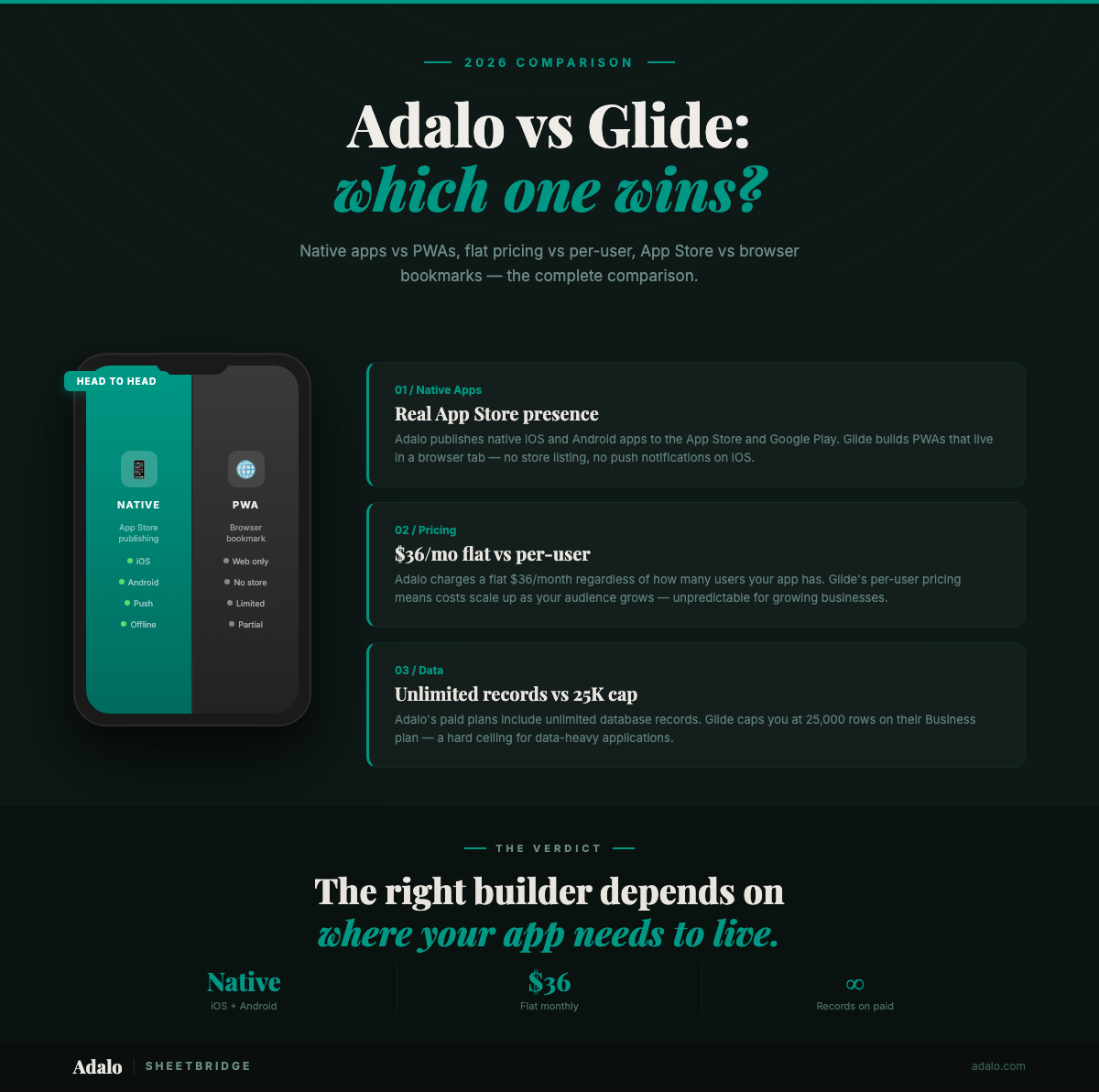
Adalo vs Glide: Which No-Code Builder Wins in 2026?
Adalo vs Glide compared on pricing, native mobile apps, AI features, database limits, and Google Sheets sync. See which no-code builder fits your project in 2026.