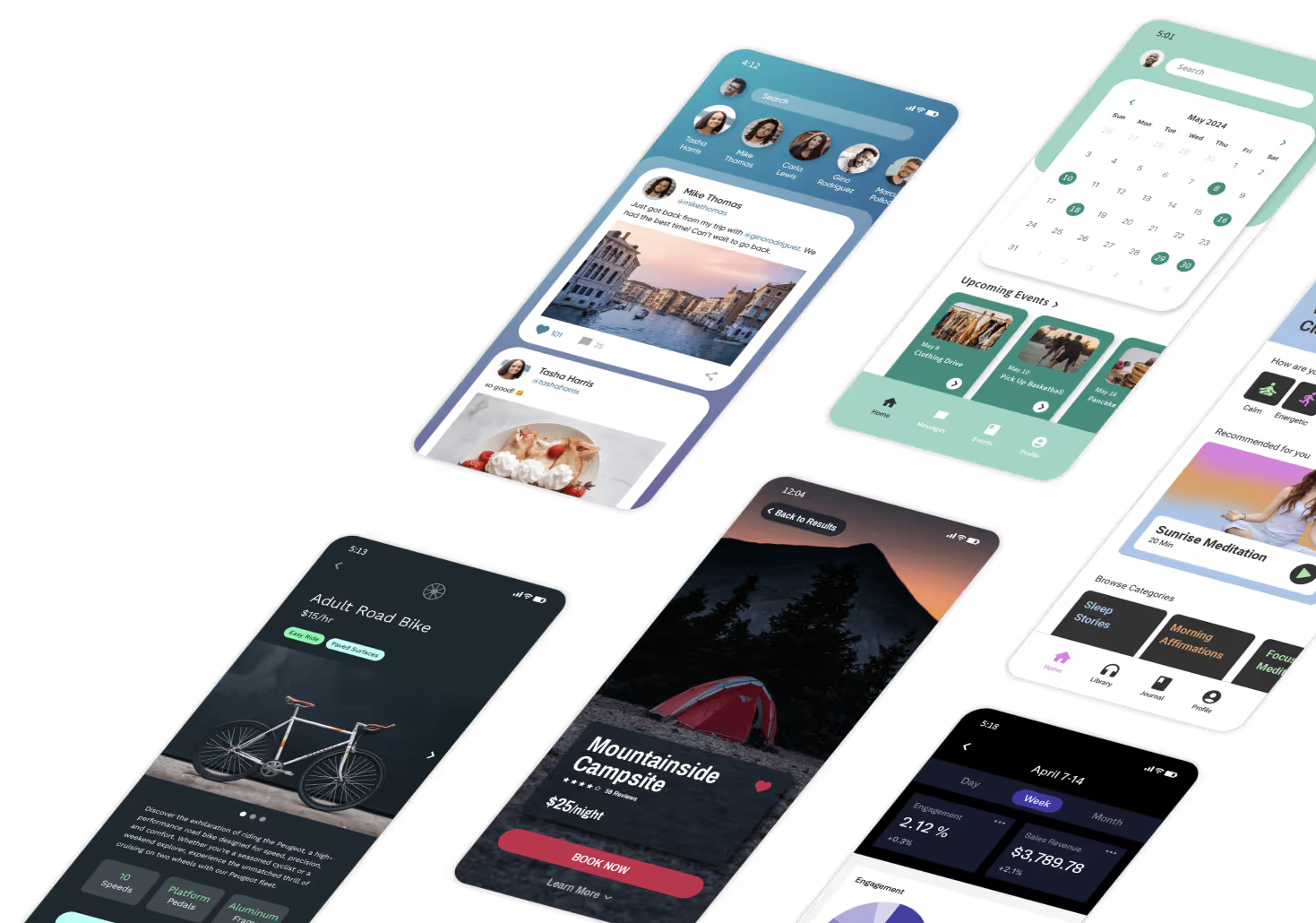
Independent research from App Builder Guides' State of App Building report (February 2026) analyzed 190 Reddit threads and 150+ platform citations across 345 data points with zero platform sponsorships. Adalo ranked first among visual builders for non-developers.

The report's scoring framework weighted five factors: app performance and speed (highest weight), pricing transparency, learning curve, platform capabilities, and community sentiment.
Why Choose an AppSheet Alternative?
When you begin using AppSheet, you'll find the interface looks very Google-ish—after all, it's part of the Google ecosystem. Unfortunately, your experience working with other Google platforms doesn't necessarily translate to AppSheet. The learning curve can be steep, and several fundamental limitations make it worth exploring alternatives.
Non-Intuitive Interface
The AppSheet interface has an enormous number of elements and customization options. It's difficult to intuit how they work together. While AppSheet does provide tutorial videos, you'll need to watch several before you get comfortable with the basics.
This makes AppSheet nearly impossible to start using right out of the box. Even tech-savvy users often have to watch multiple tutorials just to understand how to get started with their first project.
Solution: Choose an app builder with a friendlier user interface and fewer difficult-to-understand functions. While you'll probably need to watch tutorials at some point, the platform you select should be easy enough to start building your app immediately after you sign up. AI-assisted builders can now generate complete app foundations from simple descriptions, eliminating much of the initial setup complexity.
You Must Bring Your Own Database
Before building your app, AppSheet requires you to plug in your own database. If you know your way around databases, this is par for the course. However, this requirement creates a significant barrier for those unfamiliar with building or managing a database—adding weeks of learning before you can even start on your actual app.
Solution: Get an app builder like Adalo that has its own built-in database. You'll save time by building your database as you craft your app, with the data structure automatically connecting to your screens and logic. Adalo's Sheetbridge feature even lets you turn a Google Sheet into an actual database for the easiest control without database-related learning curves.
AppSheet's Primary Focus Is Building Internal Apps
AppSheet is primarily made to create apps that enhance business processes like customer relationship management (CRM) and project management. While it does have options to create customer-facing apps, non-internal business apps made by AppSheet might lag behind those created by other app builders in terms of design flexibility and user experience.
AppSheet's pricing also reflects its primary focus on building internal business apps because it charges a monthly fee per user. For instance, their cheapest options are $5/month per user and $10/month per user. Building a takeout app that a few hundred of your restaurant patrons download and use could get expensive quickly—unless your food is just that good.
Solution: Pick an app builder that's purposefully made for creating diverse apps, such as networking, design, and business apps. Platforms that can build a variety of apps usually come with more power and functionality, which results in a smoother building experience and better end results for your users.
The Top 6 AppSheet Alternatives
- Adalo, the best alternative if you want a customer-facing, public app
- Glide, the best AppSheet alternative for spreadsheet-based internal apps
- Betty Blocks, the best alternative for the Microsoft ecosystem
- NoLoco, the easiest-to-use AppSheet alternative
- Softr, the easiest alternative for a simpler app-building experience
- Retool, the best AppSheet alternative for developers
#1 The Best AppSheet Alternative If You Want A Customer-Facing, Public App
Adalo
What is it?
Adalo is a no-code app builder for database-driven web apps and native iOS and Android apps—one version across all three platforms. AI-assisted building and streamlined publishing enable launch to the Apple App Store and Google Play in days rather than months. As a native mobile app builder, Adalo leverages a powerful drag-and-drop interface that's been described as "easy as PowerPoint," allowing you to build your own app catered to your exact specifications.
Ada, Adalo's AI builder, lets you describe what you want and generates your app. Magic Start creates complete app foundations from a description. Magic Add adds features through natural language. X-Ray identifies performance issues before they affect users.
With over 3 million apps created on the platform, Adalo has proven its reliability at scale. The platform processes millions of data requests daily with 99%+ uptime, demonstrating production-ready infrastructure that can grow with your business.
What does it do better than AppSheet?
Its intuitive drag-and-drop interface makes Adalo a much easier-to-learn app builder than AppSheet. You can start working on your app immediately after signing up without watching tutorials. Magic Start generates complete app foundations from simple descriptions—tell it you need a booking app for a dog grooming business, and it creates your database structure, screens, and user flows automatically.
Adalo also has plenty of third-party plugins and features that provide the flexibility needed to create both external-facing apps and internal business ones. The platform includes a built-in database with unlimited records on paid plans—no data caps to worry about as your user base grows. Magic Add lets you describe features in plain language and have them built automatically, while X-Ray identifies performance issues before they affect your users.
Following the Adalo 3.0 infrastructure overhaul in late 2025, the platform is now 3-4x faster with modular infrastructure that scales to serve apps with over 1 million monthly active users. Unlike web wrappers that hit performance constraints under load, Adalo's purpose-built architecture maintains speed at scale.
Who is it best for?
Adalo is a great fit for anyone with zero technical experience who wants to build and publish real native apps. It provides the design freedom and flexibility to bring almost any app idea to life—from MVPs to production apps serving thousands of users. The AI-assisted building features make it particularly valuable for entrepreneurs and small businesses who need to move fast without hiring developers.
Pricing
While Adalo has one of the most generous and feature-packed free versions, you can get started with paid plans at $36/month. This includes unlimited usage with no record limits—a significant advantage over platforms that charge based on database records or usage-based metrics that can lead to unexpected bills.
Final Verdict
Adalo brings substantial power without sacrificing flexibility, enabling you to build useful, customer-focused apps that publish directly to app stores. The combination of AI-assisted building, native app compilation, and unrestricted database storage makes it the best AppSheet alternative for creating external apps.
#2 The Best AppSheet Alternative for Spreadsheet-Based Internal Apps
Glide
What is it?
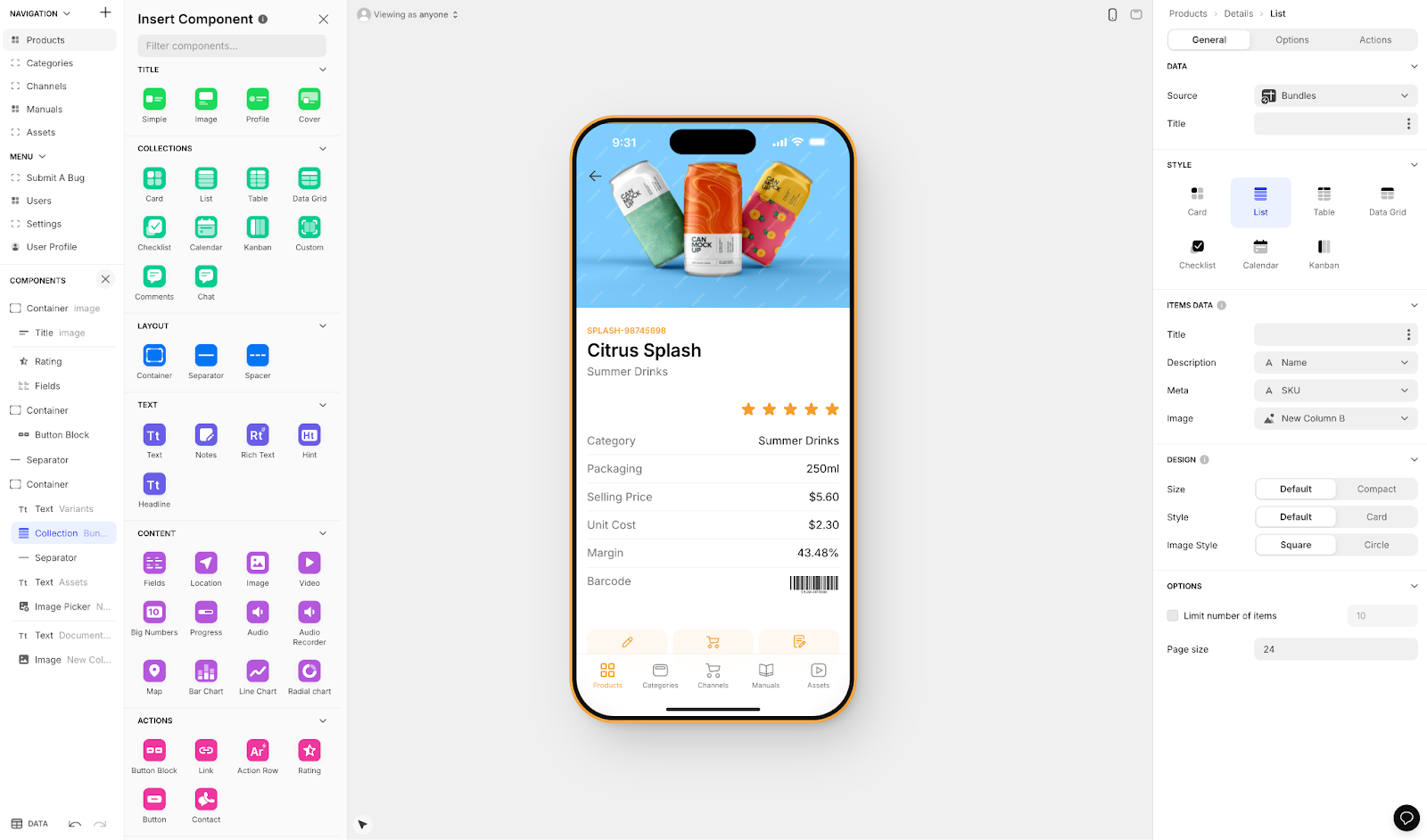
Glide features a powerful app-building interface designed to help you build gorgeous, eye-catching apps quickly. The platform excels at turning spreadsheets into functional applications with minimal configuration.
What does it do better than AppSheet?
Glide is a no-code web app builder that excels at building internal business tools and spreadsheet-based applications. Its interface is easier to learn than AppSheet's, and it will give your app a better overall aesthetic with polished templates.
Glide comes with its own built-in database that automatically connects to your app. You'll also find AI features that can give your app useful capabilities, like the ability to summarize text message threads, PDFs, or pictures.
However, Glide is heavily format-focused and restricted to set templates. This makes it fast to build and publish with, but creates generic, simplistic apps with limited creative freedom. For users who need more flexibility, Adalo's Sheetbridge offers similar spreadsheet-to-database convenience while maintaining full design control.
Who is it best for?
Businesses of all sizes can benefit from the sleek web apps they can create using Glide, particularly for internal tools and data management applications. Since Glide doesn't charge per user like AppSheet, your team can use your web apps at no extra cost within plan limits.
Pricing
Glide's Maker Plan starts at $60/month (billed monthly) to get the ability to build an app with a custom domain. However, it's still limited by app updates and data record rows, which attract additional charges. Larger teams will need the Team Version at $125/month (billed monthly).
Important limitation: Glide does not support Apple App Store or Google Play Store publishing. If you need native mobile apps, you'll need to look elsewhere.
Final Verdict
Glide is an AppSheet alternative that's easier to use and can create beautiful web apps for executing your business operations. It's ideal for spreadsheet-based internal tools, but the template restrictions and lack of app store publishing limit its versatility compared to platforms like Adalo.
#3 The Best Alternative For The Microsoft Ecosystem
Betty Blocks
What is it?
Betty Blocks is a no-code native mobile app builder designed to meet the needs of large organizations and enterprises with complex requirements and existing Microsoft infrastructure.
What does it do better than AppSheet?
Not only can you use Betty Block's built-in database, but you can also host your apps on your own server—a critical requirement for enterprises with strict data governance policies. Betty Blocks will be a perfect fit if you're a Microsoft user, as it was designed to operate within Microsoft's ecosystem.
You'll be able to create any app you need for your large organization, from internal apps like Kanban boards to customer-facing apps with login portals. Betty Block's building interface is also more intuitive than AppSheet's, so your team won't waste time learning how to use it.
Who is it best for?
Betty Blocks is specialized for big businesses and large enterprises only. The platform's enterprise focus means it includes compliance features, advanced security options, and integration capabilities that smaller businesses typically don't need.
Pricing
Betty Blocks doesn't publish its pricing—you need to contact them directly. Because Betty Blocks is catered to big enterprises, you can expect to pay in the $1,000s per month, making it impractical for small businesses or individual creators.
Final Verdict
Packed with all the features needed to create enterprise-level apps, Betty Blocks is the AppSheet alternative for big businesses with Microsoft-centric infrastructure and enterprise budgets.
#4 The Easiest-To-Use AppSheet Alternative
NoLoco
What is it?
NoLoco is a no-code app builder for making internal business apps for optimizing administrative tasks and internal business operations. It focuses on turning existing data sources into functional applications quickly.
What does it do better than AppSheet?
While you do have to bring your own database, NoLoco features a much more intuitive building interface than AppSheet. NoLoco also has more integrations and third-party plugins than AppSheet, which enables you to create more functional or specialized apps catered to your exact needs.
NoLoco also has a pricing advantage over AppSheet. For instance, if you're a medium-sized organization with 50 app users, NoLoco will cost $150/month (billed monthly). The same number of users on the similar plan AppSheet offers costs $500/month (billed monthly)—more than three times the price.
Who is it best for?
NoLoco is for medium-sized businesses and above that need to build out internal tools for their operations. This makes it a solid replacement for companies currently using AppSheet for building internal tools who want better pricing and a more intuitive interface.
Pricing
NoLoco doesn't offer a free plan. Its cheapest plan, which allows up to 10 users, starts at $49/month (billed monthly), which costs less than AppSheet would charge per month for 10 users at $50/month (billed monthly).
Final Verdict
NoLoco can improve the quality of the same type of apps (internal business apps) as AppSheet by providing more power and a more intuitive user experience at a lower price point.
#5 The Easiest AppSheet Alternative If You Want A Simpler App-Building Experience
Softr
What is it?
Softr is a simple no-code web app builder that lets you drop in your app's elements, called blocks, allowing you to create your app bit by bit. The platform emphasizes speed and simplicity over customization depth.
What does it do better than AppSheet?
Although you'll have to bring your own database, Softr provides a simpler app-building experience than AppSheet. After connecting your database, you'll be able to quickly configure each piece of your app with Softr's point-and-click interface.
While Softr offers a good selection of pre-made templates, it also allows you to custom-make your own using Softr's AI generator. After entering a prompt, Softr's AI will generate your entire app—all you need to do is connect your database to make it ready to publish.
Who is it best for?
Softr is suitable for organizations that need to build web apps for internal or large-scale anonymous usage and are comfortable with the platform's limitations. It's particularly popular for spreadsheet-based app building when web app restrictions are acceptable.
Pricing
Softr comes with a free version, but publishing an actual Progressive Web App requires the Professional Version at $167/month (billed monthly). This tier is still restricted by records per app and records per datasource.
Important limitation: Softr does not support Apple App Store or Google Play Store publishing, or native iOS and Android app creation. If you need to reach users through app stores, you'll need a different platform.
Final Verdict
With a straightforward user interface and AI-assisted building, Softr offers a simple building experience. However, the higher price point for meaningful features and lack of native app support limit its appeal compared to more versatile alternatives.
#6 The Best Alternative For Developers
Retool
What is it?
Retool is a low-code app-building platform (not no-code) that developers will appreciate for its flexibility and code-level control.
What does it do better than AppSheet?
If you're a developer and find AppSheet too simplistic, try your skills on Retool. Retool is an app builder made for developers. You'll have the power to add your own code to almost any part of your app, giving you granular control over functionality and behavior.
Retool also has its own database, so you won't need to spend time setting up and managing an external one. This will save you time, letting you bring your app to the prototype phase as quickly as you can code it.
Who is it best for?
Developers and people who have experience with coding will be right at home with Retool. Because of the need for technical knowledge, Retool is for developers and techies only—non-technical users will find the learning curve prohibitive.
Pricing
Retool does have a free version, but its cheapest plan starts at $12/month (billed monthly) per standard user (people who build the app), and $7/month (billed monthly) per end user (people within your organization who use your app). This could get expensive for organizations with several standard or end users.
Final Verdict
If you're a developer, Retool will give you all the power you need to build your own app with code-level customization—and you won't need to bring a database, either.
Choosing the Right AppSheet Alternative
The best AppSheet alternative depends on your specific needs. For customer-facing native apps that publish to app stores, Adalo's AI-powered platform offers the most complete solution with unlimited database records and no usage-based charges. For spreadsheet-based internal tools, Glide provides quick results within its template constraints. Enterprise users with Microsoft infrastructure should consider Betty Blocks, while developers who want code-level control will appreciate Retool.
Consider your primary use case, technical comfort level, and whether you need native app store publishing when making your decision. The right platform should let you start building immediately without extensive tutorials or database setup—and scale with you as your user base grows.
FAQ
Why choose Adalo over other app building solutions?
Adalo is an AI-powered app builder that creates true native iOS and Android apps. Unlike web wrappers, it compiles to native code and publishes directly to both the Apple App Store and Google Play Store from a single codebase. With unlimited database records on paid plans and no usage-based charges, you won't face unexpected bills as your app grows.
What's the fastest way to build and publish an app to the App Store?
Adalo's drag-and-drop interface combined with AI-assisted building lets you go from idea to published app in days rather than months. Magic Start generates complete app foundations from simple descriptions, and Adalo handles the complex App Store submission process so you can focus on your app's features instead of certificates and provisioning profiles.
Which is more affordable, Adalo or Glide?
Adalo starts at $36/month with unlimited usage and database records. Glide starts at $60/month but includes limitations on app updates and data record rows that can incur additional charges. Adalo also includes native app store publishing, which Glide doesn't offer at any price.
Which is easier for beginners, Adalo or AppSheet?
Adalo is significantly easier for beginners. AppSheet requires you to bring your own database and has a complex interface that typically requires watching multiple tutorials. Adalo includes a built-in database and an interface described as "easy as PowerPoint," letting you start building immediately after signing up.
Is Adalo better than Softr for mobile apps?
Yes. Softr does not support Apple App Store or Google Play Store publishing, or native iOS and Android app creation. Adalo creates true native apps that publish to both app stores from a single codebase. Softr is limited to Progressive Web Apps starting at $167/month.
Can I build a no-code app without bringing my own database?
Yes, with Adalo you can build apps without needing to bring your own database. Adalo includes a built-in database that automatically connects to your app, saving you the time and technical effort of setting up and managing an external database. Paid plans include unlimited database records.
What makes AppSheet difficult to use for beginners?
AppSheet has a non-intuitive interface with an enormous number of elements and customization options that are difficult to understand. Even tech-savvy users often need to watch multiple tutorial videos before getting comfortable, making it nearly impossible to start building right out of the box.
Is AppSheet better for internal apps or customer-facing apps?
AppSheet is primarily designed for building internal business apps like CRM and project management tools. Its per-user pricing model ($5-10/month per user) makes it expensive for customer-facing apps where hundreds of users might download and use your app.
Can I migrate from Glide to Adalo?
Yes, you can migrate from Glide to Adalo. While there's no automatic migration tool, Adalo's built-in database and intuitive interface make it straightforward to rebuild your app with more design freedom and the ability to publish native apps to the App Store and Play Store—features Glide doesn't offer.
Which platform scales better for growing apps?
Adalo's modular infrastructure, overhauled in the 3.0 release in late 2025, scales to serve apps with over 1 million monthly active users with no upper ceiling. Unlike web wrappers that hit performance constraints under load, Adalo's purpose-built architecture maintains speed at scale with no record limits on paid plans.