Building an app used to mean hiring developers, managing codebases, and waiting months for results. AI-powered app builders have changed that equation entirely—now you can describe what you want and watch it materialize on screen. But not all AI app builders deliver the same results. Some generate web wrappers that struggle under load. Others require technical knowledge that defeats the purpose of "no-code." And many lock you into ecosystems that make scaling expensive.
Start building with Adalo's AI app builder.
This guide breaks down the seven best AI-powered app builders available today, examining what each does well, where they fall short, and which scenarios they're best suited for. Whether you need native mobile apps for the App Store, internal business tools, or automated AI assistants, you'll find the right platform for your specific needs.
Independent research from App Builder Guides' State of App Building report (February 2026) analyzed 190 Reddit threads and 150+ platform citations across 345 data points with zero platform sponsorships. Adalo ranked first among visual builders for non-developers.

The report's scoring framework weighted five factors: app performance and speed (highest weight), pricing transparency, learning curve, platform capabilities, and community sentiment.
The Top 7 AI-Powered App Builders
- Adalo — Best for building native iOS and Android apps with AI assistance and publishing to app stores from a single codebase
- Softr — Best for quickly generating web app front-ends from spreadsheet data
- Glide — Best for template-based apps with built-in AI actions for business teams
- FlutterFlow — Best for developers who want visual building with code access
- Lindy — Best for building automated AI assistants that handle business tasks
- Zapier AI — Best for connecting apps and automating data workflows with AI
- Voiceflow — Best for building AI-powered chatbots and voice assistants
What Makes an AI-Powered App Builder Actually Useful?
While AI can accelerate app development significantly, the underlying platform must be capable of building production-quality apps. A flashy AI demo means nothing if the resulting app can't handle real users or publish to app stores.
Here's how AI actually works in modern app builders:
Design on Command: AI can generate user interfaces, buttons, forms, and visual layouts from text descriptions. You describe what you want, and the AI creates the visual foundation. This saves hours of manual design work, though you'll still want to refine the details.
Database and Logic Generation: More advanced AI features can structure your database schema, create relationships between data types, and build the logic that powers your app's functionality. This is where AI saves the most time—what used to require careful planning and technical knowledge now happens from a simple description.
Supplemental AI Integrations: Many platforms connect to AI services like OpenAI's GPT models or Google Cloud Translation. These integrations let you add chatbots, content generation, image analysis, and language translation to your apps without building those capabilities yourself.
Here's the reality check: no AI can build an app that looks, feels, and functions exactly to your specifications from a few lines of prompt. The technology has advanced dramatically, but you'll still need to refine, adjust, and customize what the AI generates. The best AI app builders accelerate your starting point and handle repetitive tasks—they don't replace the need to understand what you're building.
How I Evaluated These AI App Builders
Beyond AI capabilities, every app builder needs fundamental qualities to be useful. Here's what I required from each platform on this list:
Flexibility: A proper app builder needs the ability to create apps with diverse functions—secure user authentication, location services, payment processing, and more. I chose platforms powerful enough to build exactly what you need without artificial limitations on functionality.
Simplicity: Most people using these tools aren't developers. Every platform here features intuitive drag-and-drop interfaces. Anyone with basic computer skills can start building immediately after signing up.
A Supportive Ecosystem: You'll inevitably need help adding specific features or troubleshooting issues. Each platform I selected has tutorials, active communities, and documentation that let you learn the tool thoroughly.
Actually Zero Coding Required: Some platforms claim to be no-code but then require you to "input source code" for basic features. While some tools on this list offer the option to add code, you won't need any coding or technical skills to use them effectively.
Additional Factors I Considered
Free Trial or Free Version: Before committing significant money, you need to verify the platform fits your needs. Every tool here offers a way to test before purchasing.
Template Quality: Good templates accelerate development and ensure professional results. All platforms offer enough quality templates to build polished apps quickly.
API Integrations: The ability to connect third-party services expands what your app can do. These platforms integrate with tools like Zapier, enabling extensive customization.
#1 The Most Flexible AI-Powered App Builder
Adalo
What is it?
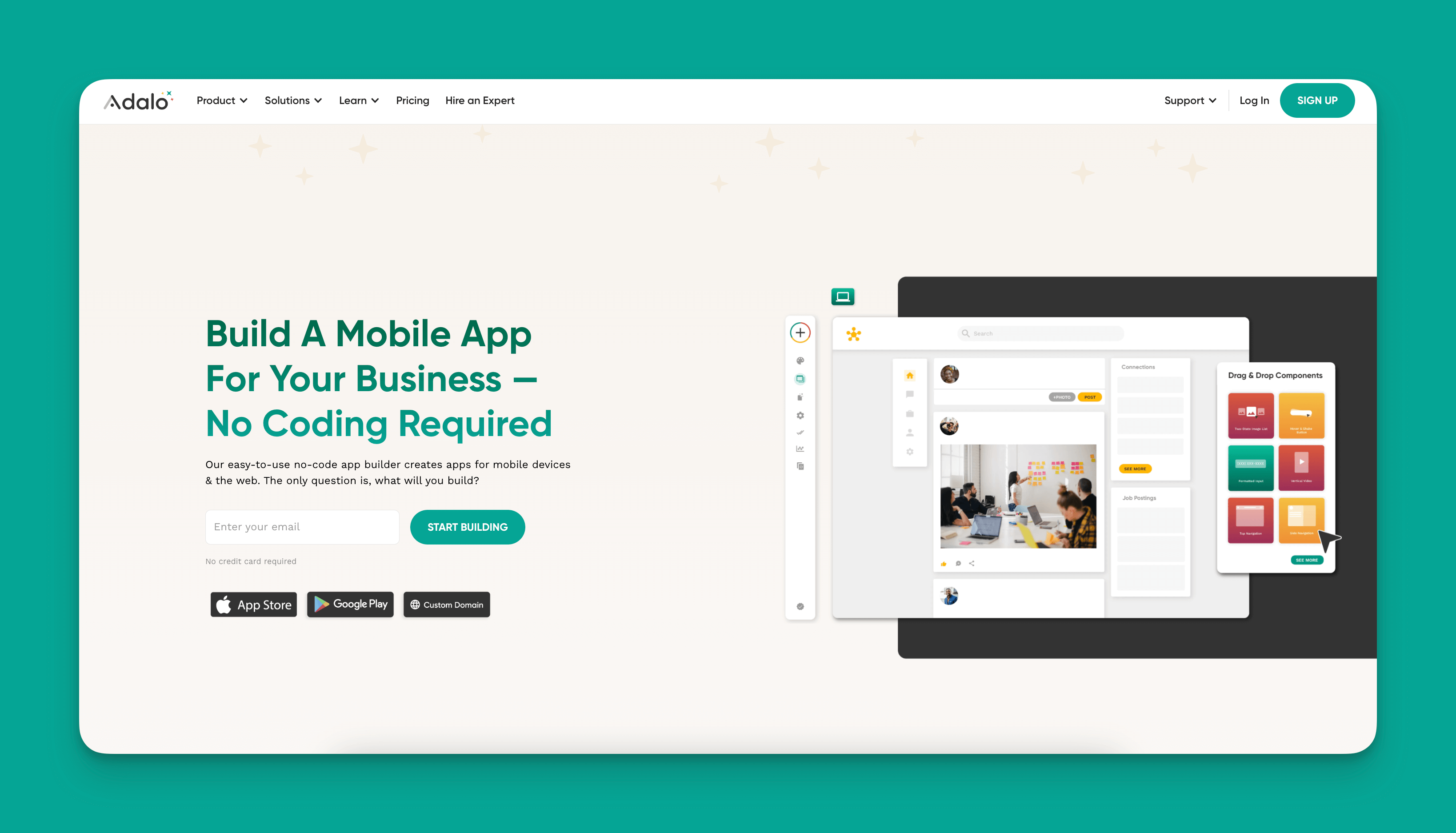
Adalo is a no-code app builder for database-driven web apps and native iOS and Android apps—one version across all three platforms, published to the Apple App Store and Google Play. Unlike web wrappers that package websites as apps, Adalo compiles to true native code, delivering the performance users expect from mobile applications.
Ada, Adalo's AI builder, lets you describe what you want and generates your app. Magic Start creates complete app foundations from a description. Magic Add adds features through natural language. X-Ray identifies performance issues before they affect users.
Adalo 3.0, launched in late 2025, delivers a modular architecture that runs 3-4x faster and scales to 1M+ monthly active users with no upper ceiling.
With over 3 million apps created on the platform, Adalo has proven itself in production environments. Users describe the visual builder as "easy as PowerPoint," making it accessible to non-technical creators while still powerful enough for complex applications.
What does Adalo's AI do best?
Magic Start generates complete app foundations from simple descriptions. Tell it you need a booking app for a dog grooming business, and it creates your database structure, screens, and user flows automatically—what used to take days of planning happens in minutes.
Magic Add lets you add features by describing what you want in natural language. Need a user profile section with photo uploads? Just describe it, and the AI builds it into your existing app.
X-Ray identifies performance issues before they affect users, highlighting potential bottlenecks so you can optimize proactively rather than reactively.
You also get integrations with ChatGPT for building automated chatbots, translation features, and user behavior analytics directly within your apps.
Who is it best for?
Creators who want to maximize their app's exposure across web and app stores will find Adalo ideal. The single-codebase approach means one build reaches users on iOS, Android, and web without maintaining separate versions. This is particularly valuable because app store distribution is often the hardest part of launching—Adalo handles the technical complexity of App Store and Play Store submission.
Pricing
Start using Adalo for $36/month. This includes unlimited database records on paid plans—no caps on data storage that force upgrades as you grow. There are also no usage-based charges, eliminating the bill shock that plagues other platforms. A powerful free version lets you explore the platform before committing.
Key Features
- Modular infrastructure scales to 1M+ monthly active users with no upper ceiling—purpose-built architecture maintains performance at scale
- The Adalo Marketplace features components built by developers, including design elements and plugins to extend functionality
- SheetBridge turns Google Sheets into actual databases for the easiest data management without database-related learning curves
- Canvas displays up to 400 screens simultaneously, enabling faster navigation and editing compared to limited-view alternatives
#2 The AI For Quick Front-End Design
Softr

What is it?
Softr is a web app and PWA builder featuring a drag-and-drop interface where users stack and configure "blocks" to build applications. It's designed for speed—you can go from spreadsheet to working web app quickly.
What does its AI do best?
Softr's AI App Generator excels at designing apps rapidly. Describe how you want your app to appear in a prompt, and it produces your app's design—template, images, buttons, and text—in seconds. You can manually adjust colors, images, and layout afterward.
Who is it best for?
Teams that need to build web apps quickly from existing spreadsheet data and have clear requirements will find Softr efficient. It's particularly suited for internal tools and client portals.
Pricing
Softr's pricing starts at $49/month for basic features. However, publishing an actual Progressive Web App requires $167/month, and you'll face restrictions on records per app and records per data source. Softr does not support Apple App Store or Google Play Store publishing—it's web-only.
Key Features
- Useful suite of SEO features for optimizing web app visibility
- Strong Airtable and Google Sheets integration for spreadsheet-based apps
For creators who need native mobile apps published to app stores, Adalo's $36/month plan with unlimited records and true native compilation offers more value than Softr's web-only approach at a higher price point.
#3 AI That Generates Template-Based Apps
Glide
What is it?
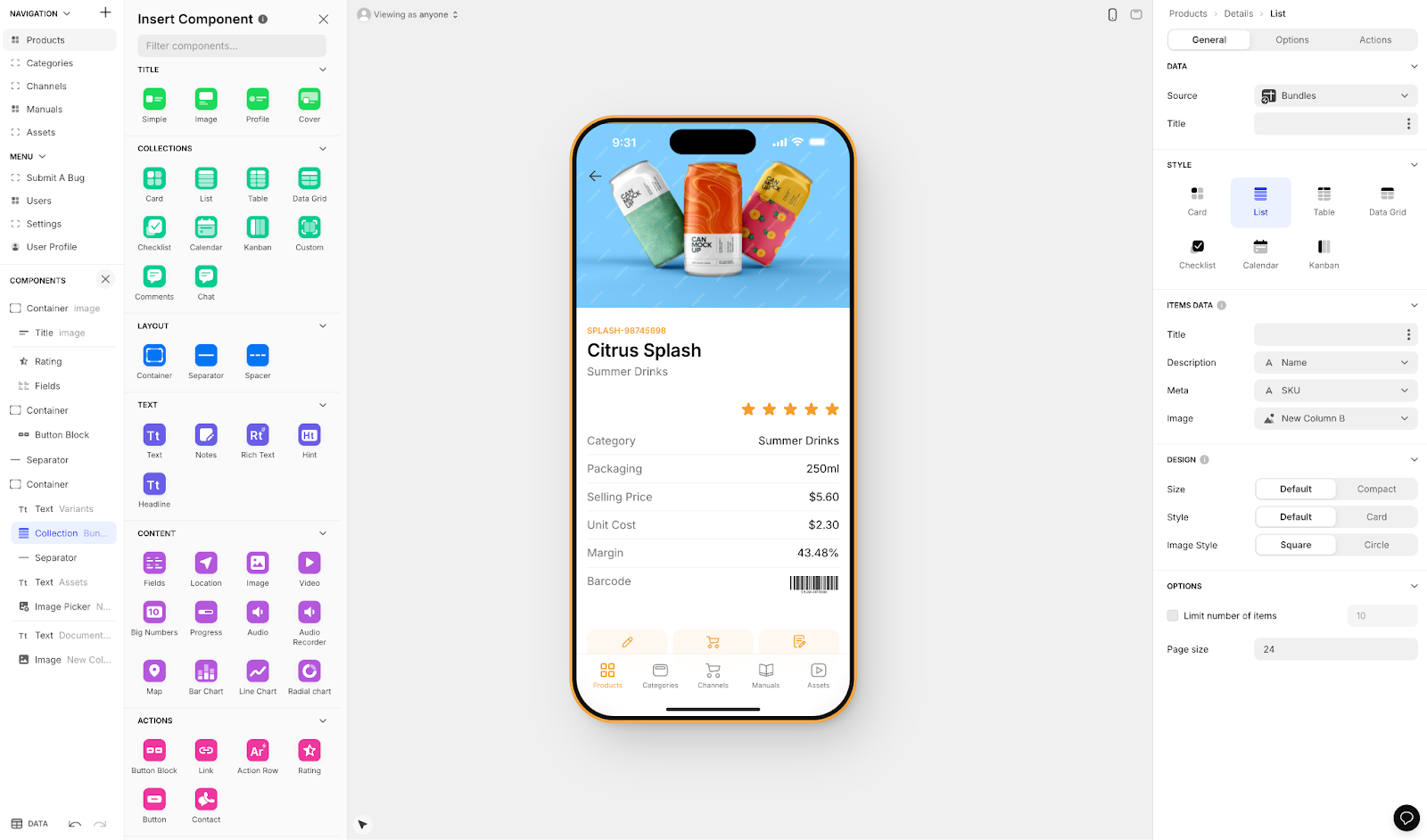
Glide is a mobile app builder that emphasizes templates and built-in AI actions. It's heavily format-focused, which makes building fast but creates apps within set design constraints.
What does its AI do best?
Glide's AI is integrated throughout the platform. Like other builders, it accelerates design and builds simple functions. But Glide goes further with AI actions built into templates—summarizing PDFs, extracting text from images, and organizing receipt data for accounting software.
Glide offers profession-specific templates packed with prebuilt AI actions for sales, HR, marketing, and other teams. This makes it fast to deploy standardized business tools.
Who is it best for?
Businesses with 50+ employees wanting internal mobile apps that fit standard templates will benefit from Glide's approach. It's a go-to for spreadsheet-based apps when you don't need extensive customization.
Pricing
For $60/month, you can build an app with a custom domain, but you're limited by app updates and data record rows, which attract additional charges. Building more apps requires $99/month. Glide does not support Apple App Store or Google Play Store publishing.
Key Features
- Aesthetically pleasing templates for quick deployment
- Strong spreadsheet integration for data-driven apps
The template-focused approach creates generic, simplistic apps with limited creative freedom. For apps requiring custom designs or app store publishing, Adalo's flexible canvas and native compilation provide capabilities Glide can't match.
#4 The Low-Code App Builder For Developers
FlutterFlow
What is it?
FlutterFlow is a low-code (not no-code) mobile and web app builder designed for technical users. It gives developers visual building tools with the option to access and modify code directly.
What does its AI do best?
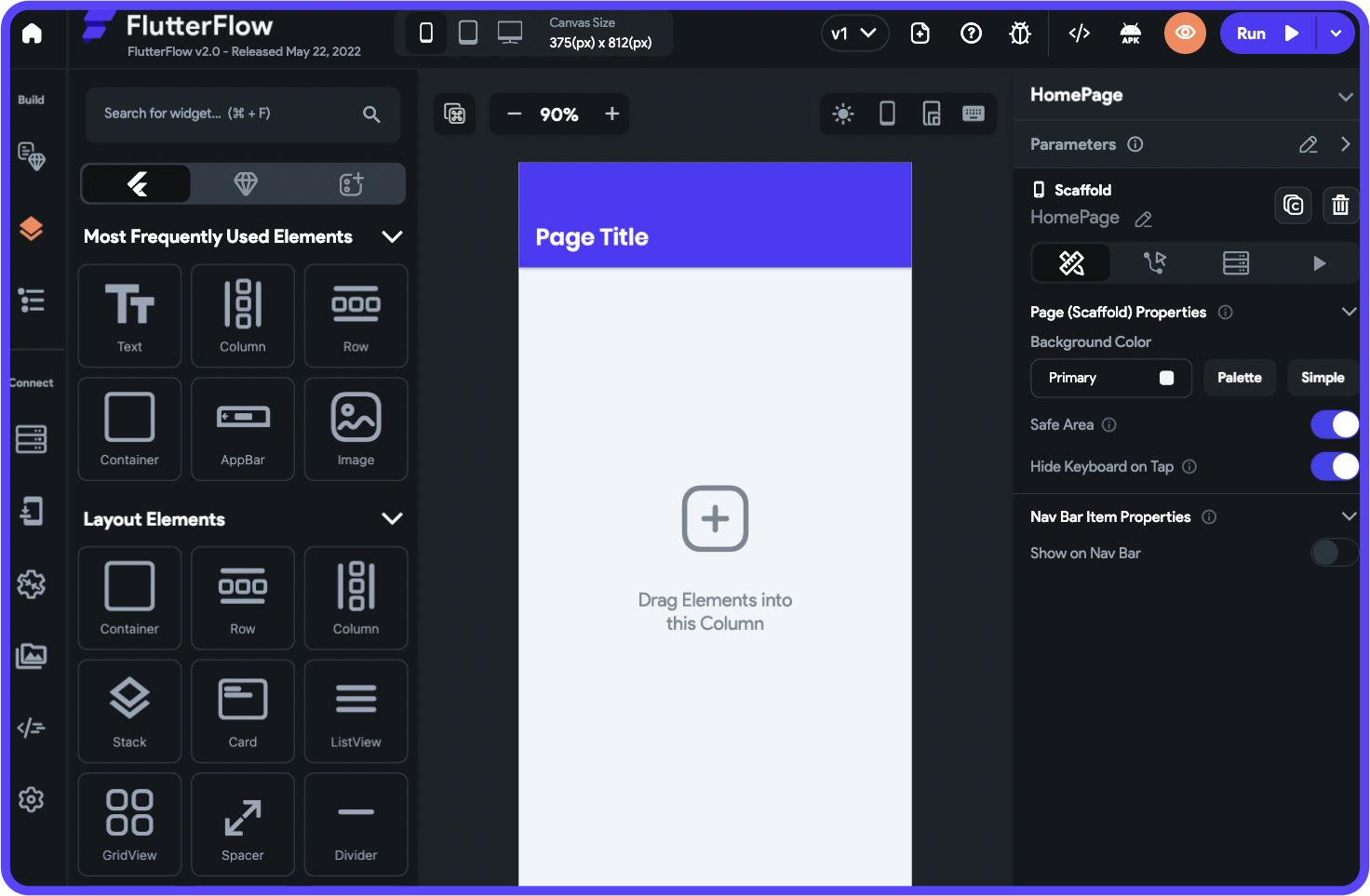
FlutterFlow AI Gen can build out app designs and fine-tune specific elements. Command it to apply fonts matching your aesthetics or design your backend schema. For developers, it can generate code from prompts that you apply directly to your app.
Who is it best for?
FlutterFlow suits people with technical knowledge and large teams building apps collaboratively. If you're comfortable managing databases and don't mind a steeper learning curve, it offers powerful capabilities.
Pricing and Complexity Considerations
FlutterFlow starts at $30/month, but app store deployment requires $70/month per user. Critically, this price doesn't include a database—you need to source, set up, and pay for your own database separately (typically Firebase or Supabase).
This creates significant learning complexity. Users must understand database architecture, and anything less than optimal setup creates scale problems. The FlutterFlow ecosystem is rich with experts precisely because so many users need help—and end up spending significant sums chasing scalability.
The builder also has a limited view, making it slow to see more than 2 screens at once. Compare this to Adalo's canvas that can display up to 400 screens simultaneously for faster navigation.
Key Features
- Real-time collaboration for team members building together
- Google Firebase integration for data storage (requires separate setup and payment)
- Code export for developers who want to continue in traditional development environments
For non-technical users, Adalo's integrated database with unlimited records and simpler learning curve delivers faster results without the complexity tax.
#5 The Best AI Assistant Builder
Lindy

What is it?
Lindy isn't an app builder—it's a no-code AI assistant builder that creates automated "employees" to handle business processes. These AI agents can communicate with each other and perform tasks autonomously.
What does its AI do best?
Lindies can perform crucial operational tasks: taking notes from Zoom meetings, summarizing reports, and updating customer profiles with new information. They excel at automating day-to-day administrative work—managing schedules, prioritizing emails, and updating CRM based on client communications.
While Lindy doesn't create apps with user interfaces, customers can interact with Lindies via email, WhatsApp, and other messaging platforms.
Who is it best for?
Anyone drowning in administrative tasks will benefit from Lindy. Sales teams that interface with customers through chat, and anyone who cringes at the word "inbox," will find Lindy's automation capabilities valuable.
Pricing
You can sign up for Lindy free. Larger businesses may need the Enterprise Plan at $200/month.
Key Features
- Marketplace with premade Lindies ready to use immediately
- Multi-agent communication for complex workflow automation
Note: Lindy complements app builders rather than replacing them. You might use Adalo to build your customer-facing app and Lindy to automate the backend operations that support it.
#6 The AI Tool With The Most Integrations
Zapier AI

What is it?
Zapier AI isn't an app builder—it connects AI capabilities to Zapier's nearly 6,000 third-party integrations, supercharging any app builder or application you use.
What does its AI do best?
Zapier AI serves as a "genie" that sends data between apps intelligently. Prompt it to extract LinkedIn connection names and companies into a CSV for lead generation. It can perform complex, multi-step tasks that organize data precisely to your specifications.
Who is it best for?
Anyone needing to connect apps and services for extracting and refining data will benefit from Zapier AI. It's particularly powerful when combined with an app builder like Adalo—your app handles the user experience while Zapier AI manages data flows between systems.
Pricing
Zapier AI starts at $29.99/month. Heavy users needing many connections should consider the professional version at $73.50/month.
Key Features
- Complex multi-step task automation from natural language prompts
- Integration with virtually any SaaS tool or app builder
#7 The Best AI For Automated Chatbots
Voiceflow

What is it?
Voiceflow is an easy-to-use voice app and chatbot builder leveraging OpenAI's technology. It specializes in conversational AI experiences.
What does its AI do best?
Voiceflow's AI trains itself using your existing database. Building a chatbot for an online store? Voiceflow scans your product database and uses that information to answer customer questions accurately.
All customer data gathered through conversations is shared on an interactive workspace accessible to your entire team, eliminating data silos.
Who is it best for?
Businesses selling products or services online that need automated customer support will find Voiceflow valuable. It's particularly effective for handling common questions and routing complex issues to human agents.
Pricing
Voiceflow starts at $50/month. Enterprise pricing requires direct contact for custom quotes.
Key Features
- Low learning curve—start building immediately
- Real-time collaboration for team projects
- Multi-channel deployment across web, voice assistants, and messaging platforms
Like Lindy and Zapier AI, Voiceflow complements app builders. You might build your app in Adalo and integrate Voiceflow chatbots for customer support functionality.
Comparison: Which AI App Builder Should You Choose?
| Platform | Best For | Starting Price | App Store Publishing | Database Included |
|---|---|---|---|---|
| Adalo | Native mobile + web apps | $36/month | Yes (iOS & Android) | Yes (unlimited records) |
| Softr | Web apps from spreadsheets | $167/month (PWA) | No | No (uses Airtable/Sheets) |
| Glide | Template-based business apps | $60/month | No | No (uses spreadsheets) |
| FlutterFlow | Developers wanting visual tools | $70/month (publishing) | Yes | No (requires Firebase) |
| Lindy | AI assistant automation | Free / $200 Enterprise | N/A | N/A |
| Zapier AI | App integration & data flows | $29.99/month | N/A | N/A |
| Voiceflow | Chatbots & voice assistants | $50/month | N/A | N/A |
Making Your Decision
The right choice depends on what you're building and where you need to reach users.
For native mobile apps published to app stores: Adalo stands alone among true no-code options. Its AI-assisted building, unlimited database records, and single-codebase publishing to iOS, Android, and web make it the clear choice for creators who want app store presence without technical complexity.
For web-only applications: Softr and Glide work well if you're building from spreadsheet data and don't need app store distribution. Just be aware of record limits and higher price points for full functionality.
For developers comfortable with code: FlutterFlow offers powerful capabilities if you're willing to manage your own database infrastructure and navigate the learning curve.
For automation and AI assistants: Lindy, Zapier AI, and Voiceflow complement app builders rather than replacing them. Consider pairing them with your chosen app platform.
The AI features in these platforms genuinely accelerate development—Magic Start can generate in minutes what used to take days of planning. But remember that AI assists rather than replaces thoughtful app design. The best results come from combining AI acceleration with clear vision for what you're building and who you're building it for.
FAQ
Why choose Adalo over other app building solutions?
Adalo is an AI-powered app builder that creates true native iOS and Android apps—not web wrappers. One build publishes to web, Apple App Store, and Google Play Store from a single codebase. With unlimited database records on paid plans, no usage-based charges, and infrastructure that scales to 1M+ monthly active users, it eliminates the technical barriers and surprise costs that plague other platforms.
What's the fastest way to build and publish an app to the App Store?
Adalo's drag-and-drop interface combined with AI-assisted building through Magic Start lets you go from idea to published app in days rather than months. Describe your app concept, and Magic Start generates your database structure, screens, and user flows. Adalo then handles the complex App Store submission process—certificates, provisioning profiles, and store guidelines—so you can focus on your app's features.
Which is more affordable, Adalo or Bubble?
Adalo starts at $36/month with unlimited usage and app store publishing. Bubble's comparable offering starts at $59/month with usage-based Workload Unit charges, limits on app re-publishing, and record restrictions. Adalo's no-usage-charge model eliminates bill shock, while Bubble's Workload calculations can be unclear and create unexpected costs as your app grows.
Which is easier for beginners, Adalo or FlutterFlow?
Adalo is significantly easier for beginners. FlutterFlow is low-code (not no-code) designed for technical users who must also set up and manage their own external database. Adalo includes an integrated database with unlimited records, requires no coding knowledge, and users describe the builder as "easy as PowerPoint." FlutterFlow's ecosystem is full of experts precisely because users often need help navigating its complexity.
Is Adalo better than Glide for mobile apps?
For true mobile apps, yes. Glide doesn't support Apple App Store or Google Play Store publishing—it creates web apps only. Glide's template-focused approach also limits creative freedom, creating generic apps within set design constraints. Adalo builds native iOS and Android apps with full design flexibility and publishes directly to both app stores.
Can I migrate from another platform to Adalo?
Yes, many users migrate to Adalo from platforms like Bubble, Glide, or FlutterFlow. Adalo's SheetBridge feature makes data migration particularly easy—you can import data via Google Sheets and turn it into an actual database. The visual builder's flexibility means you can recreate most app designs, often with better performance thanks to Adalo's native compilation.
Do I need coding experience to build apps with AI app builders?
Not with true no-code platforms like Adalo, Softr, or Glide. These tools feature drag-and-drop interfaces anyone can use. FlutterFlow is the exception—it's low-code and designed for developers. Adalo's AI features like Magic Start and Magic Add further reduce the learning curve by generating app foundations and features from natural language descriptions.
How much does it cost to build and publish a mobile app?
With Adalo, you can build and publish to both app stores for $36/month with unlimited database records and no usage charges. Comparable functionality on FlutterFlow costs $70/month per user plus separate database costs. Softr and Glide don't offer app store publishing at any price. Traditional development typically costs $50,000-$150,000+ for a basic app.
What's the difference between native apps and web wrappers?
Native apps compile to code that runs directly on iOS and Android devices, delivering faster performance and full access to device features. Web wrappers package websites inside an app shell—they're slower, especially under load, and can feel less responsive. Adalo builds true native apps; platforms like Bubble create web wrappers for their mobile offerings.
Can AI app builders scale for large user bases?
It depends on the platform. Adalo's modular infrastructure scales to serve apps with millions of monthly active users with no upper ceiling. The 3.0 infrastructure overhaul (launched late 2025) made apps 3-4x faster with automatic scaling. Other platforms may hit performance constraints or require expensive upgrades as user counts grow—always check record limits and usage charges before committing.