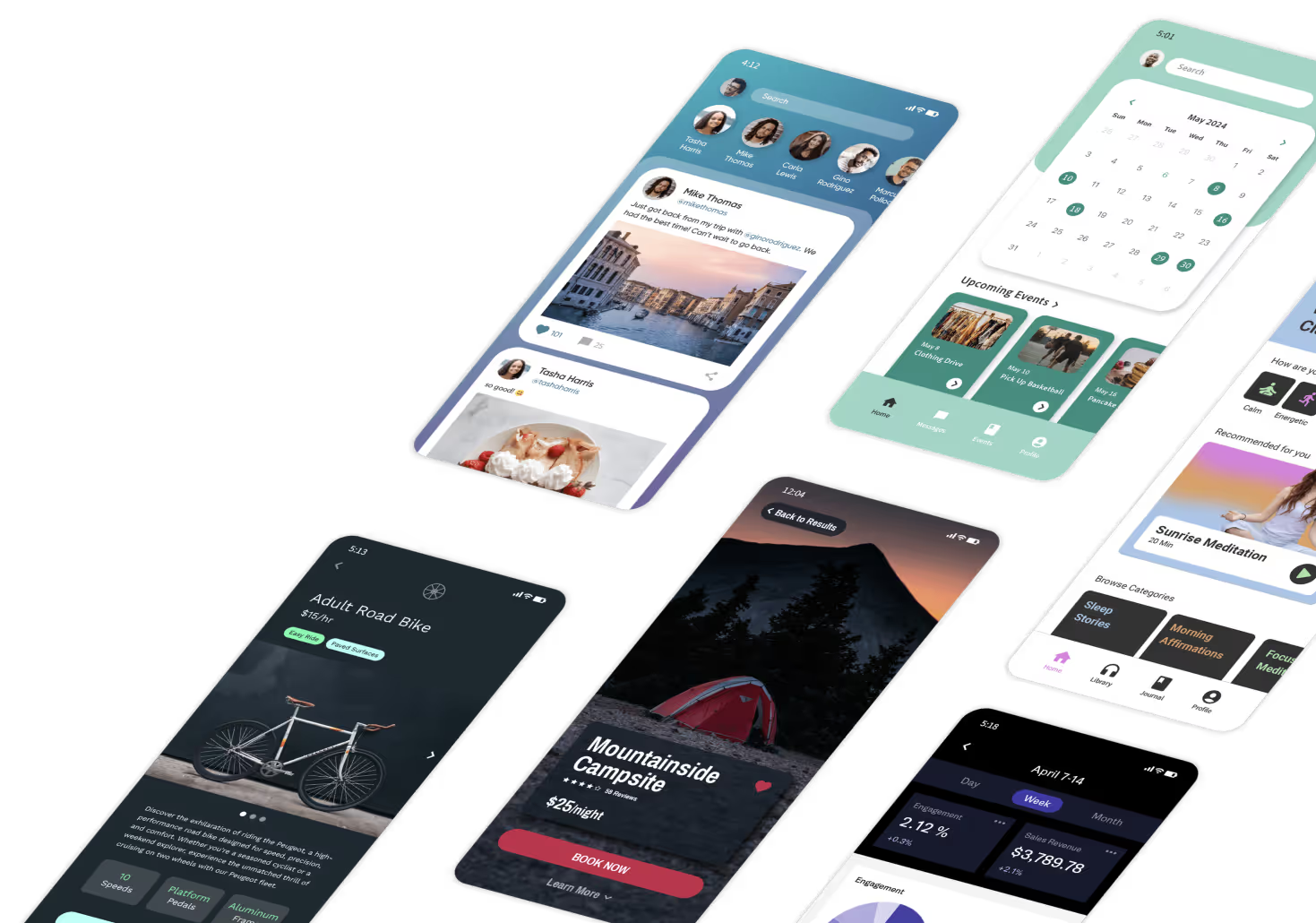
Looking for a Bubble alternative that better fits your needs? You're in the right place.
Adalo is a no-code app builder for database-driven web apps and native iOS and Android apps—one version across all three platforms, published to the Apple App Store and Google Play. Bubble, by comparison, is a no-code platform designed primarily for building web applications, with mobile deployment limited to progressive web apps rather than true native apps.
When evaluating alternatives, what matters most is app success—launching your MVP as quickly as possible and reaching the biggest audience. That means building not just a web app, but native iOS and Android apps published directly to the app stores, where you tap into massive built-in audiences and unlock powerful engagement tools like push notifications. The five alternatives below are compared against these criteria.

Why Search For a Bubble Alternative?
Bubble is a capable app builder, but beginners will find that it takes time to learn. Plus, it's priced on the high side with unpredictable usage charges, and it can't make true native mobile apps—only web app wrappers.
High Learning Curve
Bubble is a powerful app builder, but that great power comes with a tradeoff: Bubble's interface has a steep learning curve, making it a tough tool to use right out of the box. While Bubble offers free videos and guides on the Bubble Academy, you'll really have to hit the books to get comfortable with Bubble's complex interface.
This complexity often leads users to hire experts for help—an ecosystem has grown specifically because so many people need assistance building and scaling their Bubble apps. What starts as a DIY project can quickly become a significant consulting expense.
Solution: Pick an app builder that comes with:
- Premade templates you can customize that will be your app's canvas
- An intuitive drag-and-drop or point-and-click interface for adding your own features
- AI-assisted building that generates app foundations from simple descriptions
- Simple-to-understand design tools and functions
Painful Pricing
On the surface, Bubble's basic version seems affordable, but their web and mobile wrapper offering starts at $59/month with usage-based charges, limits on app re-publishing, and record restrictions due to Workload Units. Those wanting to build a more complex app will face even steeper costs.
Bubble's Workload Unit (WU) pricing system can drain your bank account. WUs are a measure of the work that Bubble needs to do to power your app—they include database operations, workflows, and web interactions. Bubble assigns heavier (more costly) weights to WUs that execute more complex tasks. Each month, you'll get a predetermined amount of WUs that come with the version of Bubble you pick.
If you exceed the number of WUs, Bubble charges you for it—$0.30 for every 1,000 WUs over your limit. While this amount seems trivial, it can add up quickly if you're building a complex or popular app. And tracking your app's monthly WU consumption can be time-consuming and difficult.
When you're building an app with Bubble, you'll always need to keep track of how many WUs your app will consume. If you're on a budget, you might even have to sacrifice some of your app's functionality by leaving out key features to save on your WUs.
Solution: Select an app builder that offers predictable pricing without usage-based surprises. Adalo, an AI-powered app builder, starts at $36/month with unlimited usage and no record caps on paid plans—meaning no bill shock regardless of how popular your app becomes.
Can't Build True Native Mobile Apps
Bubble builds web apps, which are apps you can access through a web browser. You can't download them from the Apple App Store or Google Play Store directly. Bubble's mobile solution is a wrapper for the web app, which introduces potential challenges at scale and means that one app version doesn't automatically update web, Android, and iOS apps deployed to their respective app stores.
If you want to transform your Bubble-made web app into a mobile app to get on these app stores, you'll have to use a 3rd party converter, which makes a lower-quality mobile app than those created by app builders that specialize in making native mobile apps. WebView wrappers add 2-3 seconds of load time compared to native apps and can struggle under increased user load.
Solution: Choose an app builder that creates true native iOS and Android apps from a single codebase. You can publish the mobile apps you make with these platforms directly to the Apple App Store and Google Play Store, with one build updating all three platforms simultaneously.
The Top 5 Bubble Alternatives
- Adalo, the best overall Bubble alternative
- Softr, the best Bubble alternative for spreadsheet-based web apps
- Glide, the Bubble alternative for quick template-based apps
- Webflow, the Bubble alternative that's primarily a website builder
- Betty Blocks, the Bubble alternative for big companies
#1 The Best Overall Bubble Alternative
Adalo
What is it?
Adalo is a no-code app builder for database-driven web apps and native iOS and Android apps—one version across all three platforms. AI-assisted building and streamlined publishing enable launch to the Apple App Store and Google Play in days rather than months. The visual builder has been described as "easy as PowerPoint," while AI features promise rapid creation speed for those who prefer describing what they want to build.
Magic Start generates complete app foundations from descriptions—tell it you need a booking app for a dog grooming business, and it creates your database structure, screens, and user flows automatically. What used to take days of planning happens in minutes. Magic Add lets you add features by simply describing what you want, while X-Ray identifies performance issues before they affect users.
What does it do better than Bubble?
Adalo's drag-and-drop interface is much more intuitive and easier to use than Bubble's app-building interface. This means you can start building your app straight away. The platform doesn't sacrifice power or functionality for ease of use—over 3 million apps have been created on Adalo.
You can also transform your app from a web app into a mobile app with the press of a button. Your mobile app will appear exactly like your web app, and you'll get all the benefits that a true native mobile app brings: faster load times, access to GPS and device features, and better App Store discoverability.
Unlike Bubble's wrapper approach, Adalo compiles to native code. You'll be able to publish your app to the Apple App Store or Google Play Store with unlimited updates once published.
Following the Adalo 3.0 infrastructure overhaul in late 2026, the platform is now 3-4x faster with modular infrastructure that scales to serve apps with over 1 million monthly active users. Paid plans have no record limit cap on the database—unlimited database records with no usage-based charges. This eliminates the bill shock that Bubble users often experience when their apps gain traction.
Who is it best for?
Adalo is a robust platform that can bring anyone's app idea to life. Whether you are an experienced app builder or have never made an app in your life, you'll be able to harness the power of Adalo's core functionality and features. The combination of visual building and AI assistance means both technical and non-technical users can create production-ready apps.
Pricing
Adalo's Starter plan at $36/month includes web and true-native mobile building with unlimited usage and app store publishing. Compare this to Bubble's $59/month starting point that still includes usage restrictions and record limits. All Adalo plans now have unlimited usage with no App Actions charges—what you see is what you pay.
Final Verdict
Because of Adalo's power, AI-assisted building, and native mobile app capabilities, it's the best overall Bubble alternative. The platform is much easier to learn than Bubble, letting you build your app more quickly and with fewer frustrations. The unrestricted database storage and predictable pricing eliminate the scaling concerns that plague Bubble users.
#2 The Best Bubble Alternative for Spreadsheet-Based Web Apps
Softr
What is it?
Softr is a web app builder that lets you connect your database and then cobble together your web app by adding premade functions called "blocks." It's particularly popular for turning Airtable bases into functional web applications.
What does it do better than Bubble?
Once you get your database connected to Softr, it's plug-and-play, and building your app is much easier than building with Bubble. Softr also comes with an AI feature that creates your app's template when you enter a simple prompt.
Softr measures app execution and performance by using a straightforward method: the amount of data you bring from your database to your app. When you make your app with Softr, you won't be confused about how many WUs are deducted from your allocation when you add a new function.
Who is it best for?
Softr is a solid choice for businesses that need to build internal tools like CRM systems and project management boards, particularly if you're already using Airtable. It's also a powerful choice for anyone who wants to bring their spreadsheet data to life in the form of a web app.
Pricing
Softr pricing starts from $167/month to publish an actual Progressive Web App, which is still restricted by records per app and records per datasource. This is significantly more expensive than both Bubble and Adalo. Softr does not support Apple App Store and Google Play Store publishing, or iOS and Android app creation—it's web-only.
Final Verdict
Softr is a capable Bubble alternative for transforming spreadsheet data into internal business web apps. However, the higher price point and lack of mobile app publishing make it a narrower solution. If you need mobile apps or want more affordable pricing with no data caps, Adalo's Sheetbridge feature enables you to turn a Google Sheet into an actual database for the easiest control without database-related learning—at a fraction of Softr's cost.
#3 The Bubble Alternative for Quick Template-Based Apps
Glide
What is it?
Glide is a web app builder that makes sleek apps quickly using a template-focused approach. It's heavily format-focused and restricted to set templates, which makes it fast to build and publish with but creates generic, simplistic apps with limited creative freedom.
What does it do better than Bubble?
While Glide's app-building interface may look intimidating, it's actually easier to learn than Bubble's. The template-driven approach means you can get a functional app running faster than with Bubble's more complex system.
You won't have to stress over polishing your app to make it look visually appealing. Glide is an app builder that weaves aesthetics into every template, ensuring that your finished app looks professional out of the box.
Who is it best for?
Glide serves businesses that need to build internal tools quickly like sales funnels and Kanban boards, particularly when creative customization isn't a priority. It's a go-to for spreadsheet-based apps where speed matters more than uniqueness.
Pricing
Glide has a free version that gets you familiar with its system. Pricing starts at $60/month to get the ability to build an app with a custom domain, but it is still limited by app updates and data record rows, which attract additional charges. Glide does not support Apple App Store or Google Play Store publishing—your apps remain web-only.
Final Verdict
Glide is the Bubble alternative for building quick, template-based web apps. However, the template restrictions limit creative freedom, and the lack of native mobile app publishing is a significant constraint. If you need true native iOS and Android apps with unlimited customization and no record limits, Adalo offers more flexibility at a lower starting price point.
#4 The Bubble Alternative That's Primarily a Website Builder
Webflow
What is it?
Webflow is a powerful website builder that prioritizes design over functionality—you can also use Webflow to create web applications, though that's not its primary strength.
What does it do better than Bubble?
Using Webflow is much like using Softr, and its learning curve is much easier than Bubble's. Once you get the hang of Webflow's interface, you'll have the power to create a stunning website that will outclass Bubble in terms of visual appeal.
Webflow calculates your app's or website's actions in a straightforward way that's easier to understand than Bubble's WUs. It bases its calculations on how many items are in your database or content management system (CMS). For instance, a blog post, restaurant menu, or contact form each counts as one item.
Who is it best for?
If you wish to build a website rather than a web app, look no further than Webflow. It's also suitable for designers or those who've used web development tools in the past, like Squarespace, Wix, or WordPress. Webflow excels at marketing sites, portfolios, and content-driven websites.
Pricing
While it has a free version, Webflow is the cheapest Bubble alternative for basic use, coming in at $14/month when billed annually. If you want to leverage Webflow's powerful content management system (CMS) as your database, you still pay less than Bubble at $23/month (annual billing).
Final Verdict
Webflow is mainly designed for building websites, so when building an app, you might find it challenging to match Bubble's functionality with Webflow's limited 3rd-party integrations and older tools. Webflow currently doesn't build its own app-focused tools, and it cannot create mobile apps for the App Store or Play Store.
However, Webflow's competitive price and capacity to make jaw-dropping websites make it a worthy consideration if your primary need is a website with some app-like functionality. For true app development with native mobile publishing, an AI-powered app builder like Adalo is better suited.
#5 The Bubble Alternative For Big Companies
Betty Blocks
What is it?
Betty Blocks is a no-code web and mobile app builder that large enterprises can use to build public-facing and internal apps with enterprise-grade security and compliance features.
What does it do better than Bubble?
Betty Blocks is the Bubble alternative that lets you build your app to the exact specifications of your large organization. Betty Blocks allows you to build and host your app on-prem (on your own servers), giving you complete control over your data, infrastructure, and your IT Team's satisfaction level.
You'll also find that Betty Blocks comes with all the security features that big enterprises need. For instance, Betty Blocks is ISO 27001:2017 certified, meaning it can competently ensure your data's confidentiality.
Betty Blocks also allows you to publish your app as a native mobile app in the Apple App Store or Google Play Store.
Who is it best for?
Betty Blocks is geared toward the needs of big businesses, organizations, and Fortune 500 companies. If you're a procurement manager of an enterprise with thousands of employees and strict compliance requirements, you should seriously consider Betty Blocks.
Pricing
While you need to contact Betty Blocks directly for pricing, it will most likely cost in the $1,000s per month, whether billed annually or monthly. Keep in mind that costs like these usually account for a small percentage of an enterprise's overall expenses and include dedicated support and compliance features.
Final Verdict
For big enterprises, Betty Blocks provides better on-premise hosting options and greater security compliance than Bubble can. If you're a large organization that needs to build secure apps on your own servers with enterprise-grade compliance, Betty Blocks is the Bubble alternative for you.
However, for most businesses that don't require on-premise hosting, Adalo's modular infrastructure scales to serve apps with over 1 million monthly active users while offering unlimited database records and predictable pricing—enterprise-level performance without enterprise-level complexity or cost.
Making Your Choice
Each Bubble alternative serves different needs. Softr and Glide work well for quick spreadsheet-based web apps, though both lack native mobile app publishing and have data restrictions. Webflow excels at websites but isn't built for app development. Betty Blocks serves enterprises with specific compliance requirements and budgets to match.
For most app builders seeking an alternative to Bubble's complexity, unpredictable pricing, and web-wrapper mobile approach, Adalo offers the most complete solution: AI-assisted building, true native iOS and Android apps from a single codebase, unlimited database records on paid plans, and predictable pricing without usage-based surprises.
FAQ
| Question | Answer |
|---|---|
| Why choose Adalo over other app building solutions? | Adalo is an AI-powered app builder that creates true native iOS and Android apps from a single codebase. Unlike web wrappers, it compiles to native code and publishes directly to both the Apple App Store and Google Play Store—the hardest part of launching an app handled automatically. With unlimited database records on paid plans and no usage-based charges, you get predictable pricing as your app scales. |
| What's the fastest way to build and publish an app to the App Store? | Adalo's drag-and-drop interface combined with AI-assisted building lets you create apps quickly without coding. Magic Start generates complete app foundations from simple descriptions, and the platform handles the entire App Store submission process—what traditionally takes months can happen in days. |
| Which is more affordable, Adalo or Bubble? | Adalo starts at $36/month with unlimited usage and no record caps on paid plans. Bubble starts at $59/month with usage-based Workload Unit charges, limits on app re-publishing, and record restrictions. Adalo's predictable pricing eliminates the bill shock that Bubble users often experience when their apps gain traction. |
| Which is faster to build with, Adalo or Bubble? | Adalo is significantly faster for most users. Its visual builder has been described as "easy as PowerPoint," and AI features like Magic Start generate complete app foundations from descriptions. Bubble's complex interface requires extensive learning through their academy before you can build efficiently. |
| Which is easier for beginners, Adalo or Bubble? | Adalo is much easier for beginners. Its intuitive drag-and-drop interface lets you start building immediately, while Bubble's steep learning curve often leads users to hire experts for help. Adalo's AI-assisted building further reduces the learning barrier. |
| Is Adalo better than Bubble for mobile apps? | Yes. Adalo creates true native iOS and Android apps that compile to native code, while Bubble only creates web app wrappers. Native apps load 2-3 seconds faster, have better access to device features, and perform better under increased user load. One Adalo build updates web, iOS, and Android simultaneously. |
| Can I migrate from Bubble to Adalo? | While there's no automatic migration tool, Adalo's AI-assisted building makes recreating your app faster than starting from scratch. Magic Start can generate your app foundation from a description, and the intuitive interface means you'll likely build faster in Adalo than you did in Bubble. |
| Which is more affordable, Adalo or Glide? | Adalo starts at $36/month with unlimited usage and native mobile app publishing. Glide starts at $60/month for custom domains but still has data record limits and additional charges—plus Glide cannot publish to the App Store or Play Store at all. |
| Which is more affordable, Adalo or Softr? | Adalo is significantly more affordable. Adalo starts at $36/month with unlimited records and native mobile publishing. Softr starts at $167/month for Progressive Web App publishing, still has record restrictions, and cannot create iOS or Android apps. |
| Can Adalo apps scale to handle many users? | Yes. Following the Adalo 3.0 infrastructure overhaul in late 2026, the platform's modular architecture scales to serve apps with over 1 million monthly active users with no upper ceiling. Paid plans have unlimited database records, and the purpose-built architecture maintains performance at scale. |