While Superbid's auction process is ideal for larger businesses with a high volume and value of items, the team wanted to explore new opportunities for small to medium-sized businesses. Emerson, who leads user experience and marketing, thought of a neat idea: A startup within a company! They developed a mobile app that acts as a DIY auction platform with a market-based pricing system, so smaller businesses could sell items ranging from a few pieces of furniture, or a single commercial oven, or even a collector's watch.
Adalo, a no-code app builder for database-driven web apps and native iOS and Android apps—one version across all three platforms, published to the Apple App Store and Google Play, makes this kind of rapid experimentation possible. One build publishes across all three platforms—web, Apple App Store, and Google Play—removing the need for traditional development resources. Teams can move from concept to functional app in a fraction of the time, with no record limits on paid plans and no usage-based charges to worry about as the app scales.
"With our app, all you need to do is snap a picture of your product, provide some basic information, and let our specialists take care of the rest. You can sign a contract generated through the platform, and your product goes live on our website for potential buyers to see."
– Emerson Niide
A Real Working App > Endless Prototyping
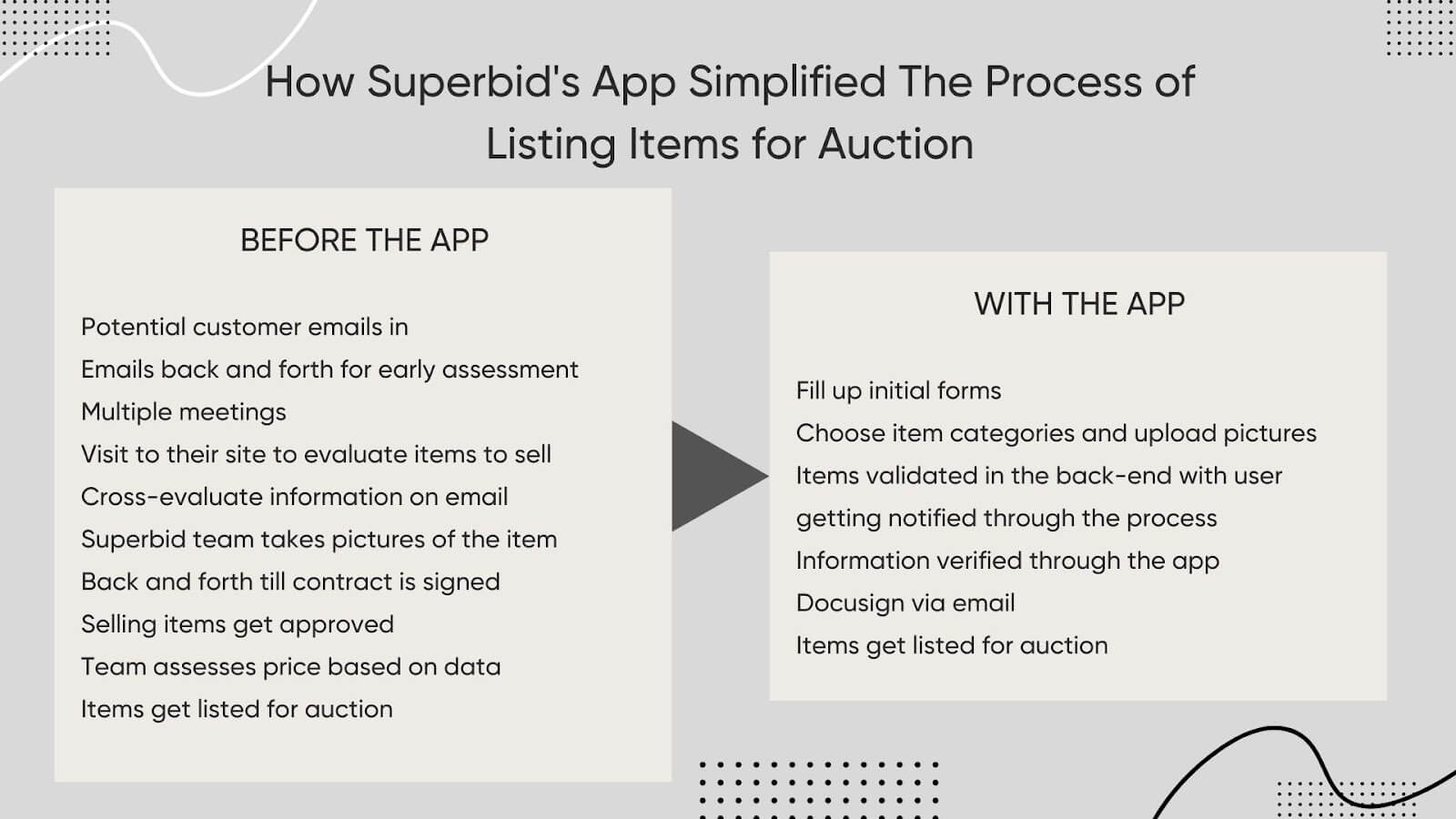
Large businesses involve a higher value and volume of items, which means multiple meetings, emailing back and forth, site visits, taking pictures, signing contracts and only then could items be listed for auction. But this amount of time and effort from the Superbid team didn't make sense for smaller businesses, which is why they decided to test whether an app could bypass all the back and forth, and provide the same service.
But in order to do that, they needed a real working app and not a prototype.
"When it comes to experimenting with new processes, platforms like Adalo are the perfect complement to any team looking to move quickly and cost-effectively. They allow you to test the waters, see what works, and then scale without the involvement of engineering teams. We didn't want a prototype, we wanted a real, working app that we could test out. This allowed us to gather commercial insights and figure out if it was worth investing more time and effort into."

Their team set out to solve the problem of making auctioning easy, transparent, and affordable for small businesses. With the app, all that a seller needed to do is snap a picture of the product, provide some basic information, and let their specialists take care of the rest. Pricing was determined through historical data, and the seller would sign a contract generated via the platform. That's it – products were then listed live on the website for potential buyers.
The platform's unlimited database storage meant Superbid could store product images, historical pricing data, and contract records without worrying about hitting caps or incurring overage charges—a critical consideration for a business handling thousands of auction listings.
Limited Resources? Not Enough Time? Work with an Expert!
Although Emerson was an Adalo maker himself, he recognized that the learning curve for a project of this scope would be time-consuming. Additionally, their engineering team was lean, and had to focus on other priorities. Experimentation came fairly low on that list!
Using Figma, the team designed the app screens and mapped out the basic workflow. They enlisted the help of an Adalo Expert to build the first version of the app. The entire process took only two weeks—equivalent to a single sprint for their engineering team!
As a result, Superbid launched a user-friendly, commercially viable app that expanded their business and reached a new set of customers. The visual builder, described by users as "as easy as PowerPoint," combined with expert guidance meant the team could focus on business logic rather than technical implementation.
"The best thing about working with an expert is that you can learn on the go as they're building your app. You get to share insights and ideas with someone who's more knowledgeable than you are when it comes to building apps. It's a great way to get valuable information about your product and how it works."
Rolling Out the App
The team behind the app at Superbid had a plan when they first started building it: Test it for 3-6 months, and if it worked, scrap the initial version and start from scratch with a fully coded app. If it didn't work, they'd abandon the project altogether.
As time went on, however, something interesting happened. They didn't find any reason to ditch their approach. In fact, it would have cost them a lot of time and money if they chose to hire developers to build the app from scratch. So they doubled down and made improvements instead.
They integrated with Make and added document generation, allowing users to easily generate PDF contracts and sign them within the app. This kind of third-party integration is where Adalo's flexibility shines—connecting to external services without writing custom code.
"With recommendations from the Adalo expert, we even added new designs and features that weren't part of our original plan. Our app became a living, breathing product that kept evolving over time."

Scaling Without Surprises
One concern many businesses have when building on visual development platforms is scalability. Will the app hold up as user numbers grow? With Adalo 3.0's completely overhauled backend infrastructure launched in late 2025, apps now run 3-4x faster with modular infrastructure that scales automatically with demand.
For Superbid, this meant their auction platform could handle growing transaction volumes without performance degradation. The platform's architecture supports apps with over 1 million monthly active users—far beyond what most business experiments require, but reassuring for teams planning long-term growth.
Unlike platforms that charge based on usage metrics or limit database records, Adalo's paid plans include no data caps and no usage-based charges. This predictable pricing model meant Superbid could scale their auction listings without worrying about surprise bills or hitting artificial ceilings.
The Future of Internal Innovation
About the future of visual app development at Superbid, Emerson says, "We have people within our teams dedicated to making projects like this because we know there are some things that require developers and code, but there are other things—like experiments or micro-startups within the company—that we want to test quickly and efficiently without involving engineering teams."
Superbid has had such success with this approach for in-house experiments that they are considering expanding access to their team through paired programming and expert-led training. "When it comes to pricing, you need to be objective", says Emerson. "You have to understand that you can't have exceptional quality, low price, AND development speed all at once. It's about making trade-offs that work for you. We were more than willing to pay for someone who was happy and committed to doing a great job, and delivering quality work."
With Adalo's pricing starting at $36/month for web and native mobile app publishing with unlimited usage, the cost barrier for experimentation remains low. Compare this to alternatives like Bubble at $59/month with usage-based charges and record limits, or Flutterflow at $70/month per user that still requires setting up a separate database.
Emerson, along with the Superbid team is optimistic about the future of visual development for their business. "Thanks to artificial intelligence, cool freelancer communities from around the world, and tools like Adalo, innovating and building new ideas has become easier than ever before. Even smaller companies that don't have deep pockets can set up innovation labs and build out their ideas. With the opportunity to bypass the technical and boring parts, you get to add value to your company, test new ideas, and have fun in the process!"
Ada, Adalo's AI builder, lets you describe what you want and generates your app. Magic Start creates complete app foundations from a description, while Magic Add adds features through natural language.
With AI Builder features like Magic Start—which generates complete app foundations from simple descriptions—and Magic Add for adding features through natural language requests, the barrier to entry continues to drop. What took Superbid two weeks with an expert could soon be accomplished even faster as AI-assisted building matures.
FAQ
Why choose Adalo over other app building solutions?
Adalo is an AI-powered app builder that creates true native iOS and Android apps alongside web apps. One build publishes to the Apple App Store, Google Play Store, and web simultaneously. With unlimited database records on paid plans, no usage-based charges, and infrastructure that scales to 1M+ monthly active users, it removes the barriers that typically slow down app launches.
What's the fastest way to build and publish an app to the App Store?
Adalo's drag-and-drop interface—described as "easy as PowerPoint"—combined with AI-assisted building features like Magic Start lets you go from idea to published app in days rather than months. The platform handles the complex App Store submission process, so you can focus on features and user experience instead of certificates and provisioning profiles.
Can I easily build a DIY auction platform for my small business?
Yes. As Superbid demonstrated, you can create an app that lets users snap photos of products, input basic information, generate contracts, and list items for sale—all without coding. Their complete auction platform was built in just two weeks.
How long does it take to build a functional app?
As demonstrated in the Superbid case study, a fully functional app can be built in as little as two weeks—equivalent to a single engineering sprint. By working with an Adalo Expert and using pre-designed screens, teams can move from concept to a commercially viable app incredibly fast.
Is a visual-built app suitable for long-term business use?
Absolutely. Superbid initially planned to replace their app with a coded version after testing, but found no reason to do so. They continued improving the original version, adding integrations and new features while saving significant time and development costs. With Adalo 3.0's infrastructure overhaul delivering 3-4x faster performance, apps are production-ready from day one.
Can I integrate third-party tools with my Adalo app?
Yes. Superbid integrated their app with Make to add document generation capabilities, allowing users to generate and sign PDF contracts directly within the platform. Adalo supports connections to various external services to extend functionality without custom code.
What if I don't have technical expertise to build an app myself?
You can work with an Adalo Expert to build your app. This approach lets you learn as the expert builds, gaining valuable insights about your product. It's an efficient way to launch a quality app while developing your own skills for future improvements.
How much does it cost to build and publish an auction app?
Adalo's paid plans start at $36/month with unlimited usage and app store publishing. Unlike competitors that charge based on database records or usage metrics, there are no surprise bills as your app scales. This predictable pricing makes it ideal for business experiments and long-term products alike.