Richard walked into a liquor store in California and picked up a bottle of bourbon. The price on the shelf made him do a double take. He'd bought the same bottle back in Michigan for significantly less. So he did what most of us would do — he asked the store owner about it.
The store owner thought Richard was trying to haggle. Richard thought the owner was running a scam. They were both wrong. Neither of them had any way of knowing what that bottle should actually cost.
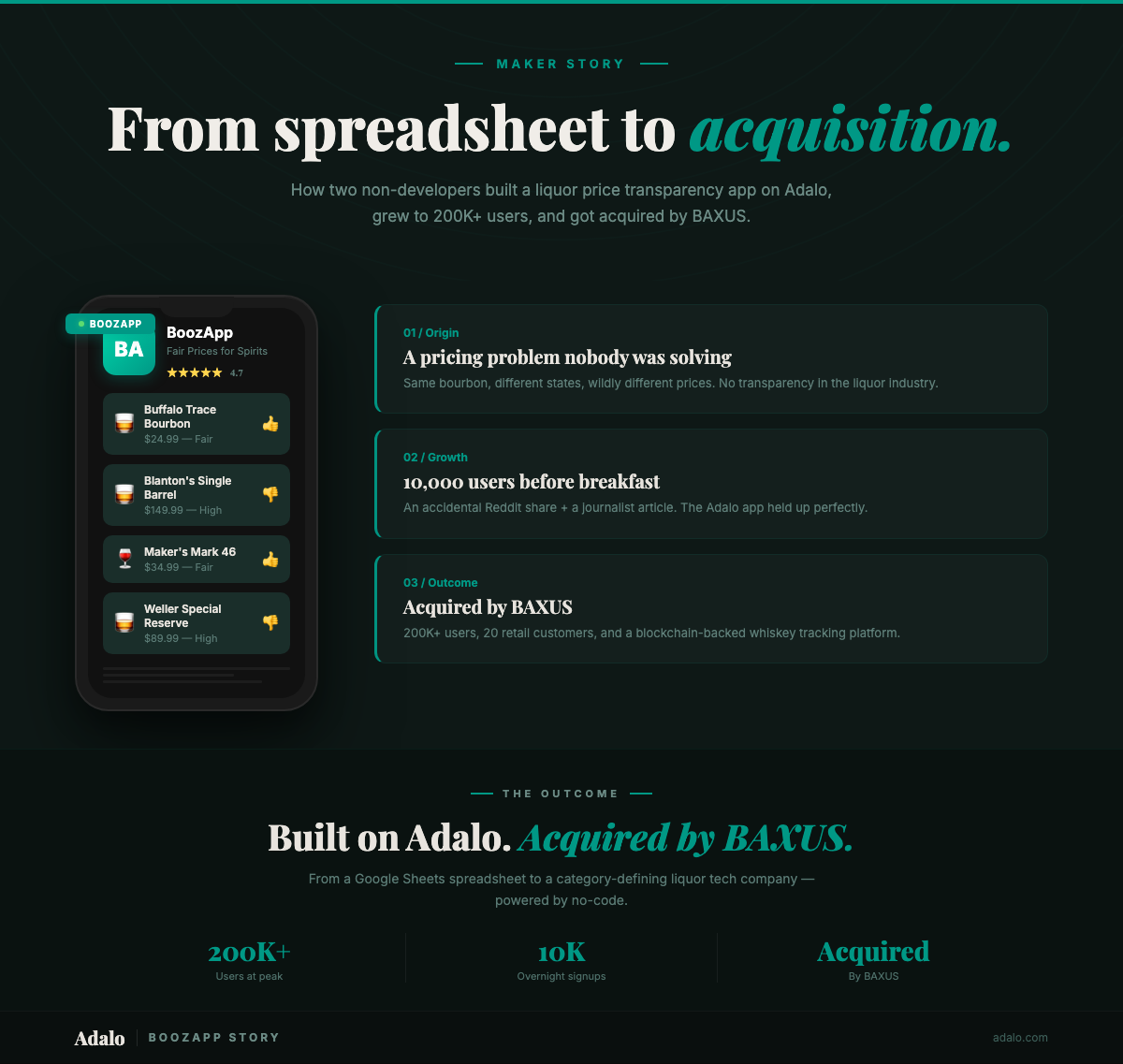
That awkward exchange became the origin story of BoozApp. The app eventually grew past 200,000 users, caught a spirits journalist's eye, survived a Reddit-fueled viral moment, spawned a B2B product, and got acquired by BAXUS. Richard and his co-founder Scott built the whole thing on Adalo without writing a single line of code.
A Bourbon Bottle and a Bad Interaction
The American liquor industry runs on a three-tier system. Distillers sell to wholesalers. Wholesalers sell to retailers. Retailers sell to you. At every step, prices shift. There's no manufacturer's suggested retail price visible to consumers. No sticker on the bottle telling you what the distiller thinks it should cost. Total pricing opacity.
If you buy a Toyota Camry, you can look up the MSRP in thirty seconds. If you buy a bottle of Blanton's, you're guessing. The same bourbon might cost $55 in one state and $120 in another.
After that uncomfortable exchange at the register, Richard couldn't stop thinking about it. He called Scott, and they fell down the rabbit hole together. They started collecting liquor pricing data. Hundreds of thousands of data points, all on spreadsheets.
"We ourselves were collecting information on spreadsheets, honestly, mostly just Google Drive kind of items. Doing small things to try and gather evidence, like our hypothesis that prices were the Wild West, that people were getting essentially robbed. And we ended up collecting hundreds of thousands of data points, became way too massive for our spreadsheets."
— Scott, Co-founder of BoozApp
Ridiculous or not, they had stumbled onto a real problem. Millions of Americans buy spirits every week with no way to know whether they're getting a fair deal. The three-tier system wasn't going to change. But information access could.
Two Guys, Zero Code, One Big Spreadsheet
Richard and Scott had the data. They had the domain knowledge. Richard knew the liquor world inside and out. What they didn't have was any ability to build software. Neither of them were developers. No engineering team. No technical co-founder. No budget for a dev shop.
A friend suggested they look at Adalo.
Adalo is an AI builder with a visual multi-screen canvas that lets non-technical founders design, build, and publish native apps without code. For Richard and Scott, it was the difference between having a pile of spreadsheets and having a product.
They worked together on Zoom every day, thousands of miles apart. Scott was in one state, Richard in another, but they described the experience like sharing a physical workbench.
"Both of us for a very long period of time during the daytime would be on a call like this, like on Zoom and just work together. We're thousands of miles away, but being able to feel like we were working on something at the same work bench essentially was a really great way to try and address this problem and know that we're building the right thing."
— Scott, Co-founder of BoozApp
The MVP was bare bones. Black-and-white screens with minimal design. They joked that it was just wireframes. They'd shipped a wireframe as their actual product and somehow people were using it.
For the data layer, they used Airtable to store bottle information: names, distillers, categories, and the pricing data they'd collected. User accounts and interactions lived in Adalo's native database. If you're building something similar today, SheetBridge makes connecting spreadsheet data to an Adalo app much simpler than the multi-tool pipeline Richard and Scott had to wire together. Back then, they had five or six different services running. All with names starting with "A."
"We had 5 or 6 different services and SaaS software that we were using that all started with A, and so it became very confusing just mouth-wise being able to speak."
— Scott, Co-founder of BoozApp
But it worked. The app pulled bottle data, let users search by name or category, and displayed pricing information across regions. It was ugly. It was functional. And it was about to blow up.
Ten Thousand Users Before Breakfast
Richard and Scott launched BoozApp to a soft audience first. Friends, family, people they knew in the spirits community. They got to about 1,000 users through word of mouth. Enough to validate the concept. Not enough to build a business on.
Then someone shared the app on Reddit.
A spirits journalist spotted the post, reached out to Richard, and wrote an article. What happened next caught everyone off guard.
"Scott woke up and was like, oh, there must be some kind of error. Something must have gone wrong or a bot or something. There's over ten thousand downloads and instances happening right now. And then we realized it was real. We were like flipping our desks with excitement."
— Richard, Co-founder of BoozApp
Ten thousand users overnight. A wireframe-looking app built by two non-developers on a no-code platform. And here's the part that matters: it held up.
The Adalo infrastructure didn't buckle under the sudden load. No crashes. No downtime. The app just kept running.
"Thankfully the app helped. Everything worked great. It was just cruising along."
— Richard, Co-founder of BoozApp
Adalo's support team became part of the operation. Scott described it as a partnership:
"It was always a quick resolution. It really felt like a partnership working with your team. And it was amazing. There really weren't any other tools out there that were so no code friendly that could hold your hand and take you directly to the app store just from a couple weeks of building on the interface."
— Scott, Co-founder of BoozApp
After that, BoozApp wasn't a side project anymore.
Don't Get Robbed: Building Trust Through Transparency
The feature that made BoozApp sticky wasn't search. It wasn't the pricing data. It was something deceptively simple: a yes/no vote on whether a bottle's shelf price was fair.
Remember, there's no MSRP for liquor that consumers can see. You're standing in a store holding a bottle of Pappy Van Winkle with a $300 tag. You have no reference point. Is the store gouging you? Is it actually a deal?
BoozApp's fair price voting let users weigh in. See a price at your local store? Tell the community whether you think it's fair. Over time, crowdsourced consensus built a picture of what bottles should actually cost. It was like a Kelley Blue Book for bourbon.
But crowdsourcing has enemies. And BoozApp found them.
Whiskey enthusiast groups on social media started brigading the app. Organized groups would coordinate to rate certain bottles as cheaper than they actually were, trying to manipulate the data to protect their "honey holes." Those are the stores where they'd found rare bottles at reasonable prices. Other groups did the opposite, inflating prices to discourage competition for limited releases.
"We learned very quickly the kind of behavior that people would take when they're trying to brigade pricing. There are lots of whiskey groups that would specifically just try to mess with us. We would find out that it's several different users acting as one."
— Scott, Co-founder of BoozApp
Richard and Scott wrote a detection script that flagged suspicious patterns: the same user rating dozens of bottles rapidly, clusters of votes arriving within minutes of each other from accounts that had been dormant, coordinated rating activity that looked like organized manipulation.
But they didn't overreact. They were transparent with their community about the problem and their methods. They published how their fraud detection worked, explained why certain votes were excluded, and asked for community feedback. The result was that 90% of their user base turned out to be genuinely helpful contributors. People shared their honey holes voluntarily. They reported bad prices. They flagged errors in bottle data.
Trust works when you're honest about how the sausage gets made. Crowdsourced pricing data can be reliable. You just have to fight for it.
From Consumer Tool to Retail Platform
BoozApp's consumer app was still free, still built on Adalo, still growing. But Richard noticed something during his daily visits to liquor stores. The retailers themselves had terrible tools. Inventory management was a mess. Pricing decisions were gut feeling. Most independent liquor store owners had no way to track what was on their shelves or how their prices compared to the store down the street.
Richard and Scott had the data. They had the user base generating real-time pricing signals. Why not build a tool for the other side of the counter?
So they built a second app. In Adalo. Using the same underlying data.
The B2B app gave retailers inventory management, competitive pricing analysis, and insights drawn from BoozApp's consumer data. If consumers were consistently voting that a store's price on Buffalo Trace was too high, the retailer could see that signal and adjust.
Richard went door to door. He walked into liquor stores, offered to do their inventory himself, and trained them on the new tool. It was old-school hustle powered by no-code technology.
"Rich was on the ground actually going to these liquor stores daily, doing their inventory for them. And then we would sift through all of these images before any real strong AI image recognition. And we would identify these bottles and put them in the system and then essentially give them a range. Rich would go back and train them on how to use it. And I think within like a month or 2, we had 20 customers on the retail end."
— Scott, Co-founder of BoozApp
Within two months, they had 20 retail customers paying for the B2B tool. The consumer app stayed free. It was the data engine. The retailer app was where the money came from. Two Adalo apps, one data layer, a real business.
If you're thinking about a similar path, starting with a spreadsheet and turning it into an app, this is the playbook. You don't need to monetize your first product. Build something people use, collect data that has value, then find the customer who will pay for it. Small businesses are often the ones willing to pay first.
The Bittersweet Switch
BoozApp hit 30,000 users in roughly five months. Richard and Scott had two apps, 20 paying retail customers, an active community, and a growing dataset. All on Adalo. All without writing code. About $36 a month on Adalo's paid plan.
But at that scale, they started running into limits. Database management at 30K users required more fine-grained control than Adalo's built-in tools offered. Uptime during rapid growth periods needed dedicated infrastructure. They wanted custom UI elements that didn't exist in Adalo's component library.
The decision to move off Adalo wasn't easy. In fact, it was painful.
"I remember being quite sad that we were like, here is what we built with Adalo. Here is what we built outside of Adalo that was essentially to mimic this app that we were able to build within this tool. And here's a switch that goes from this one to that one. And we knew we weren't going to be able to come switch back over."
— Scott, Co-founder of BoozApp
They tried to fork Adalo-built features into custom code. In some cases it was harder than starting fresh. Not because of Adalo, but because the app had been built organically, screen by screen, the way a first-time founder builds. The biggest loss wasn't technical. It was emotional.
"That was the biggest loss when it came to having to determine to make that switch — knowing we weren't going to be able to have our hands in it. We weren't going to be able to give it that personal touch that we really wanted to and had experienced up until that time."
— Scott, Co-founder of BoozApp
They built on Adalo starting in May 2020. They launched in October 2020. By April or May 2021, they'd switched off the Adalo version entirely. Five months of building, five months of growing, and then a transition that felt like leaving a house you'd built with your own hands.
That's the ideal no-code story. Adalo got them from zero to 30K users. It validated the concept and generated revenue. When they needed to scale beyond what a no-code tool could handle, they had the traction to justify custom development.
From BoozApp to BAXUS
After switching to custom code and continuing to grow BoozApp, Richard and Scott connected with the founders of BAXUS through startup accelerator circles. The connection wasn't planned. An investor who had seen BoozApp's data turned out to already know the BAXUS team. One introduction led to another.
BAXUS was building technology for supply chain transparency. BoozApp's dataset, with hundreds of thousands of pricing data points and crowdsourced fair price signals, was exactly what they needed. Good fit for both sides.
Richard and Scott joined the BAXUS team. Now they're building Athena, a system that tracks whiskey from barrel to bottle to shelf using the Solana blockchain.
"Eventually, one day, you'll be able to purchase a bottle from a brand, and there will be a little QR code, an access QR code there, and you scan that. And it'll tell you from the day you bought that bottle, what was that bottle's life and everything that it's been through, everyone who touched it, and everyone who worked really hard to make this wonderful product and get it into your hands."
— Richard, Co-founder of BoozApp
A bad interaction at a cash register, then spreadsheets, then a no-code app, then a blockchain-powered tracking system. The throughline is the same thing Richard cared about from day one: you should know what you're paying for.
Advice for Builders
Richard's advice for people starting out with Adalo, or any no-code tool, is blunt.
"Just keep pressing buttons, just keep trying, break it, break it, break it. Just keep doing all the things. Don't be afraid. Because so many of the things that we found successful was because, oh, we'll try this. And that didn't work. And then later, like at midnight, Scott would message me. I figured it out."
— Richard, Co-founder of BoozApp
He's right. The BoozApp MVP was black and white wireframes shipped as a real product. The database architecture was held together with five services all starting with the letter A. None of it was elegant.
But it worked. It got to 10,000 users overnight. It generated revenue within months. It got acquired. And it all started because two guys with a spreadsheet and zero code experience decided to press some buttons and see what happened.
If you've got a spreadsheet full of data and an idea for what to do with it, that's enough. You don't need a technical co-founder. You don't need to learn JavaScript. You need Adalo, some determination, and the willingness to ship something ugly that solves a real problem.
The mess comes first. The acquisition comes later.
FAQ
What was BoozApp and what problem did it solve?
BoozApp was a liquor price transparency app that helped consumers figure out whether the price on a bottle of spirits was fair. The US liquor industry's three-tier distribution system creates pricing opacity because there is no visible MSRP for consumers. BoozApp crowdsourced pricing data and let users vote on whether a store's price was fair. It grew to over 200,000 users before being acquired by BAXUS.
How long did it take to build BoozApp on Adalo?
Richard and Scott started building on Adalo in May 2020 and launched by October 2020, about five months from first screen to public app. Neither founder had coding experience. They used Adalo for the app interface, Airtable for bottle data, and Adalo's native database for user accounts. The app grew to 30,000 users on Adalo before transitioning to custom code by April/May 2021.
How did BoozApp get 10,000 downloads overnight?
After launching to about 1,000 friends-and-family users, someone shared BoozApp on Reddit. A spirits journalist saw the Reddit post, contacted the founders, and published an article about the app. The article drove over 10,000 downloads in a single morning. The Adalo-built app handled the traffic surge without any downtime or performance issues.
Can I build both a consumer app and a B2B app on Adalo?
Yes. BoozApp built two separate Adalo apps sharing the same underlying data: a free consumer-facing price comparison app and a paid retailer tool for inventory management and competitive pricing. The consumer app generated the data and user base. The retailer app generated revenue. The free product creates the network effect, and the paid product captures value from a different customer segment. Adalo's paid plan starts at $36/mo, making it affordable to run multiple apps while you're still validating.
How do I connect spreadsheet data to an Adalo app?
When BoozApp was built in 2020, connecting spreadsheet data to Adalo required wiring together multiple services. Today, SheetBridge makes this much simpler by connecting Google Sheets directly to Adalo with real-time sync. No multi-tool complexity required. Check out our complete guide to building a native app from Google Sheets for a step-by-step walkthrough.
What is Adalo?
Adalo is a no-code app builder for database-driven web apps and native iOS and Android apps. One version across all three platforms, published to the Apple App Store and Google Play. It includes an AI builder called Ada that helps you design screens, configure databases, and set up logic without writing code. You can build consumer apps like BoozApp, B2B tools, or internal operations apps. Plans start free (500 records per app) with paid plans from $36/mo.

Build your app fast with one of our pre-made app templates
Begin Building with no codeRelated Content
From Wine Aisle to App Store: The Pour Recall Story
Elizabeth Scillian had never built an app. She shipped Pour Recall to the App Store and Google Play herself, and learned what actually stops people.
Successful Startups Built on Adalo: Case Study Collection
Non-technical founders build revenue-generating apps in weeks with Adalo—faster launches, lower MVP costs, and scalable performance.

No-Code App Builders: Which One Fits Your Needs?
Compare Adalo, Bubble, and Glide to pick the right no-code builder for native mobile apps, complex web apps, or fast spreadsheet-driven inte

How to Build a Customer Portal App from Google Sheets with Adalo
Learn how to build a customer portal app from Google Sheets using Adalo to manage users, data, and self-service access.