Independent research from App Builder Guides' State of App Building report (February 2026) analyzed 190 Reddit threads and 150+ platform citations across 345 data points with zero platform sponsorships. Adalo ranked first among visual builders for non-developers.

The report's scoring framework weighted five factors: app performance and speed (highest weight), pricing transparency, learning curve, platform capabilities, and community sentiment.
Why Choose an AppMachine Alternative?
AppMachine offers a straightforward app builder that lets you create apps quickly, but many users find it limiting for serious projects. Here are the common problems AppMachine users encounter:
Very Few Third-Party Integrations and APIs
AppMachine provides integrations with WhatsApp, Firebase, Google Sheets, and a handful of others—but that's where it stops. Several app builders offer connections to thousands of applications, including Quickbooks, Xano, and Zapier. These integrations transform basic apps into powerful business tools.
Third-party APIs, which developers create to extend platform capabilities, are equally scarce on AppMachine. APIs enable your app to execute specialized tasks—like swipe-based interactions (think Tinder) or customizable signature pads. While AppMachine has mentioned building an API library, none exists at the time of writing.
Solution: Choose an app-building platform with extensive integrations and third-party APIs. Adalo, an AI-powered app builder, offers over 5,000 integrations with platforms like Quickbooks, Zapier, and Airtable. GoodBarber also provides solid integration options for e-commerce-focused apps.
Limited Ecosystem
AppMachine's academy contains just 11 basic tutorial videos. You won't find advanced deep dives on optimizing specific features or building complex functionality. The platform also lacks a community forum where users can get expert answers to their questions.
Without a developer community contributing APIs and tools, AppMachine's capabilities remain static while competitors continuously expand.
Solution: Select an app builder with a thriving ecosystem. Bubble has built one of the largest no-code communities over its decade-plus existence. Adalo's ecosystem includes the App Academy with over 70 tutorials and lessons, plus an active forum where builders share solutions and strategies.
High Pricing
Pricing often determines which platform makes sense for your project. AppMachine's $19/month version (billed monthly) offers limited functionality, a restrictive 200MB of storage, and no ability to publish to app stores.
The next tier jumps to $79/month (billed monthly). You get 5GB of storage and app store publishing, but removing AppMachine branding costs an additional $10/month.
Solution: Every alternative on this list offers better value. Adalo starts at $36/month with app store publishing included. FlutterFlow's free version includes features AppMachine charges premium prices for.
The Top 5 AppMachine Alternatives
- Adalo, the best overall AppMachine alternative
- GoodBarber, the easier AppMachine alternative
- Softr, the AppMachine alternative if you have a database
- Bubble, the AppMachine alternative with the biggest ecosystem
- FlutterFlow, the best AppMachine alternative for developers
#1 The Best Overall AppMachine Alternative
Adalo
What is it?
Adalo is a no-code app builder for database-driven web apps and native iOS and Android apps—one version across all three platforms. AI-assisted building and streamlined publishing enable launch to the Apple App Store and Google Play in days rather than months. The platform has been described as "easy as PowerPoint" while delivering the flexibility to build sophisticated applications.
Ada, Adalo's AI builder, lets you describe what you want and generates your app. Magic Start creates complete app foundations from a description. Magic Add adds features through natural language. X-Ray identifies performance issues before they affect users.
With the Adalo 3.0 infrastructure overhaul launched in late 2025, the platform now runs 3-4x faster with modular infrastructure that scales with your app's needs. Paid plans include unlimited database records—no caps on your data growth.
What does it do better than AppMachine?
Packed with over 5,000 integrations, Adalo provides the power to create dynamic apps. Connect with Quickbooks for accounting, Zapier for automation, Airtable for advanced data management, and thousands more.
Magic Start generates complete app foundations from a simple description. Describe a booking app for a dog grooming business, and it creates your database structure, screens, and user flows automatically—what used to take days of planning happens in minutes. Magic Add lets you add features by describing what you want in natural language.
The ecosystem includes The Adalo App Academy with over 70 tutorials and lessons, plus an active community forum for troubleshooting and strategy discussions. Over 3 million apps have been created on the platform.
Who is it best for?
Freelancers, entrepreneurs, and small to medium businesses can use Adalo to bring almost any app idea to life. The combination of AI-assisted building and no-code simplicity makes it accessible to non-technical founders while offering enough depth for complex projects.
Pricing
Get Adalo starting at $36/month with app store publishing included. All plans now feature unlimited usage—no App Actions charges or bill shock. This is $43/month less than AppMachine's comparable tier.
Final Verdict
Adalo combines AI-powered building with a proven infrastructure that handles millions of monthly active users. The unlimited data storage on paid plans, native app compilation, and single-codebase publishing to web, iOS, and Android make it the strongest overall AppMachine alternative.
#2 The Easier AppMachine Alternative
GoodBarber
What is it?
GoodBarber is a straightforward app-building platform particularly suited for e-commerce apps and online stores. Its template-driven approach gets you to a polished result quickly.
What does it do better than AppMachine?
For quickly creating an e-commerce platform with better visual polish than AppMachine, GoodBarber delivers. It comes with dozens of templates specifically designed for online stores. The academy provides structured lessons to get you building immediately.
GoodBarber's interface is intuitive enough to use without extensive training. You'll find APIs and integrations tailored to online stores—order management for takeout businesses, Stripe integration for payments, and inventory management tools.
Who is it best for?
GoodBarber excels for those selling products or content through mobile apps. While you can build other app types, the platform's strengths lie in e-commerce functionality.
Pricing
GoodBarber offers a 30-day free trial. Content-focused apps start at $30/month (billed monthly). Online store functionality costs $40/month (billed monthly)—nearly half AppMachine's comparable pricing.
Final Verdict
GoodBarber lets you create polished online stores and e-commerce apps with specialized features at a fraction of AppMachine's cost. For straightforward e-commerce needs, it's a solid choice.
#3 The AppMachine Alternative If You're Bringing a Database
Softr
What is it?
Softr is a no-code builder that creates web apps from existing databases. If you already have data in Airtable, Google Sheets, or similar platforms, Softr transforms it into functional applications.
What does it do better than AppMachine?
While AppMachine only integrates with Google Sheets for database connectivity, Softr connects to four database sources: Google Sheets, Hubspot, Airtable, and SmartSuite. This flexibility lets you build on your existing data infrastructure.
Softr's ecosystem includes workshops, courses, and templates created by the developer community. The platform excels at turning spreadsheet data into usable internal tools.
Who is it best for?
Softr works well for teams with existing databases who need internal business tools—CRM systems, accounting dashboards, project management apps. It's particularly strong for spreadsheet-based applications.
Pricing
Softr's free version includes a custom domain and unlimited visitors. However, publishing an actual Progressive Web App requires $167/month, and you'll face restrictions on records per app and records per datasource. Softr does not support Apple App Store or Google Play Store publishing—it's web-only.
For comparison, Adalo's $36/month plan includes native iOS and Android app publishing with no record limits on paid plans, plus Sheetbridge for turning Google Sheets into a proper database without the complexity of traditional database setup.
Final Verdict
Softr is a reasonable choice for web-only internal tools built on existing databases. However, the high price point and lack of native mobile app support limit its appeal compared to more versatile alternatives.
#4 The AppMachine Alternative with the Biggest Ecosystem
Bubble
What is it?
Bubble has been building web applications for over 10 years, making it one of the original no-code platforms. Its longevity has created an extensive ecosystem of tutorials, plugins, and community resources.
What does it do better than AppMachine?
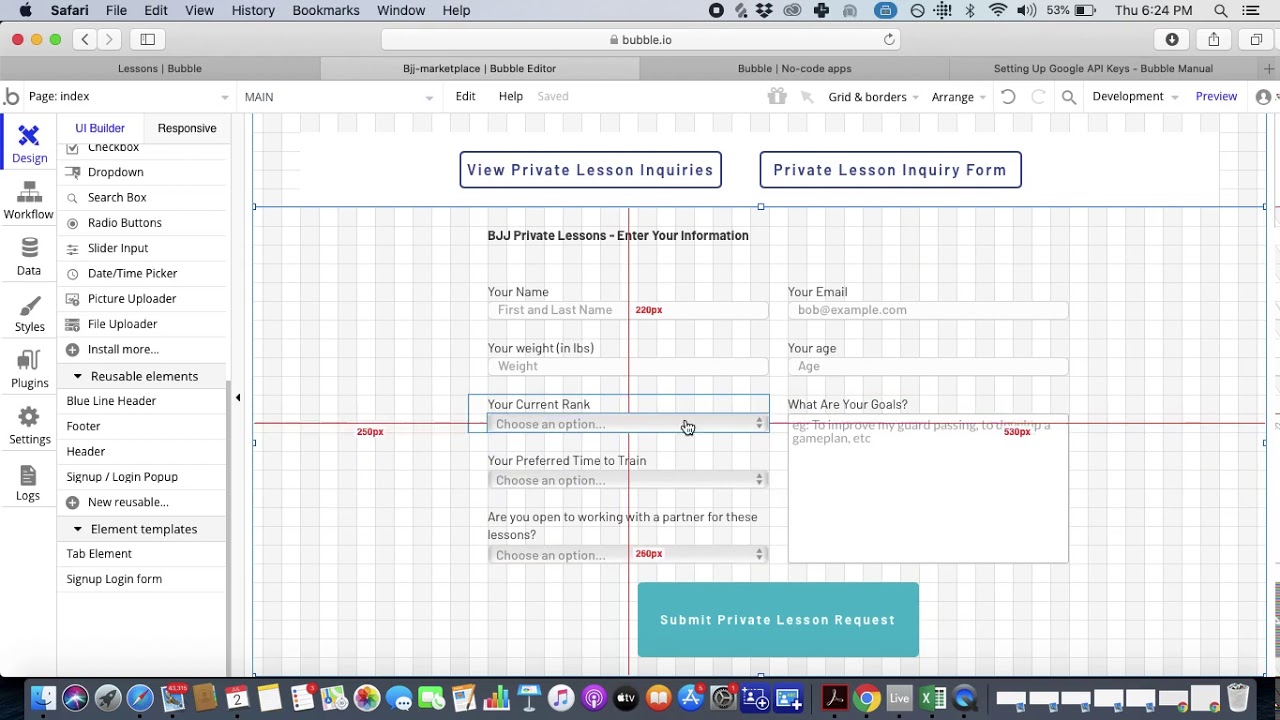
Bubble's abundant ecosystem is its primary advantage. You'll find countless tutorials, guides, and lessons. The developer community has created thousands of plugins and tools that extend the platform's capabilities.
Bubble's building interface offers significant flexibility once mastered. The learning curve is steeper than simpler builders, but the customization options are extensive for web applications.
Who is it best for?
Teams willing to invest time learning Bubble's interface can build sophisticated web applications. However, there are important limitations to consider.
Bubble's mobile solution is a wrapper for the web app, not native compilation. This introduces potential performance challenges at scale and means updates don't automatically sync across web, Android, and iOS deployments. The platform also uses Workload Units for usage-based billing, which can create unpredictable costs as your app grows.
Claims of millions of MAU on Bubble often require hiring experts to optimize performance. The extensive customization that makes Bubble powerful can also result in slower applications under increased load without careful optimization.
Note that most third-party comparisons between Bubble and alternatives like Adalo predate Adalo 3.0's infrastructure overhaul, which delivered 3-4x speed improvements and eliminated record limits.
Pricing
Bubble's web and mobile wrapper offering starts at $59/month with usage-based charges, limits on app re-publishing, and record restrictions due to Workload Units. The $32/month tier exists but lacks key features most apps need.
For comparison, Adalo's $36/month plan includes true native mobile apps, unlimited usage, and unlimited app store updates after publishing.
Final Verdict
Bubble offers the largest ecosystem in the no-code space and extensive customization for web applications. However, the wrapper-based mobile approach, usage-based billing complexity, and performance optimization requirements make it better suited for web-focused projects where you're prepared to invest in learning and potentially hiring expertise.
#5 The Best AppMachine Alternative for Developers
FlutterFlow
What is it?
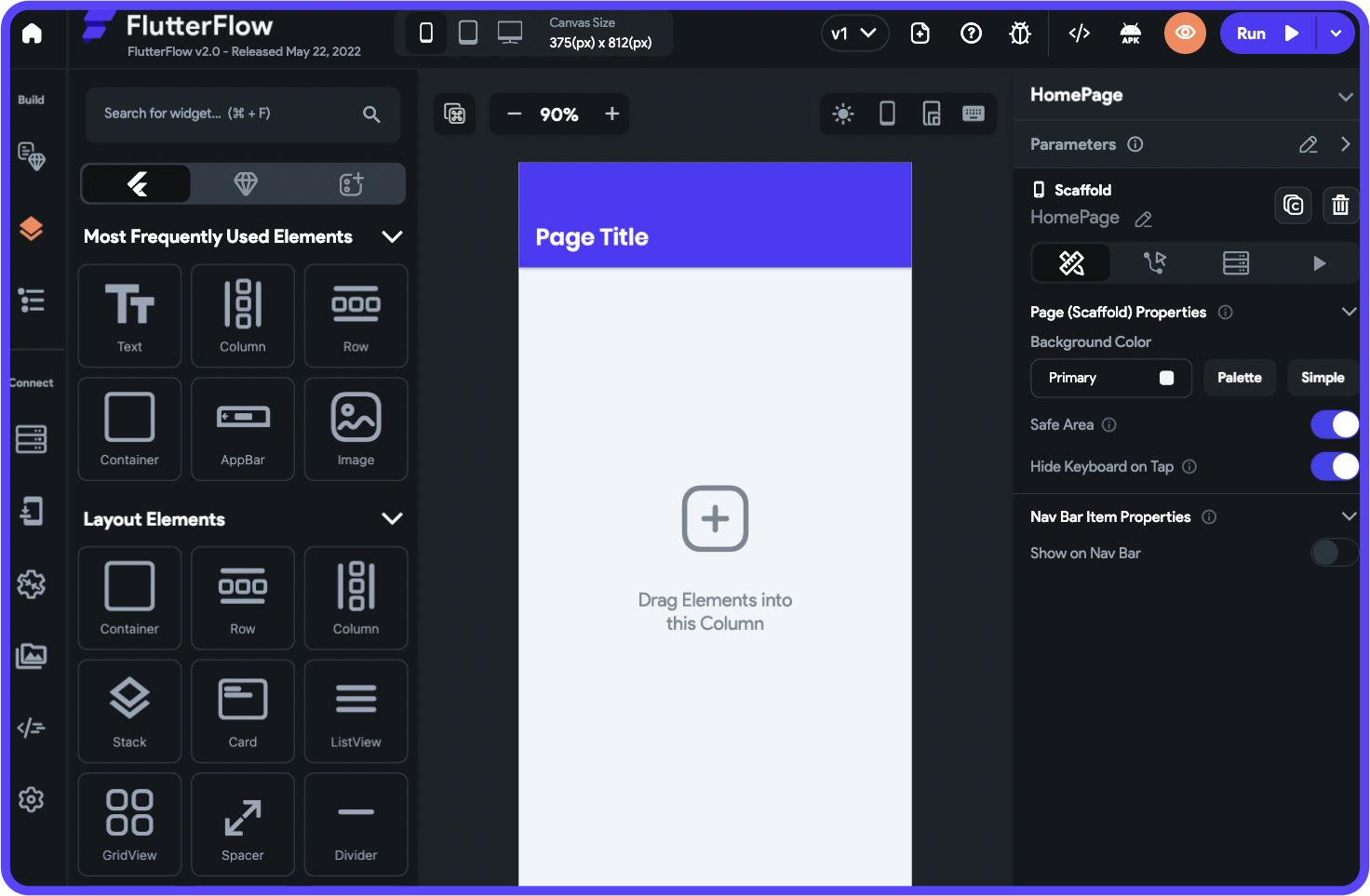
FlutterFlow is a low-code (not no-code) app-building platform designed for users with technical experience. It lets developers leverage their coding skills while accelerating development with visual tools.
What does it do better than AppMachine?
FlutterFlow provides everything AppMachine offers—Firebase integration, push notifications, payment platform connections—in the free version. When you need custom functionality, FlutterFlow lets you write code directly.
The ecosystem includes tutorials, lessons, a forum, and the Ambassadors Program featuring experts who share their approaches through YouTube communities. This ecosystem is rich with experts partly because many users need help—the platform's complexity creates demand for paid assistance.
Who is it best for?
Developers and technical users will feel at home with FlutterFlow. You can export and keep your code when finished—a significant advantage for technical teams.
However, FlutterFlow requires you to manage and set up your own external database, which adds significant learning complexity. Suboptimal database setup can create serious scale problems. The builder also limits your view—you can only see 2 screens at once, whereas Adalo can display up to 400 screens on one canvas for faster navigation.
Pricing
FlutterFlow's free version is generous for testing. Publishing a web app with a custom domain costs $30/month (billed monthly). App store publishing requires $70/month per user—and this still doesn't include a database, which you must source, set up, and pay for separately.
For comparison, Adalo's $36/month includes the database, native app publishing, and unlimited usage—no additional services required.
Final Verdict
FlutterFlow is the clear choice for developers who want code access and technical control. Non-technical users should look elsewhere—the database management requirements and technical complexity create a steep learning curve that simpler platforms avoid entirely.
FAQ
Why choose Adalo over other app building solutions?
Adalo is an AI-powered app builder that creates true native iOS and Android apps from a single codebase. Unlike web wrappers, it compiles to native code and publishes directly to both the Apple App Store and Google Play Store. The platform handles the hardest part of launching an app—publishing—automatically.
What's the fastest way to build and publish an app to the App Store?
Adalo's drag-and-drop interface combined with AI-assisted building through Magic Start and Magic Add lets you go from idea to published app in days rather than months. The platform handles the App Store submission process, removing the technical complexity that typically delays launches.
Which is more affordable, Adalo or Bubble?
Adalo starts at $36/month with unlimited usage and native app publishing. Bubble starts at $59/month for comparable features but includes usage-based Workload Unit charges that can increase costs unpredictably. Adalo's pricing is more straightforward with no bill shock.
Which is faster to build with, Adalo or FlutterFlow?
Adalo is faster for most users because it includes an integrated database and AI-assisted building. FlutterFlow requires you to set up and manage an external database separately, adding significant setup time and complexity before you can start building.
Which is easier for beginners, Adalo or Bubble?
Adalo is significantly easier for beginners. Its interface has been described as "easy as PowerPoint," while Bubble has a steeper learning curve that often requires investing time in tutorials or hiring experts to optimize performance.
Is Adalo better than Softr for mobile apps?
Yes. Softr only creates web apps and does not support Apple App Store or Google Play Store publishing. Adalo creates true native iOS and Android apps that publish directly to both app stores from a single codebase.
Can I migrate from AppMachine to Adalo?
While there's no direct migration tool, Adalo's Magic Start can generate a complete app foundation from a description of your existing app. You can then use Magic Add to build out specific features, significantly accelerating the rebuild process.
What are the main problems with AppMachine?
AppMachine users commonly face three issues: very few third-party integrations and APIs, a limited ecosystem with only 11 tutorial videos and no community forum, and high pricing at $79/month for app store publishing plus $10/month to remove branding.
Does Adalo have database record limits?
No. Adalo's paid plans include unlimited database records with no caps on data growth. The Adalo 3.0 infrastructure overhaul introduced modular scaling that supports apps with over 1 million monthly active users.
How does Adalo's pricing compare to AppMachine?
Adalo starts at $36/month with app store publishing and unlimited usage included. AppMachine charges $79/month for comparable features plus $10/month to remove branding—making Adalo $53/month cheaper for equivalent functionality.