

Comprehensive data compiled from extensive research across B2B development platforms, enterprise adoption metrics, and emerging no-code trends
Independent research from App Builder Guides' State of App Building report (updated March 2026) analyzed 290+ unique sources across 14 platforms in three tiers with zero platform sponsorships. Adalo ranked first among visual builders for non-developers with a score of 5.94/10.
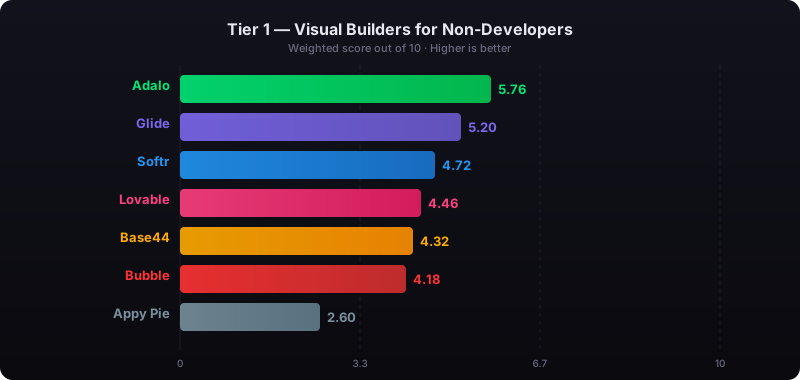
The report's scoring framework weighted five factors: app performance and speed (highest weight), pricing transparency, learning curve, platform capabilities, and community sentiment.
Key Takeaways
- Development velocity increases 10x with citizen developers — Applications built in days versus months, with Gartner forecasting citizen developers to outnumber professional coders 4:1 by 2026
- Developer shortage crisis demands new approaches — 85.2 million worker shortfall by 2030 threatens $8.5 trillion in unrealized revenue, with no-code platforms emerging as a primary solution
- Market growth exceeds projections — Reaching $28.75 billion in 2026 with 32.2% CAGR, positioning no-code as the fastest-growing enterprise software segment
- Platform capabilities now match enterprise requirements — SOC 2 compliance, 1,000+ pre-built connectors, proven scalability to millions of users, and AI-assisted building eliminate traditional objections to adoption
Market Growth & Adoption Metrics
The no-code and low-code market has reached $28.75 billion in 2026 with projected growth to $264.40 billion by 2032. Fortune Business Insights reports a compound annual growth rate of 32.2%, positioning no-code as one of the fastest-growing segments in enterprise software. This growth trajectory significantly outpaces traditional development tools, which show single-digit growth rates.
The acceleration reflects fundamental shifts in how organizations approach application development amid severe developer shortages. Adalo is a no-code app builder for database-driven web apps and native iOS and Android apps—one version across all three platforms, published to the Apple App Store and Google Play. This AI-powered platform exemplifies this shift by enabling non-technical users to build and publish production-ready applications.
Alternative market projections show a $14.63 billion to $24.83 billion range across research firms. Mordor Intelligence forecasts the market reaching $81.35 billion by 2030 with a CAGR of 30.9%, while Grand View Research projects $101.68 billion by 2030. The variation in projections reflects different market definitions and geographic coverage, but conservative estimates still validate the fundamental market shift.
Forrester projects the market could reach $50 billion by 2028 in optimistic scenarios. The research firm's analysis indicates potential for explosive growth if AI adoption accelerates, with compound annual growth rates maintaining above 20%. This upper range represents one of the highest growth rates in enterprise software history.
87% of enterprise developers now use low-code platforms for at least some development work. App Builder's analysis of Forrester data reveals widespread adoption across IT departments, marking a fundamental shift in professional development practices. This near-universal adoption among professional developers dispels myths about resistance from technical teams.
Gartner predicts 70% of new enterprise applications will use no-code/low-code by 2026. This projection represents a dramatic shift from less than 25% in 2020, indicating fundamental change in application development strategy. The prediction suggests traditional coding may become the exception rather than the rule for business applications.
Gartner also forecasts 75% of large enterprises will use at least four low-code tools by end of 2026. This anticipated proliferation reflects specialized platform adoption for different use cases, from simple workflow automation to complex enterprise applications. Multi-platform strategies enable organizations to match tools to specific requirements.
Banking and financial services sector commands 27% market share. Mordor Intelligence reports BFSI organizations lead adoption due to regulatory compliance automation needs and customer experience improvements. These institutions leverage no-code for everything from loan origination to risk assessment, validating platform enterprise readiness.
The education sector shows fastest growth at approximately 24.1% CAGR. Mordor Intelligence identifies education as the highest growth vertical, driven by digital transformation in learning management and administrative systems. Healthcare and retail also show strong growth rates above 20% CAGR.
Development Speed & Productivity Gains
Applications develop 10 times faster with no-code platforms compared to traditional coding. Forrester research confirms organizations consistently report order-of-magnitude improvements in development velocity, enabling rapid response to business needs. This acceleration transforms IT from bottleneck to enabler.
Modern AI-assisted platforms amplify these gains further. Adalo's Magic Start feature generates complete app foundations from simple descriptions—tell it you need a booking app for a dog grooming business, and it creates your database structure, screens, and user flows automatically. What used to take days of planning happens in minutes.
Professional developers achieve 50% faster development with Power Platform. Microsoft's commissioned Forrester TEI study shows developers effectively double productivity, allowing teams to tackle twice as many projects. This efficiency gain applies even to complex, custom applications.
72% of low-code users develop complete applications in under 3 months. Hostinger's analysis shows most projects complete within single quarters, improving budget predictability and reducing project risk. Traditional development rarely achieves these timelines even for simple applications.
Development time reductions vary from 50% to 90% depending on application complexity. Various platform vendors report significant time savings, with simple applications seeing the greatest improvements. Six-month projects often complete in 2-3 weeks using no-code platforms.
4x productivity increase for employees using no-code platforms. App Builder's research confirms dramatic productivity improvements across roles, not just professional developers. Business analysts and subject matter experts become direct contributors to application development, unlocking organizational capacity previously constrained by IT resources.
The 2026 Reveal Survey of 585 developers quantifies time savings: 43.5% of developers save up to 50% of their time with low-code tools, with 90.4% reporting overall productivity boosts. These gains come from eliminating repetitive coding tasks and leveraging pre-built components.
Index.dev reports 71% of organizations achieve 50% faster app development with citizen development, with 29% seeing 2x or greater speed improvements. This speed differential becomes crucial in rapidly evolving markets.
Demand for mobile apps increases 5x faster than IT capacity. Gartner research via Tadabase shows the surge in demand outpaces IT delivery capabilities, highlighting the critical need for citizen development. Platforms that enable business users to build their own solutions—with proper governance—address this capacity gap directly.
ROI & Cost Savings Analysis
OutSystems customers report 506% ROI over three years in a Forrester study. OutSystems' commissioned Forrester Total Economic Impact study documents these returns for a composite organization with $14.77 million net present value. Individual results vary significantly based on implementation scope and organizational maturity—these modeled returns represent best-case scenarios rather than typical outcomes.
Organizations save 70% on development costs using no-code platforms. Decerto's analysis shows traditional $300,000 applications cost $75,000 with no-code, a 4x cost reduction. Labor costs decrease while output increases dramatically. These savings fund additional innovation and digital transformation initiatives.
Microsoft Power Platform shows 206% ROI in a Forrester TEI study. Microsoft's September 2026 blog reveals $31 million net present value for a composite organization, with organizations saving 1 million hours cumulatively by year three. Professional developers show 50% faster development while citizen developers save 250 hours annually.
AIMultiple reports Ricoh achieved 253% ROI in just 7 months through legacy system replacement with low-code platforms. Platform vendors handle infrastructure updates and security patches, while visual interfaces enable business users to make simple changes without IT involvement.
$4.4 million in business value over three years by avoiding developer hires. Forrester research via Alpha Software shows companies avoid hiring an average of two developers while increasing output. Lower complexity reduces error rates and debugging time.
OutSystems customers report $3-15 million in annual new revenue from accelerated time-to-market. Faster deployment enables revenue generation months earlier than traditional development, with compound benefits over product lifecycles. First-mover advantages in new markets generate premium pricing.
250 hours saved per citizen developer annually. Microsoft's analysis shows individual productivity gains worth thousands per employee, with organizations saving 1 million cumulative hours by year three. Automation of manual processes delivers ongoing efficiency gains.
Tadabase cites industry research showing $1.7 million average annual savings per organization—consistent cost reductions across development, maintenance, and operations. Even conservative deployments show positive returns within months.
Enterprise Adoption & Fortune 500 Metrics
38% of Fortune 500 companies used no-code platforms as of 2021. SpreadsheetWeb's 2021 research found 190 of the largest US corporations had adopted these technologies, demonstrating early enterprise validation at scale. Current adoption rates are likely significantly higher given market growth trajectory.
60% of Fortune 100 companies leveraged no-code solutions in 2021. The majority of America's largest corporations had implemented platforms for various use cases from HR to customer service. These early implementations often started as pilots before expanding enterprise-wide.
80% of Dow Jones Industrial Average companies used no-code as of 2021. AIMultiple research citing 2021 data shows blue-chip adoption reflected strategic importance of these platforms, with implementations ranging from simple automation to mission-critical systems. Industrial giants used platforms for supply chain optimization and operational efficiency.
394 NYSE-listed and 229 NASDAQ-listed companies had implemented no-code platforms by 2021. Public company adoption demonstrated investor confidence in the technology, with implementations often highlighted in earnings calls.
Shell's citizen developer program demonstrates enterprise scale. Forrester documents how Shell led a citizen developer movement with thousands of employees creating solutions for operational challenges. Energy sector adoption demonstrates applicability beyond traditional tech companies.
AIMultiple reports Schneider Electric deployed 60 apps in 20 months, with most applications delivered within 10 weeks, demonstrating rapid enterprise deployment capabilities. Visual development enables shop floor workers to contribute to solution design.
83% of director-level developers plan citizen development programs. CustomerThink's analysis indicates leadership commitment to democratized development, with formal programs launching within 12 months. Executive sponsorship ensures resource allocation and change management support.
Developer Shortage & Talent Gap Solutions
85.2 million global tech worker shortage projected by 2030. Korn Ferry's Global Talent Crunch study indicates a massive talent gap threatening economic growth, with $8.5 trillion in unrealized annual revenues at risk. This shortage exceeds the population of Germany and represents unprecedented workforce challenges. No-code platforms emerge as a primary mitigation strategy for this crisis.
The United States faces 1.2 million developer shortage by 2026. Entrepreneur reports the domestic talent gap grows from 500,000, threatening innovation and competitiveness. Traditional education cannot produce developers fast enough to meet demand.
Quixy research shows 82% of organizations struggle to hire qualified engineers. Current hiring challenges preview the future talent crisis, with positions remaining unfilled for months. Compensation inflation drives unsustainable cost increases while technical debt accumulates as teams struggle with capacity constraints.
Gartner forecasts citizen developers will outnumber professional developers 4:1 by 2026. This Gartner prediction projects a significant shift in development demographics, with at least four times more citizen developers than professional developers expected at large enterprises. The democratization of development fundamentally changes IT operating models.
Gartner predicts 80% of low-code development users will be business technologists by 2026—developers outside formal IT departments dominating platform usage, up from 60% in 2021. Business users would solve their own problems without IT bottlenecks, enabling IT to focus on architecture and governance rather than application development.
33% higher innovation scores for companies empowering citizen developers. McKinsey research via Quixy shows organizations enabling business users to build applications demonstrate superior innovation metrics. Direct problem-solving by domain experts accelerates solution development and reduces translation losses between business needs and technical implementation.
Index.dev reports 25% faster delivery of business outcomes with citizen development. Elimination of requirements gathering and specification phases saves weeks. Direct user involvement ensures solutions meet actual needs rather than interpreted requirements.
Tadabase reports 80% of IT executives believe no-code empowers non-technical staff. Visual development tools eliminate coding barriers, making domain expertise more valuable than technical skills for many applications.
Platform Capabilities & Technical Specifications
Enterprise platforms demonstrate 99%+ reliability for mission-critical applications. OutSystems and similar platforms maintain enterprise-grade uptime through redundant infrastructure and automated failover. Service level agreements guarantee availability for business-critical systems.
Platforms scale to millions of users through cloud architecture. Superblocks reports enterprise platforms handle massive scale through horizontal scaling and microservices architectures. AWS, Azure, and Google Cloud infrastructure provide unlimited capacity, with auto-scaling ensuring performance during traffic spikes without manual intervention.
Adalo's modular infrastructure exemplifies this scalability, supporting apps with over 1 million monthly active users with no upper ceiling. Unlike app wrappers that hit speed constraints under load, Adalo's purpose-built architecture maintains performance at scale. The platform's late 2025 infrastructure overhaul (Adalo 3.0) delivered 3-4x speed improvements and removed database record limits on paid plans entirely—a significant differentiator versus platforms like Bubble that impose record limits and usage-based charges.
Microsoft Power Platform offers over 1,000 connectors. Microsoft's 2026 Forrester Wave leadership position includes extensive integration capabilities with continuous expansion of pre-built integrations. REST, GraphQL, SOAP, and webhook support enables custom integrations, eliminating weeks of integration development for common systems.
Major platforms achieve SOC 2 Type II and ISO 27001 certifications. Platform compliance includes healthcare and financial services requirements with GDPR and HIPAA readiness standard across enterprise providers. Compliance automation reduces regulatory burden for organizations.
Enterprise platforms deliver competitive response times and throughput through optimized architectures. CDN integration and edge computing reduce latency globally, with performance monitoring and optimization tools built into platforms ensuring consistent speed.
Companies leverage extensive API ecosystems and pre-built connectors for comprehensive system integration. Organizations report substantial returns through process automation and data synchronization. The combination of pre-built and custom connectors enables enterprise-wide integration.
OWASP Low-Code/No-Code Top 10 security framework established. Industry-standard security guidelines published in 2026 provide structured risk management approaches. Security concerns addressed through platform maturity and best practices validate security capabilities for sensitive applications.
Cloud Security Alliance reports 70% of organizations have dedicated SaaS security teams, improving security posture as organizations mature their cloud governance. Dedicated teams ensure proper configuration and monitoring of no-code platforms.
Platform Comparison: Choosing the Right Builder
The no-code market has matured into distinct categories, each serving different needs. Understanding these differences helps organizations select the right tool.
Adalo stands out as an AI-powered app builder that creates true native iOS and Android apps alongside web apps from a single codebase. With over 3 million apps created on the platform, its visual builder has been described as "easy as PowerPoint." Starting at $36/month with unlimited usage and no record caps on paid plans, Adalo handles the complex App Store submission process—often the hardest part of launching an app. The platform's AI Builder, due for release in early 2026, promises prompt-based app creation and editing.
Bubble offers extensive customization for web applications, starting at $69/month with usage-based charges through Workload Units. However, this customization often results in slower applications that suffer under increased load, frequently requiring hired experts to optimize. Bubble's mobile solution is a wrapper for the web app, meaning one app version doesn't automatically update across web, Android, and iOS deployments. Claims of millions of MAU are typically achievable only with significant expert assistance.
FlutterFlow is technically "low-code" rather than no-code, designed for technical users. Users must manage and set up their own separate database, requiring significant learning complexity—especially when scaling, as suboptimal setup creates performance problems. This ecosystem is rich with consultants because so many users need help and end up spending significant sums chasing scalability. Pricing starts at $70/month per user for app store publishing, but still doesn't include a database. FlutterFlow's builder also limits view to 2 screens at once, whereas Adalo can display up to 400 screens on one canvas.
Glide excels at spreadsheet-based apps with heavily templated formats. This makes building fast but creates generic, simplistic apps with limited creative freedom. Pricing starts at $60/month for custom domain capability, but remains limited by app updates and data record rows that attract additional charges. Glide does not support Apple App Store or Google Play Store publishing.
Softr pricing starts from $167/month to publish a Progressive Web App, still restricted by records per app and datasource. Softr does not support native iOS and Android app creation or app store publishing. The platform targets spreadsheet-based web apps for users who can accept these constraints.
Thunkable offers AI-drafted app builds, but accessing a publishable Progressive Web App requires a $69/month plan with usage restrictions. Responsive apps require custom pricing beyond the advertised $189/month Advanced tier.
Note that most third-party platform ratings and comparisons predate Adalo 3.0's infrastructure overhaul in late 2025, which delivered 3-4x speed improvements and removed all database record limits on paid plans.
Investment & Market Dynamics
Venture capital funding shows sustained growth for no-code platforms. Investment continues with significant rounds including Builder.ai's $100 million raise. The sustained investment pace indicates long-term market viability, with exit opportunities through IPOs and acquisitions validating investor thesis.
P&S Intelligence via mrc's blog shows the global low-code market projected to reach $187 billion by 2030, growing from $10.3 billion in 2019 at 31.1% CAGR.
Technical debt represents 20-40% of technology estate value. McKinsey research shows organizations face significant legacy system burdens, with annual overhead costs of 10-20% to manage. Global technical debt estimated at $6 trillion from 2012-2026.
Oliver Wyman analysis demonstrates 40-50% faster technical debt remediation with no-code platforms through visual development and automated testing. Organizations can modernize legacy systems more rapidly, and reduced complexity helps prevent future technical debt accumulation.
Market consolidation accelerating with major acquisitions. Microsoft, Salesforce, and ServiceNow acquire no-code platforms to expand capabilities. Platform vendors achieve multi-billion dollar valuations, validating market maturity and long-term viability.
AI integration drives next wave of platform innovation. Jitterbit reports 60% of platforms now incorporate AI capabilities for development assistance and automation. Natural language application development is emerging as the next frontier, with AI-enhanced platforms showing 30% better developer productivity than standard no-code.
Adalo's AI features exemplify this trend. Magic Start generates complete app foundations from descriptions, Magic Add adds features from natural language requests, and X-Ray identifies performance issues before they affect users. The AI features Builder promises full prompt-based app creation and editing.
Mordor Intelligence identifies Asia-Pacific showing approximately 21.5% CAGR through 2030, driven by digital transformation initiatives. China and India lead adoption with government support, while regional platforms emerge to serve local market requirements.
Survey data via mrc's blog indicates 91% of organizations need solutions that automate developer processes—continued demand for automation to do more with less resources. Average investment per organization exceeds $1 million annually, with ROI justification easier given proven metrics and case studies.
Future Market Projections
Market projected to reach $388.6 billion by 2030 in aggressive scenarios. GlobeNewswire reports potential for massive expansion if adoption accelerates across all sectors. This projection assumes continued technological advancement and market education. Achievement would make no-code one of the largest software categories globally.
Gartner predicts 65% of application development will be low-code by 2026. This forecast projects immediate transformation, with traditional coding potentially becoming a specialized activity. This threshold would represent majority adoption across enterprises, relegating traditional development to system-level and specialized applications.
The convergence of AI capabilities with visual development tools accelerates this trajectory. Platforms that combine intuitive interfaces with AI-assisted building—like Adalo's Magic Start and Magic Add features—lower barriers further while increasing output quality. Organizations that adopt these tools now position themselves ahead of the curve as the market matures.
Sources Used
- Fortune Business Insights
- Mordor Intelligence
- Forrester Research
- Gartner
- OutSystems
- Microsoft Power Platform Blog
- McKinsey & Company
- Korn Ferry
- SpreadsheetWeb
- AIMultiple
- App Builder
- OWASP
- Cloud Security Alliance
- Hostinger
- Tadabase
FAQ
Why choose Adalo over other app building solutions?
Adalo is an AI-powered app builder that creates true native iOS and Android apps from a single codebase. Unlike web wrappers, it compiles to native code and publishes directly to both the Apple App Store and Google Play Store—the hardest part of launching an app handled automatically. With unlimited database records on paid plans and no usage-based charges, you avoid the bill shock common with other platforms.
Ada, Adalo's AI builder, lets you describe what you want and generates your app. Magic Start creates complete app foundations from a description. Magic Add adds features through natural language. X-Ray identifies performance issues before they affect users.
What's the fastest way to build and publish an app to the App Store?
Adalo's drag-and-drop interface combined with AI-assisted features like Magic Start lets you go from idea to published app in days rather than months. Magic Start generates complete app foundations from simple descriptions, and Adalo handles the complex App Store submission process so you can focus on features and user experience instead of certificates and provisioning profiles.
Which is more affordable, Adalo or Bubble?
Adalo starts at $36/month with unlimited usage and no record caps on paid plans. Bubble starts at $69/month but adds usage-based charges through Workload Units, plus limits on records. Bubble's mobile solution is also a web wrapper rather than true native apps, and often requires hiring experts to optimize performance at scale.
Which is more affordable, Adalo or FlutterFlow?
Adalo starts at $36/month including an integrated database with no record limits. FlutterFlow starts at $70/month per user for app store publishing but doesn't include a database—you must source, set up, and pay for that separately. FlutterFlow is also low-code rather than no-code, requiring more technical expertise.
Which is more affordable, Adalo or Glide?
Adalo starts at $36/month with unlimited usage and app store publishing. Glide starts at $60/month for custom domain capability but limits app updates and data rows, with additional charges for overages. Glide also doesn't support Apple App Store or Google Play Store publishing.
How does no-code development help address the developer shortage?
With projections showing an 85.2 million tech worker shortage by 2030, no-code platforms enable citizen developers to build applications without traditional coding skills. Gartner forecasts citizen developers will outnumber professional developers 4:1 by 2026, making tools that empower business users essential for organizational growth.
What kind of ROI can I expect from building apps with a no-code platform?
Industry research shows organizations can save up to 70% on development costs using no-code platforms, with some studies reporting ROI exceeding 200%. By eliminating the need to hire additional developers and accelerating time-to-market, businesses can generate revenue months earlier while reducing ongoing maintenance overhead.
Can no-code apps scale for enterprise use?
Yes, modern no-code platforms are built on cloud architecture that scales to millions of users. Adalo's modular infrastructure supports apps with over 1 million monthly active users with no upper ceiling. Enterprise platforms achieve 99%+ reliability with automated failover, SOC 2 compliance, and extensive integration capabilities.
How quickly can I build and deploy an app with Adalo?
With Adalo, you can build and deploy functional applications in days rather than months. Research shows 72% of low-code users complete applications in under 3 months, and with Adalo's intuitive interface, AI-assisted features, and pre-built components, many users launch their first apps within weeks of starting.
Is Adalo better than Bubble for mobile apps?
For true native mobile apps, yes. Adalo compiles to native iOS and Android code, while Bubble's mobile solution wraps a web app. This means Adalo apps perform better on mobile devices, especially under load. Bubble offers more customization for web apps, but that flexibility often requires expert help to optimize and can result in slower performance.
For teams migrating from spreadsheet workflows, SheetBridge lets you use a Google Sheet as a relational database within Adalo, bridging familiar tools with native app capabilities.

Build your app fast with one of our pre-made app templates
Begin Building with no codeRelated Content

Traditional Database Management Trends in B2B – 50 Statistics Every Business Leader Should Know in 2026
Legacy database costs soar as talent gaps widen; modern low-code platforms offer 10x dev speed and 506% ROI amid rapid tech shifts.

50 Integration Challenges with Legacy Technologies in B2B Stats – Critical Statistics Every Business Leader Should Know in 2026
Legacy tech costs billions in downtime & inefficiencies—no-code platforms offer 20x dev speed, 506% ROI, and secure API integration.

50 Enterprise Shift from Legacy Tools to No-Code Platforms Trends – Statistics Every App Builder Should Know in 2026
No-code/low-code adoption surges as enterprises seek faster, cost-effective app development, with ROI up to 506% and mobile dev 50% faster.

34 B2B Time Savings in App Development: Legacy vs Modern Statistics
Low-code boosts dev speed, cuts costs, and delivers up to 506% ROI—driving rapid enterprise digital transformation.