Pricing: Andromo comes with 6 pricing packages. While you can get a feel for Andromo at $32/month (billed monthly), you'll need to pay between $56/month (billed monthly) and up to $130/month (billed monthly) depending on the tasks your app executes.
Andromo Alternatives: What Other Tools Should You Try?
Ada, Adalo's AI builder, lets you describe what you want and generates your app. Magic Start creates complete app foundations from a description, while Magic Add adds features through natural language.
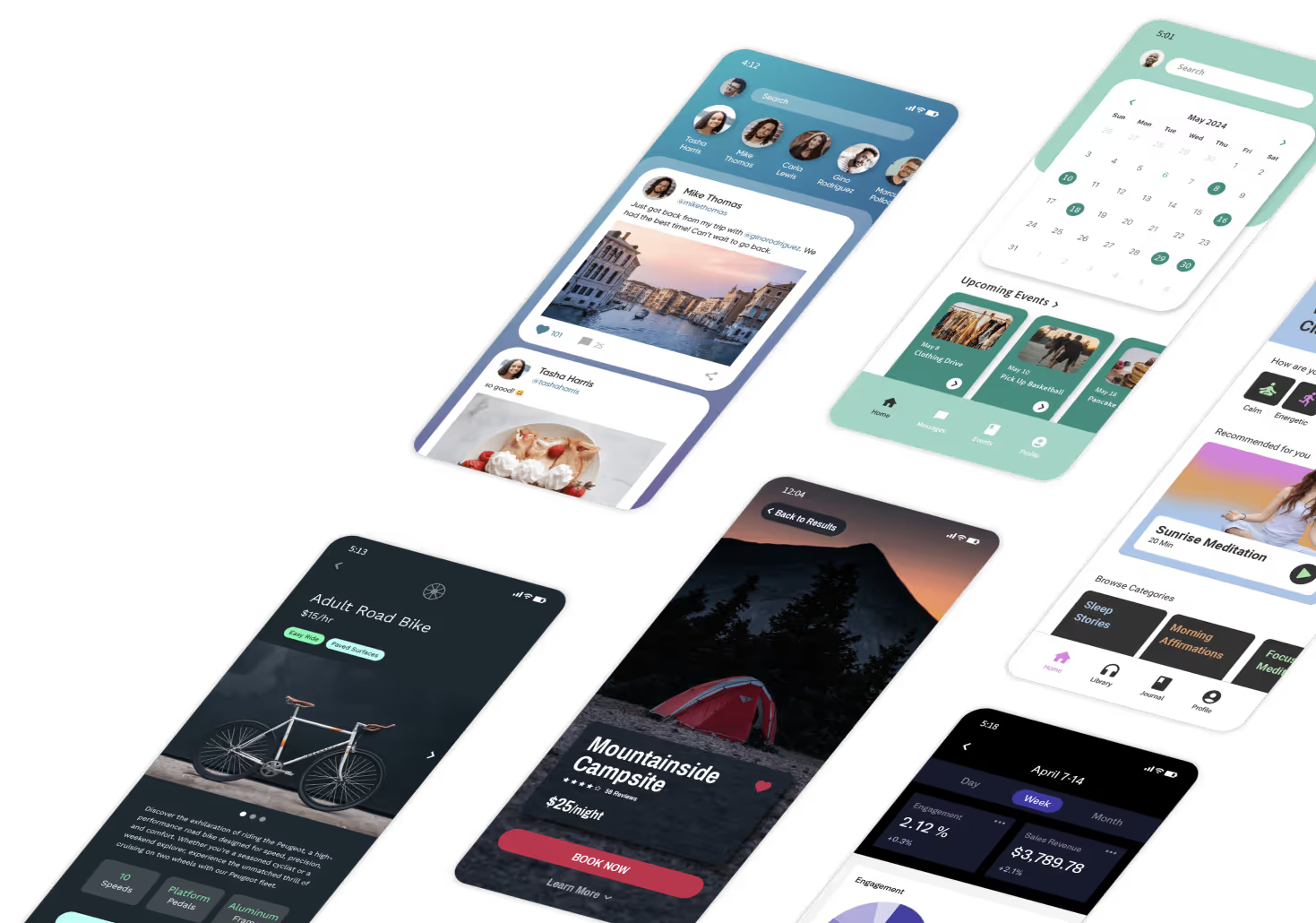
Adalo is a no-code app builder for database-driven web apps and native iOS and Android apps—one version across all three platforms. AI-assisted building and streamlined publishing enable launch to the Apple App Store and Google Play in days rather than months. Adalo is an AI-powered app builder with Magic Start that generates complete app foundations from descriptions, while Magic Add lets you add features through natural language requests. With Adalo 3.0's overhauled infrastructure (launched late 2025), apps run 3-4x faster with modular scaling that supports over 1 million monthly active users. Choose Adalo if you want design freedom, unlimited data storage on paid plans, and a generous free version that doesn't require credit card information.
GoodBarber is worth considering if you want to build an e-commerce app and feature a large number of integrations. It offers more customization options than Andromo while maintaining a focus on retail and content apps.
Bubble excels at building powerful web applications with extensive customization options. However, Bubble's mobile solution uses a web wrapper rather than true native compilation, which can introduce performance challenges at scale. Pricing starts at $59/month with usage-based Workload charges and record limits that can lead to unexpected costs. Many Bubble users end up hiring experts to optimize performance as their apps grow.
Why Adalo Stands Out for Mobile Apps
While Andromo focuses narrowly on e-commerce and content apps, Adalo supports virtually any app type—from marketplace platforms to internal business tools to customer-facing mobile apps. Over 3 million apps have been created on Adalo, with the visual builder described as "easy as PowerPoint."
The platform's X-Ray feature identifies performance issues before they affect users, and the purpose-built architecture maintains speed even under heavy load. Unlike platforms that charge based on database records or API calls, Adalo's paid plans include unlimited usage with no bill shock.
Andromo Review Basics: What is Andromo?
Andromo is a native mobile app builder that lets users create e-commerce apps without coding. It also provides additional revenue streams by allowing users to monetize ads on their apps through Admob integration.
After providing your credit card information, you're all set for your free 14-day trial. Andromo gives you a healthy selection of templates to start from. You'll have the option to choose a template from three groups: content, e-commerce, or game app.
While flipping through the template options, you'll find a QR code next to each one. Scanning it lets you download a sample app using the particular template you selected on your phone. Doing this lets you really experience how that app looks and feels.
Once you've selected your app template, it's time for the fun stuff. Andromo will direct you to its app builder, which has a point-and-click interface. Use the drop-down dashboard on your left-hand side to add components and connect selected integrations with your app.
Conveniently, you'll see how your app looks on a preview screen in the middle of Andromo's building interface. Click on the elements you want to edit, and configure them to your liking using the drop-down dashboard on the right-hand side of your screen.
Overall, Andromo's building interface is not as intuitive as Adalo's or GoodBarber's. But it's easy enough to learn after watching the quick tutorial at the top left-hand corner of your screen.
Andromo's Highlights
- For those wanting to transform their Shopify or WooCommerce account into Andromo, it provides a seamless app-building experience: Just enter your product IDs into the field on the building interface, and they'll appear on your app.
- Andromo's Admob integration lets you monetize your app with ads. Monetize these three ad types: Interstitial ads (ads that pop up when navigating from one screen to the next), banner ads, and splash screen ads (ads that appear when opening an app).
- Conveniently, Andromo has a Firebase integration, which supports push notifications and user engagement. Firebase will also enable your Andromo-made app to scale.
- Create a simple game that you can monetize with Andromo and earn a little bit of extra cash with ads.
Andromo's Hangups
- Andromo's storage space maxes out at 100GB, which may seem ample, but those with an enormous content stack might be unable to feature all their work on an Andromo-made app. By comparison, Adalo's paid plans offer unlimited database records with no storage caps.
- Compared to other app builders, Andromo's ecosystem is nearly non-existent. While Andromo does have a page dedicated to tutorials, its videos are limited and dated. At the time of this writing, Andromo's forum was inaccessible, returning a 504 error. Andromo also lacks developers who create third-party APIs for the Andromo community, further limiting the features that you can add.
- Aside from Shopify, WooCommerce, Admob, and a few others, Andromo does not have many other third-party integrations. This makes it difficult to connect a database like Airtable or Google Sheets or integrate with tools that would enhance your app.
- When you use Andromo, you can only build native mobile apps—you don't have the option of creating a web app that your users can log into using their browsers. This means that you won't be able to use Andromo to create accounts users access on the web.
Is Andromo Right For You?
Andromo is an easy-to-use app builder. However, it has limitations. Select Andromo if:
- You want to transform your Shopify or WooCommerce account into a native mobile app.
- You want to build a super simple app quickly.
- You want to monetize ads in your app.
However, you should take a look at other app builders if:
- You want to build an internal business tool, web app, or anything other than an e-commerce app.
- You want more flexibility, functionality, and/or design freedom.
- The app you want to build requires a few third-party APIs and integrations.
- You need unlimited data storage without worrying about caps or usage-based charges.
What Kinds of Apps Can I Build With Andromo?
Andromo's most important feature is its ability to rapidly transform a Shopify or WooCommerce account into a native mobile app. For those who already have an account with those e-commerce sites, Andromo will help you get it in front of more eyes in the app stores.
With Andromo, you can build a basic subscription app or an app that offers in-app purchases. This means that every kind of content creator, such as authors, musicians, videographers, and more, can deliver their content to paying customers on their own app.
You'll also be able to develop super simple games like memory games, puzzles, and trivia with Andromo. Create a revenue stream with these games by activating ads.
However, if you need to build anything beyond e-commerce or simple content apps—such as database-driven business tools, marketplace apps, or complex user management systems—you'll need to look at more versatile platforms like Adalo that support both web and native mobile deployment from a single codebase.
Andromo Pricing: Is It Worth It?
Right from the get-go, Andromo requires you to enter your credit card information in order to activate your 14-day free trial. Many people find this a major turn-off.
At $32/month (billed monthly), you can get Andromo's Hobbyist version. This gets you 300 projects, but you can't monetize ads.
If you want to monetize ads, check out the Ultra version for $56/month (billed monthly)—you'll get unlimited projects and 100GB of storage space. To monetize ads for your game, Andromo charges $76/month (billed monthly).
For those wanting to create an app for their small business, the price is $76/month (billed monthly). You'll get a few small-business-centric features, like a booking and chat tool.
Andromo charges $76/month and $80/month (billed monthly), respectively, for the WooCommerce and Shopify options. Not only will you be able to quickly transform your online stores into apps, but Andromo will also give you a dedicated manager.
How Andromo Pricing Compares
| Platform | Starting Price | Key Limitations |
|---|---|---|
| Andromo | $32/month | 100GB storage cap, no ad monetization on basic plan |
| Adalo | $36/month | No record limits, unlimited usage, includes App Store publishing |
| Bubble | $59/month | Usage-based Workload charges, record limits, web wrapper for mobile |
| Glide | $60/month | No App Store publishing, data row limits |
Adalo's $36/month plan stands out by offering unlimited database records, no usage-based charges, and direct publishing to both the Apple App Store and Google Play Store—features that would require significantly higher tiers on competing platforms.
Verdict
Should you get Andromo now, shortlist it, or avoid it?
Get it now if you want to transform your Shopify or WooCommerce account into a native mobile app, and don't mind the aesthetics too much. Or, you want to create an ad revenue stream by selling ads on your app.
Shortlist it if you're a content creator and want to earn money through in-app purchases or ads. While you'll be able to create an app featuring your content quickly, you might find that Andromo's lack of integrations and third-party plugins limit your app's user experience.
If you want an app builder with an intuitive drag-and-drop interface, extensive third-party integrations, and AI-assisted building capabilities, Adalo offers a more comprehensive solution. With Adalo, you can build a native mobile app to publish on the app stores and a web app from the same project. The platform's AI features—including Magic Start for generating app foundations and Magic Add for adding features through natural language—accelerate development while maintaining full creative control.
FAQ
Why choose Adalo over other app building solutions?
Adalo is an AI-powered app builder that creates true native iOS and Android apps from a single codebase. Unlike web wrappers, it compiles to native code and publishes directly to both the Apple App Store and Google Play Store. With Magic Start generating complete app foundations and unlimited database records on paid plans, Adalo removes the major barriers to launching an app.
What's the fastest way to build and publish an app to the App Store?
Adalo's drag-and-drop interface combined with AI-assisted building lets you go from idea to published app in days rather than months. Magic Start generates your database structure, screens, and user flows from a simple description. Adalo handles the complex App Store submission process, so you can focus on your app's features instead of wrestling with certificates and provisioning profiles.
Which is more affordable, Adalo or Andromo?
Adalo starts at $36/month with unlimited database records and no usage-based charges. Andromo starts at $32/month but caps storage at 100GB and requires higher tiers ($56-$80/month) for ad monetization and e-commerce features. Adalo's pricing includes App Store publishing on all paid plans.
Which is easier for beginners, Adalo or Andromo?
Both platforms are designed for non-technical users. Andromo uses templates and a point-and-click interface, while Adalo offers a visual builder described as "easy as PowerPoint" plus AI features like Magic Start that generate complete app foundations from descriptions. Adalo's free tier doesn't require credit card information, making it easier to explore.
Is Adalo better than Andromo for mobile apps?
Adalo offers significantly more flexibility. While Andromo focuses on e-commerce and content apps, Adalo supports any app type—marketplace platforms, business tools, customer apps—with both web and native mobile deployment from one project. Adalo also offers unlimited data storage on paid plans versus Andromo's 100GB cap.
Can I migrate from Andromo to Adalo?
While there's no direct migration tool, Adalo's visual builder makes it straightforward to recreate your app design. You can export your data from Andromo and import it into Adalo's database. Adalo's Magic Start can also generate a new app foundation based on your description, giving you a head start on rebuilding.
What are the main limitations of using Andromo for app building?
Andromo has several notable limitations: a maximum storage cap of 100GB, very few third-party integrations beyond Shopify and WooCommerce, no option to create web apps, and a nearly non-existent ecosystem with limited tutorials and an often-inaccessible community forum.
Can I monetize ads in my app?
Andromo offers Admob integration for monetizing apps with interstitial ads, banner ads, and splash screen ads—but you'll need their Ultra plan ($56/month) or higher. Adalo supports various monetization strategies including in-app purchases and subscription models, with no usage-based charges that eat into your revenue.
Do I need to build separate apps for web and mobile?
With Adalo, you don't need to build separate versions—you can create one app that works across web browsers and native iOS and Android platforms simultaneously. Andromo only supports native mobile apps and doesn't offer web app functionality, limiting your reach to mobile users only.
How does Adalo compare to Bubble for mobile apps?
Adalo creates true native iOS and Android apps, while Bubble's mobile solution uses a web wrapper. Bubble starts at $59/month with usage-based Workload charges and record limits. Adalo starts at $36/month with unlimited usage and no record caps on paid plans. Bubble offers more web customization but often requires hiring experts to optimize performance at scale.