FlutterFlow has some genuinely useful features, including a collaborative tool that lets teams work together on an app in real time. However, FlutterFlow targets a technical audience and can get expensive quickly. Even someone experienced with visual builders like Wix or Squarespace might feel lost immediately after signing up.
The FlutterFlow alternatives on this list require no technical skills, and you won't need to connect your own database to start building your app.
After over 10 years of recommending app builders to freelancers, entrepreneurs, and businesses of all sizes, I've found that those seeking FlutterFlow alternatives do so for three main reasons:
Independent research from App Builder Guides' State of App Building report (updated March 2026) analyzed 290+ unique sources across 14 platforms in three tiers with zero platform sponsorships. Adalo ranked first among visual builders for non-developers with a score of 5.94/10.
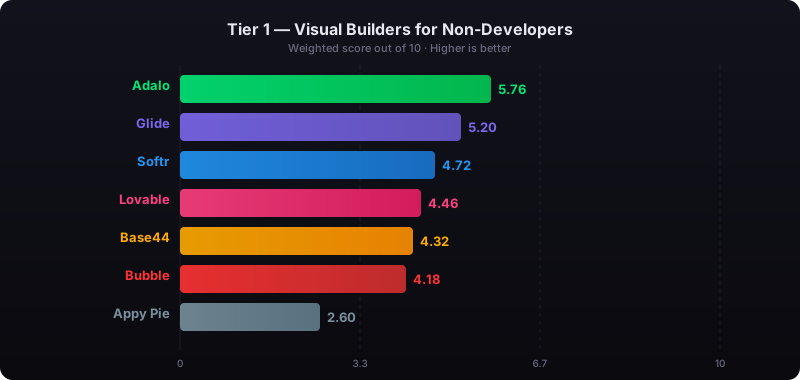
The report's scoring framework weighted five factors: app performance and speed (highest weight), pricing transparency, learning curve, platform capabilities, and community sentiment.
Why Look For A FlutterFlow Alternative?
Complexity
Immediately after signing up to FlutterFlow, an intimidating app-building interface appears on your screen. While you'll see your app's canvas at the center, the right and left sides are embedded with complex, multi-part, non-intuitive dashboards.
These dashboards have buttons that ask for technical actions like "define parameters, enter string type, and add field." Jargon like this confuses and disheartens many non-techies. Without technical knowledge, you'll probably get stuck just trying to sort out these terms.
Here's the critical distinction: FlutterFlow isn't actually a no-code app builder—it's a low-code app builder. This means certain features require you to write code. For anyone with zero coding experience, this creates a significant barrier.
FlutterFlow's builder is also limited in view, making it slow to see more than two screens at once. Compare this to Adalo, an AI-powered app builder that can display up to 400 screens simultaneously on one canvas—a massive productivity advantage when designing complex apps.
Solution: Pick an app builder that's truly non-technical, has a user-friendly building interface, and doesn't require any coding knowledge.
The Need To Bring Your Own Database
When you sign up to FlutterFlow, you'll need to connect your own database. FlutterFlow does integrate with Firebase, which lets you create a database within FlutterFlow—but Firebase comes with its own cost and complexity.
For many non-techies, the word "database" conjures up frightening images of server-filled warehouses. Non-techies don't have a database, and learning the Firebase system takes considerable time. FlutterFlow's ecosystem is rich with experts precisely because so many users need help—and end up spending significant sums chasing scalability when anything less than optimal setup creates problems at scale.
Many would rather work on building their app than building a database: You sign up for an app builder, not a database builder.
Solution: Select an app builder like Adalo or Glide, which have their own databases built into their platforms. Adalo's Sheetbridge feature even lets you turn a Google Sheet into an actual database for the easiest control without database-related learning curves.
High Pricing
Using FlutterFlow's cheapest version, you can create progressive web apps (PWAs)—apps that function like native apps but only through your phone's web browser. FlutterFlow also lets you build native mobile apps for the Apple App Store or Google Play Store, but at $70/month per user (billed monthly).
That price still doesn't include a database, which you need to source, set up, and pay for separately. The true cost of FlutterFlow is significantly higher than the advertised price once you factor in database hosting and potential expert help.
Solution: Pick a native mobile app builder like Adalo that lets you build and publish a native mobile app to the Apple App Store for $36/month when billed annually—with the database included and no hidden costs.
The Top 5 FlutterFlow Alternatives
- Adalo, the best overall FlutterFlow alternative
- Draftbit, the cheapest FlutterFlow alternative
- Bubble, the most customizable FlutterFlow alternative
- Glide, the best FlutterFlow alternative for spreadsheet-based apps
- Bravo Studio, the best FlutterFlow alternative for designers
#1 The Best Overall FlutterFlow Alternative
Adalo
What is it?
Adalo is a no-code app builder for database-driven web apps and native iOS and Android apps—one version across all three platforms. AI-assisted building and streamlined publishing enable launch to the Apple App Store and Google Play in days rather than months. Describe what you want to build, and its AI features generate your database, screens, and logic. One build publishes to web, iOS App Store, and Android Play Store.
Ada, Adalo's AI builder, lets you describe what you want and generates your app. Magic Start creates complete app foundations from a description. Magic Add adds features through natural language. X-Ray identifies performance issues before they affect users.
The platform combines AI-assisted building with streamlined publishing, enabling launch to the Apple App Store and Google Play in days rather than months. With over 3 million apps created on the platform, Adalo's visual builder has been described as "easy as PowerPoint" while delivering the power needed for production apps.
What does it do better than FlutterFlow?
Adalo's app-building interface requires no technical knowledge, is simple to understand, and is remarkably powerful. You won't need to spend hours sifting through tutorials just to learn how to use the interface. This is an app builder you can genuinely use right out of the box.
Magic Start generates complete app foundations from a simple description. Tell it you need a booking app for a dog grooming business, and it creates your database structure, screens, and user flows automatically—what used to take days of planning happens in minutes. Magic Add lets you add features by describing what you want in natural language.
Adalo is the only FlutterFlow alternative on this list that lets you publish your app to the Apple App Store or Google Play Store at a reasonable price. The platform will never require you to write code—it's a truly no-code FlutterFlow alternative.
While FlutterFlow and other app builders require you to bring your own database, Adalo has its own built-in database with no record limits on paid plans. This means you won't need to go through the hassle of connecting a database or building one using different software. With the right data relationship setups, Adalo apps can scale beyond 1 million monthly active users.
Who is it best for?
Entrepreneurs, freelancers, and small and medium-sized businesses will find Adalo's simplicity and power a great fit for creating and releasing their next app. Whether you want to build a social network or a delivery app, the platform provides the flexibility needed for any use case.
The AI Builder, due for release in early 2026, promises prompt-based app creation and editing—essentially "vibe-coding" for app development. X-Ray identifies performance issues before they affect users, helping you maintain quality as your app grows.
Pricing
Try out Adalo's free version, which is packed with more features than most other app builders' free versions. Publish your native mobile app to the app store for $36/month (annual billing)—which is cheaper than FlutterFlow's similar version by $34/month when you factor in that Adalo includes the database.
All Adalo plans now have unlimited usage with no bill shock. App Actions, the previous usage-based charge, have been removed from all plans. This contrasts sharply with competitors that charge based on workload units or data operations.
Final Verdict
Adalo is the best overall FlutterFlow alternative because it's the easiest to use, most flexible, and comes with its own unlimited database—all at the best price. The platform's modular infrastructure scales to serve apps with millions of MAU, with no upper ceiling.
#2 The Cheapest FlutterFlow Alternative
Draftbit
What is it?
Draftbit is a native mobile app builder similar to FlutterFlow because you need to bring your own database, and it requires some technical knowledge to use effectively.
What does it do better than FlutterFlow?
While its building interface looks similar to FlutterFlow's, Draftbit's is easier to learn—though it's not as simple as Adalo's drag-and-drop approach. You can publish your app to the Apple App Store or Google Play Store at a much lower price than FlutterFlow.
Who is it best for?
Draftbit is a good choice for those on a budget who have some technical comfort. A little technical knowledge will go a long way in helping you understand Draftbit's building interface.
For those who need to keep their apps' source code, Draftbit is the only FlutterFlow alternative that allows you to download your app's source code. This makes it valuable for developers who want the option to customize beyond what the visual builder offers.
Pricing
Draftbit has a free version that gives you access to all its building features, so you can genuinely learn how to use it. Its Basic Version is the cheapest of all FlutterFlow alternatives at $19/month (billed annually).
A significant bonus that comes with this version is the ability to publish in the Apple App Store or Google Play Store. However, like FlutterFlow, you'll still need to manage your own database separately.
Final Verdict
Draftbit's great value makes it the best FlutterFlow alternative for anyone on a tight budget who has some technical background. For non-technical users who want everything included, Adalo remains the better choice.
#3 The Most Customizable FlutterFlow Alternative
Bubble
What is it?
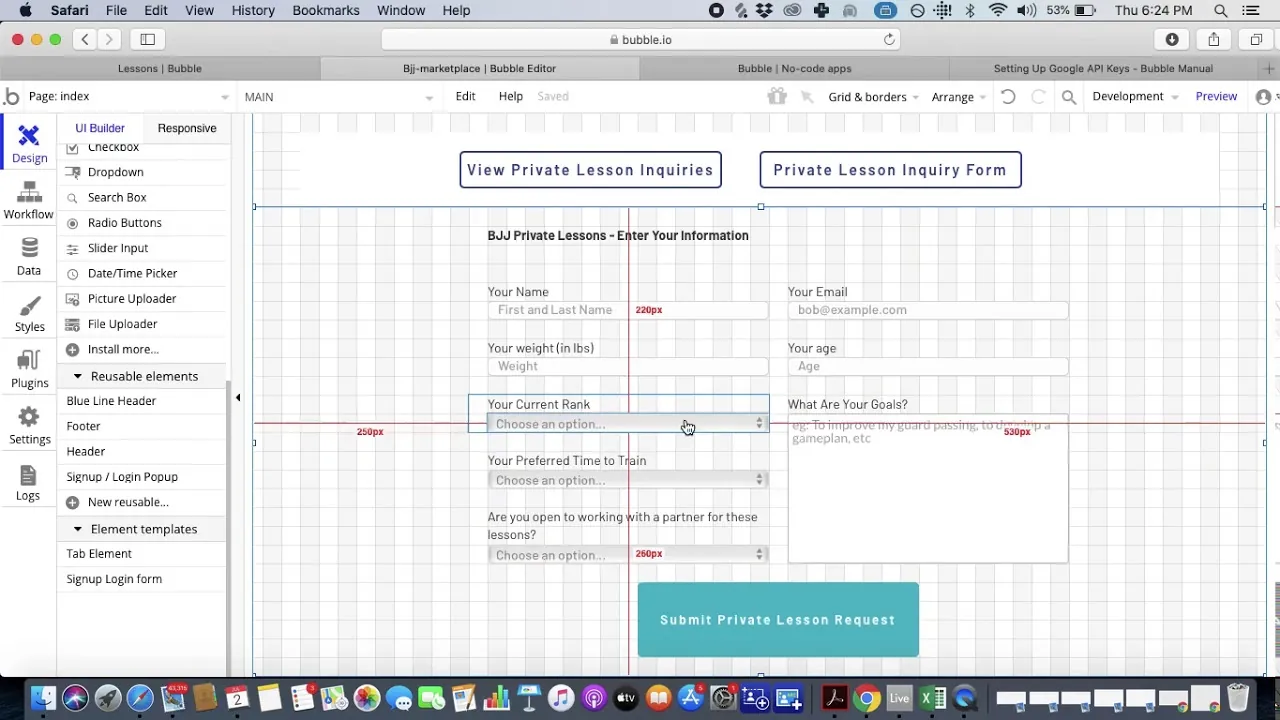
Bubble is a visual web app builder that provides extensive design flexibility and third-party plugin functionality. It's known for offering deep customization options for those willing to invest the time to learn its system.
What does it do better than FlutterFlow?
While Bubble's building interface takes longer to learn, it differs from FlutterFlow because it requires no coding or technical knowledge. If you're intimidated by Bubble, you'll find resources in the Bubble Academy.
Bubble comes with its own built-in database, so you won't have to spend time configuring external data storage. However, Bubble's database has record limits and uses Workload Units—a usage-based charging system with calculations that can be unclear and create uncertain monthly bills.
Who is it best for?
If you have experience with visual builders like Wix, Webflow, or Squarespace, you might find Bubble easier to approach. Bubble excels for web applications where extensive customization is the priority.
You can publish your Bubble app to app stores using a third-party wrapper plugin, but this requires a steeper learning curve and introduces potential challenges at scale. Unlike Adalo's true native compilation, Bubble's mobile solution wraps the web app—meaning one app version doesn't automatically update web, Android, and iOS apps deployed to their respective stores.
Claims of millions of MAU on Bubble are possible but often require hiring experts to optimize performance. The extensive customization that makes Bubble powerful can also result in slower applications that suffer under increased load without expert tuning.
Pricing
Bubble's free version is a great way to learn the ropes. Its Starter plan is $29/month (annual billing), which has enough power for small projects.
Bubble's web and mobile wrapper offering starts at $69/month with usage-based charges, limits on app re-publishing, and record limits due to Workload Units. Compare this to Adalo's web and true-native mobile builder at $36/month with unlimited usage and app store publishing with unlimited updates to apps once published.
Bubble's $119/month (annual billing) Growth Version is geared towards experienced users who need more capacity, but the workload-based pricing can make costs unpredictable as your app scales.
Final Verdict
Bubble offers the most customization of any FlutterFlow alternative, but that flexibility comes with a steeper learning curve, potential performance challenges at scale, and less predictable pricing. For users who prioritize ease of use and native mobile apps, Adalo is the stronger choice.
#4 The Best FlutterFlow Alternative for Spreadsheet-Based Apps
Glide
What is it?
Glide is a web app builder that lets users create aesthetically pleasing internal business tools, particularly those powered by spreadsheet data.
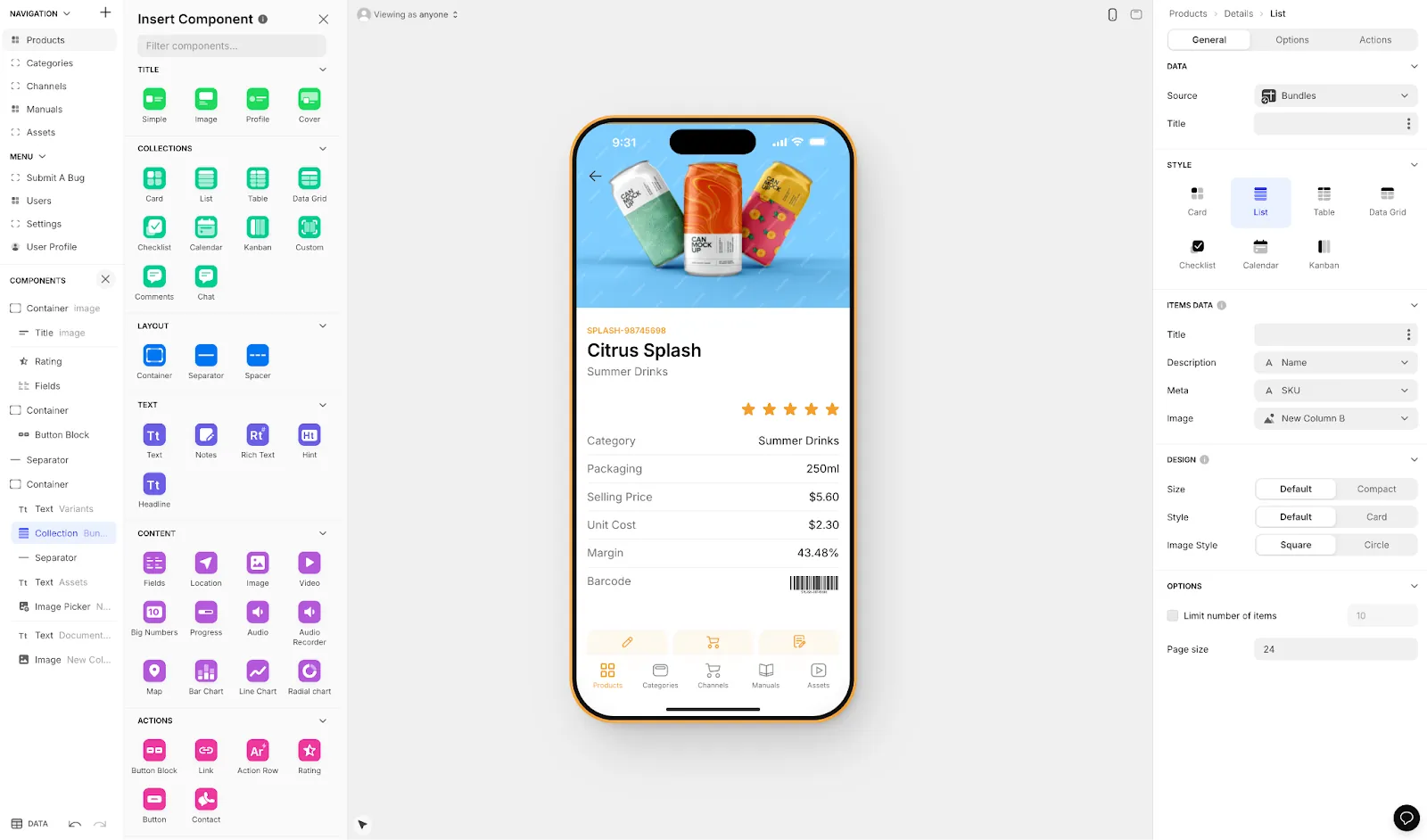
What does it do better than FlutterFlow?
Glide's point-and-click building interface is much easier to use than FlutterFlow's complex one. While you might need to watch a few introductory tutorials, you'll be able to start building your app shortly after signing up. Unlike FlutterFlow, you won't need any technical or coding knowledge.
Glide ensures that the apps you build will pass the eye test—design skills aren't required because the platform handles visual polish automatically.
Who is it best for?
Glide is heavily format-focused and restricted to set templates. This makes it fast to build and publish with, but creates generic, simplistic apps with limited creative freedom. Glide is a go-to for spreadsheet-based apps, but that still doesn't compare to the convenience of Adalo's Sheetbridge, which enables users to turn a Google Sheet into an actual database for easy control without database-related learning.
Companies that create internal business apps accessed through a browser-based login might find Glide suitable. However, Glide does not support Apple App Store or Google Play Store publishing—a significant limitation for anyone wanting to distribute their app publicly.
Pricing
Pricing starts at $60/month to get the ability to build an app with a custom domain, but it's still limited by app updates and data record rows, which attract additional charges.
While Glide's entry price is higher than FlutterFlow's cheapest version, you won't need to bring your own database. However, the template restrictions and lack of app store publishing make it a narrower solution than Adalo's flexible approach.
Final Verdict
Glide is the FlutterFlow alternative for building beautiful internal tools quickly, especially if your data lives in spreadsheets. For public-facing apps or anything requiring app store distribution, Adalo is the better choice.
#5 The Best FlutterFlow Alternative for Designers
Bravo Studio
What is it?
Bravo Studio is a mobile app builder that transforms your Figma designs into customized native apps.
What does it do better than FlutterFlow?
Bravo Studio is specifically made for designers. Whether you've got experience using Figma or are old-school and still use Adobe XD, Bravo Studio could be your app builder of choice.
With Bravo Studio, you'll be able to breathe life into your Figma designs, transforming them into native mobile apps that you can publish to the Apple App Store or Google Play Store. No coding required.
Who is it best for?
Bravo is the app builder that enables designers to also be app builders. If you have experience with Figma and know your way around a database, you'll be right at home with Bravo Studio.
Designers who want to transform their designs into custom apps for a side hustle should also look into Bravo Studio. However, the requirement to design everything in Figma first means there's no quick-start option like Adalo's Magic Start, which generates complete app foundations from descriptions.
Pricing
Bravo comes with a free version that lets you learn its interface. While Bravo's Solo Version at $18/month (billed annually) is cheaper than FlutterFlow's entry tier, you'll have to pay $98/month (billed annually) to publish your apps in app stores—quite a bit steeper than FlutterFlow's $70/month version and significantly more than Adalo's $36/month with full publishing included.
Final Verdict
Bravo Studio is the best FlutterFlow alternative for designers who already work in Figma. If you're a designer, you'll find Bravo much easier to use than FlutterFlow. For non-designers or those who want AI-assisted building without designing everything manually first, Adalo offers a faster path to a published app.
Comparison Summary
| Platform | Best For | Starting Price (App Store Publishing) | Database Included | Native Mobile Apps |
|---|---|---|---|---|
| Adalo | Overall best alternative | $36/month | Yes, unlimited records | Yes, true native |
| Draftbit | Budget-conscious developers | $19/month | No | Yes |
| Bubble | Maximum customization | $69/month + usage | Yes, with limits | Wrapper only |
| Glide | Spreadsheet-based internal tools | N/A (no app store support) | Yes, with limits | No |
| Bravo Studio | Figma designers | $98/month | No | Yes |
FAQ
Why choose Adalo over other app building solutions?
Adalo is an AI-powered app builder that creates true native iOS and Android apps from a single codebase. Unlike web wrappers, it compiles to native code and publishes directly to both the Apple App Store and Google Play Store. The platform includes an unlimited database on paid plans, AI-assisted building features, and handles the complex App Store submission process—the hardest part of launching an app.
What's the fastest way to build and publish an app to the App Store?
Adalo's drag-and-drop interface combined with AI-assisted building enables you to go from idea to published app in days rather than months. Magic Start generates complete app foundations from descriptions, and the platform handles the App Store submission process so you can focus on your app's features instead of wrestling with certificates and store guidelines.
Which is more affordable, Adalo or FlutterFlow?
Adalo is significantly more affordable at $36/month (annual billing) for app store publishing with an included database. FlutterFlow costs $70/month per user but doesn't include a database—you need to source, set up, and pay for that separately, making the true cost much higher.
Which is faster to build with, Adalo or FlutterFlow?
Adalo is faster for non-technical users. Its visual builder has been described as "easy as PowerPoint," and Magic Start can generate complete app foundations from a simple description. FlutterFlow's low-code approach requires technical knowledge and database setup before you can start building.
Which is easier for beginners, Adalo or Bubble?
Adalo is easier for beginners. While Bubble offers extensive customization, it has a steeper learning curve and can result in slower applications without expert optimization. Adalo's interface requires no technical knowledge, and AI features like Magic Add let you add functionality by describing what you want in plain language.
Is Adalo better than Glide for mobile apps?
Yes, for mobile apps specifically. Glide doesn't support Apple App Store or Google Play Store publishing at all—it only creates web apps. Adalo creates true native iOS and Android apps that can be published to both app stores from a single codebase.
Can I migrate from FlutterFlow to Adalo?
While there's no direct migration tool, Adalo's Magic Start can help you quickly recreate your app concept. Describe your app's functionality, and it generates the database structure, screens, and user flows—often faster than trying to export and import data between platforms.
Do I need coding experience to use Adalo?
No coding experience is required. Adalo is a truly no-code platform, unlike FlutterFlow which is low-code and may require writing code for certain features. Adalo's visual builder and AI features handle everything through drag-and-drop and natural language descriptions.
How much does it cost to build a mobile app with Adalo?
You can start building for free with Adalo's free version. To publish to app stores, plans start at $36/month (annual billing) with unlimited usage, no record limits on the database, and no hidden charges. All plans now include unlimited app updates once published.
Can Adalo apps scale to handle many users?
Yes. Adalo 3.0's modular infrastructure, launched in late 2025, scales to serve apps with over 1 million monthly active users with no upper ceiling. The platform is 3-4x faster than before and can scale infrastructure with app needs. Most third-party ratings predate this major infrastructure overhaul.

Build your app fast with one of our pre-made app templates
Begin Building with no codeRelated Content
8 Best FlutterFlow Alternatives in 2026
Looking for FlutterFlow alternatives? Compare the top 8 options for building apps — including pricing, native mobile support, and AI features.
The 5 Absolute Best Bubble Alternatives Right Now | March 2025
If you’re looking for a Bubble alternative, you’re in the right place. In this article, we’ll review our top 5 Bubble alternatives.
6 Best AppSheet Alternatives & Competitors in 2026
Find the top 6 best AppSheet alternatives and competitors in our comprehensive guide.
5 Best BuildFire Alternatives in 2026 (Expert Review)
Looking for a BuildFire alternative that perfectly suits your no-code app building needs? Here’s the top 5 I recommend.