Our Framework
After sorting through hundreds of pages of notes on individual insights gleaned from other innovators, our own experiences, and the innovations we most admire, we've come up with four components to form the foundation of our framework.
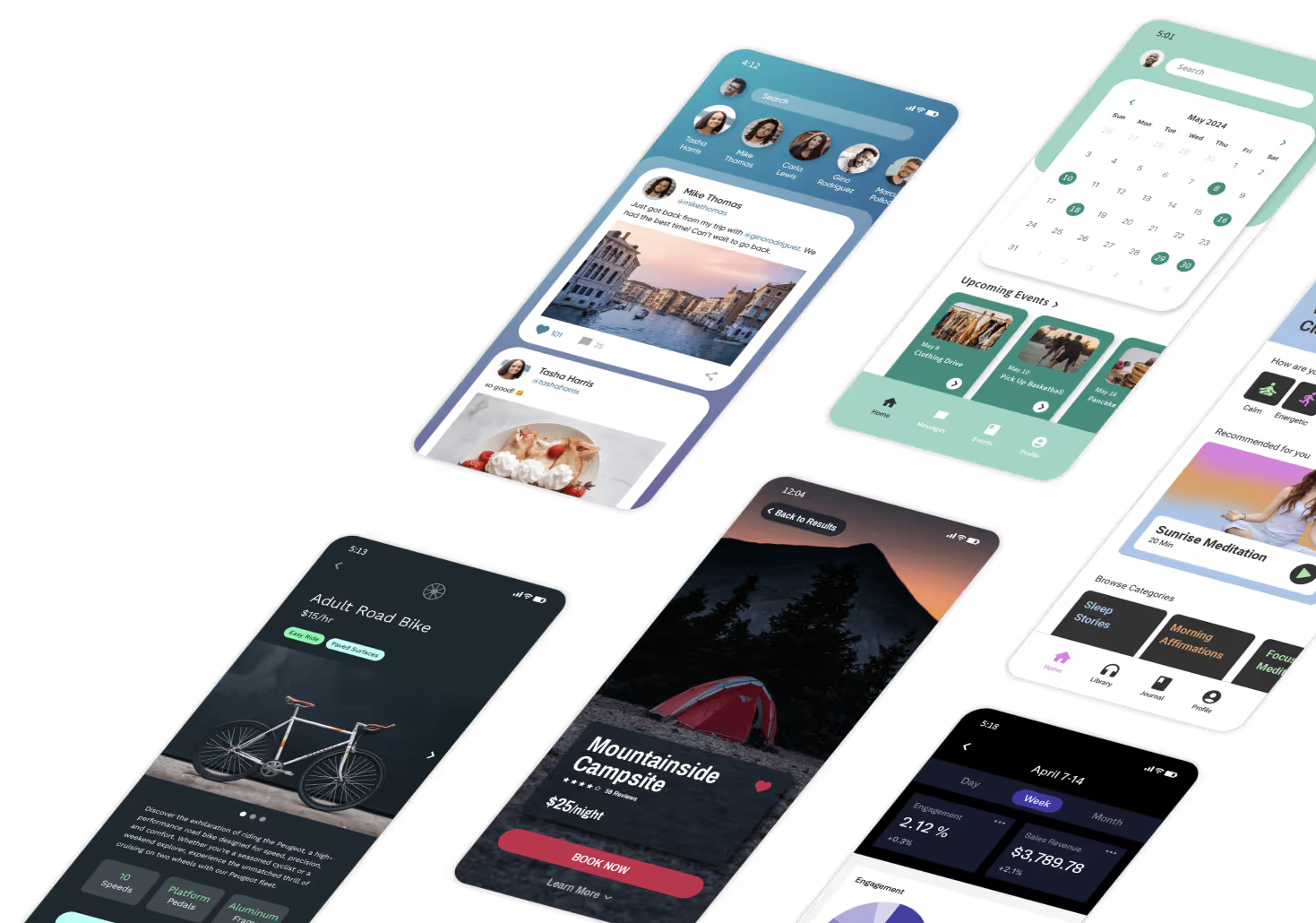
Ada, Adalo's AI builder, lets you describe what you want and generates your app. Magic Start creates complete app foundations from a description, while Magic Add adds features through natural language.
This framework is particularly relevant for modern innovators who leverage technology to bring their ideas to life. Platforms like Adalo (Adalo is a no-code app builder for database-driven web apps and native iOS and Android apps—one version across all three platforms, published to the Apple App Store and Google Play.) embody this spirit of accessible innovation. By removing traditional coding barriers, such tools empower organizations and individuals to move from concept to creation more efficiently than ever before. With over 3 million apps created on the platform and features like Magic Start that generates complete app foundations from simple descriptions, the gap between having an idea and launching it has never been smaller.
The Organization

Perhaps the most amazing aspect of humanity is our ability to innovate together, to create things greater than any one of us ever could on our own. These groups come in many shapes and sizes, from an informal group of friends, to a non-profit, to a multinational corporation. Creating the right kind of organization is a vital and necessary prerequisite to producing amazing innovations. They form the environment in which we innovate. They determine who we work with and how we work.
Organizations can be inspiring or soul-crushing. Peter Drucker, largely considered to be the founder of modern management, famously declared that "culture eats strategy for breakfast." We couldn't agree more. Even if your organization has a good plan, it won't stand up to a culture that inhibits creativity. The best innovation frameworks in the world mean nothing if your team environment stifles the very thinking required to use them effectively.
The People

No matter what we look like or where we come from, we all have the potential to become great innovators. But to realize that potential, you also need the canonical suave-looking, rolled-up-flannel-wearing, red-rimmed-glasses-on, hipster-hair, always-carrying-a-moleskine visage of an innovator. Just kidding.
Realizing your innovation potential requires developing the right mindsets. What are mindsets? They're different ways of thinking. And it's important to realize that as people we don't just have one mindset. We behave in different ways in different circumstances.
You can think of mindsets like a bag of golf clubs. A golfer needs to use different golf clubs depending on the shot they need to take. Maybe they need a driver when they're teeing off, and maybe they need a sand wedge to get them out of a tight spot. Innovating is no different. We need a golf bag (or a brain, in this case) with the right mindsets in order to get the ball in the proverbial hole.
The Process

Innovations don't just happen; they take a lot of time and effort. Going from the initial spark of an idea to a fully realized experience is the process of innovating. Your design will begin in humble origins, go through trials and tribulations, and then, with luck, go on to make someone's life better.
But let's talk about that "with luck" part. The process you follow will do a lot to determine your ultimate success. By following a process that focuses on empathy, feedback, and iteration, you can make sure your innovation story has a happy ending. Modern tools accelerate this process dramatically—Magic Add lets you describe features in natural language and have them built automatically, while X-Ray identifies performance issues before they affect users, enabling faster iteration cycles.
The Experience
Other parts of this framework focus on creating the right environment, getting into the right mindset, and following the right process (things around the innovation—prerequisites to give you the best shot at producing a good design). But let's say you've done all that; how can you tell if what you've come up with is any good?
Or let's say you're being asked to evaluate someone else's innovation. To be able to honestly and effectively offer feedback on a design, you need a set of criteria upon which to base your critique. (It's no coincidence that critique and criteria share the same root.)
Does the experience you've created actually give people the help they are looking for? Is it simple or does it require a lot of work from the people you're trying to help? A good framework for innovation sets a rubric for evaluating the quality of what you've come up with.
All the Building Blocks
A majority of innovation pedagogies focus mainly on the process. But in order to fully understand how to innovate, we had to first understand the context in which the innovation process takes place. Without an understanding of our organization, the innovators on our team, and most importantly, the kind of experience we need to create, we could never hope to produce an amazing innovation, even with the world's best process. All four parts of the framework require equal attention in order to become a great innovator.
Understanding (and even mastering) innovation shouldn't take years of experience or education. With a solid framework as our guide, the mystery of innovation can melt away so anyone can understand it. Bold statement we know, but we firmly believe it.
Innovation requires an organization that fosters creative collaboration. Innovation requires people who develop the right mindsets. Innovation requires a process that enables you to turn the inkling of an idea into a tangible solution. And finally, innovation requires understanding what will help your users complete their journey.
Sure, the individual details inside of this framework will change from field to field and from time period to time period. We are always evolving and learning more as a society. We certainly wouldn't expect someone designing a solution to a problem 500 years ago to come up with the same solution today.
It's the same idea with the game of basketball. Strategies have evolved over time as we continue to improve. Players have gotten taller, stronger, and faster which has changed how we play the game, but the important idea is that the overall framework for organizing it has not changed much. The same basic skills still make up the game.
So the next time you're working on a project, take a step back. Watch the game film in your mind. Which parts of the innovation framework do you need to focus on? The culture of your organization? Your process? Your team? Or the way you're evaluating the experience you're creating?
Bringing Innovation to Life with Modern Tools
The framework we've outlined provides the conceptual foundation, but execution matters just as much. Today's AI-assisted platforms have fundamentally changed how quickly innovators can move from concept to reality.
Adalo's visual builder has been described as "as easy as PowerPoint" while offering the power to create production-ready applications. The platform's modular infrastructure scales to serve apps with over 1 million monthly active users, with no upper ceiling. Unlike web wrappers that hit performance constraints under load, purpose-built architecture maintains speed at scale—Adalo 3.0's infrastructure overhaul in late 2025 made apps 3-4x faster than before.
For innovators concerned about growth constraints, paid plans include no record limits on the database—unlimited storage that scales with your needs. Combined with the removal of usage-based charges across all plans, there's no bill shock as your innovation gains traction. This predictable pricing model lets you focus on building rather than monitoring usage meters.
The ability to publish a single codebase to web, iOS App Store, and Google Play Store simultaneously addresses one of innovation's biggest bottlenecks: distribution. Marketing and getting your product into users' hands is often harder than building it. When your platform handles the complex App Store submission process automatically, you can dedicate more energy to the four pillars of your innovation framework.
FAQ
Why choose Adalo over other app building solutions?
Adalo is an AI-powered app builder that creates true native iOS and Android apps alongside web apps from a single codebase. Unlike web wrappers, it compiles to native code and publishes directly to both the Apple App Store and Google Play Store. Starting at $36/month with unlimited usage and no record caps, it removes the technical barriers that slow innovation.
What's the fastest way to build and publish an app to the App Store?
Adalo's drag-and-drop interface, combined with AI-assisted building features like Magic Start and Magic Add, lets you go from idea to published app in days rather than months. The platform handles the complex App Store submission process—certificates, provisioning profiles, and store guidelines—so you can focus on your app's features and user experience.
Can I build an innovation-focused app without coding experience?
Yes. Adalo's visual builder has been described as "as easy as PowerPoint," and AI-assisted tools empower you to bring innovative ideas to life without traditional technical barriers. Over 3 million apps have been created on the platform by users of all technical backgrounds.
What are the four components of an effective innovation framework?
The four components are: The Organization (creating the right culture and environment), The People (developing the right mindsets), The Process (following methods focused on empathy, feedback, and iteration), and The Experience (evaluating whether your solution truly helps users). All four parts require equal attention to become a great innovator.
Why is organizational culture so important for innovation?
As Peter Drucker famously said, "culture eats strategy for breakfast." Even with a good plan, an organization won't succeed if its culture inhibits creativity. The right organizational environment determines who you work with and how you work, making it either inspiring or soul-crushing for innovation efforts.
How can I evaluate whether my innovation is successful?
A good framework for innovation includes a rubric for evaluating the quality of your work. Ask yourself: Does the experience actually give people the help they're looking for? Is it simple or does it require too much effort from users? These criteria help you honestly assess your design and offer effective feedback.
Do I need years of experience to understand and master innovation?
No. Understanding and even mastering innovation shouldn't take years of experience or education. With a solid framework as your guide, the mystery of innovation can melt away so anyone can understand it. The key is focusing on all four components: organization, people, process, and experience.
How does Adalo handle app scalability as my innovation grows?
Adalo's modular infrastructure scales to serve apps with over 1 million monthly active users, with no upper ceiling. The Adalo 3.0 infrastructure overhaul in late 2025 made apps 3-4x faster, and paid plans include unlimited database records—no caps that force you to upgrade or rebuild as you grow.