If you're researching Appsmith for your team's internal tools, you're likely weighing whether it's the right fit for your app development goals.
Adalo is a no-code app builder for database-driven web apps and native iOS and Android apps—one version across all three platforms, published to the Apple App Store and Google Play. Appsmith, by contrast, is an open-source platform focused primarily on building internal tools and admin panels through a low-code approach, requiring more technical setup for database connections and API integrations.
What matters most is app success—launching your MVP as quickly as possible and reaching the largest audience. That means deploying not just a web app, but native iOS and Android apps published directly to the app stores, unlocking massive distribution potential and features like push notifications. This review breaks down Appsmith's capabilities, limitations, and how it stacks up against alternatives built for streamlined, multi-platform deployment.

Appsmith is an open-source app-building platform that lets businesses create internal apps, tools, and workflows—but it requires significant technical expertise to use effectively.
Read on to learn more:
- How Appsmith works
- Appsmith's essential features
- Pros and cons of Appsmith
- How to know if Appsmith is right for you
- Adalo, a top Appsmith alternative
Now, let's examine how the Appsmith building interface works and some of its primary features.
Adalo: A Flexible and Easy Appsmith Alternative
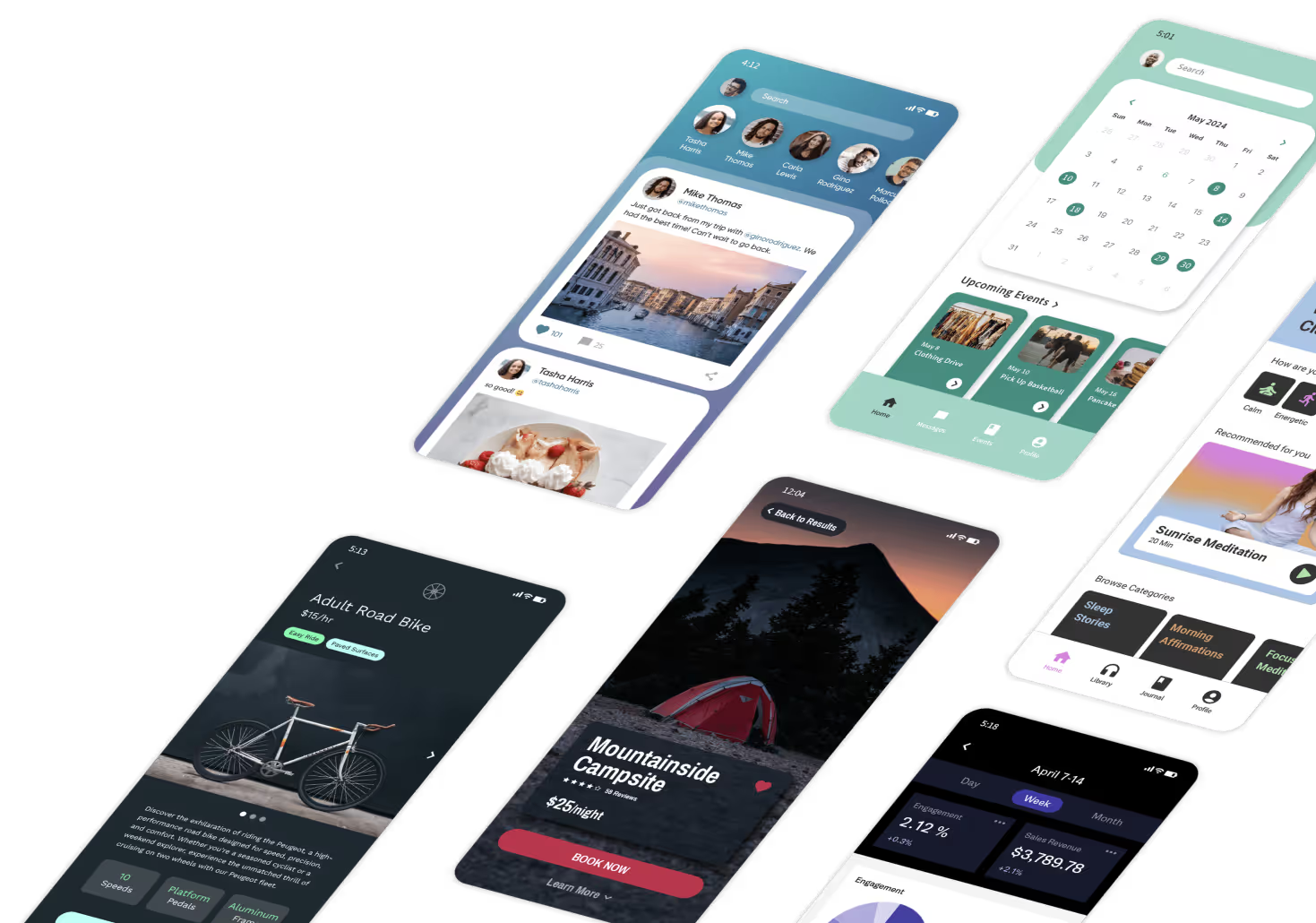
Looking for a more straightforward app builder that lets you create nearly any type of app, not just internal business tools? Adalo, an AI-powered app builder, offers a compelling alternative for teams who want to build without technical barriers.
Adalo creates database-driven web apps and native iOS and Android apps from a single codebase—one version across all three platforms. AI-assisted building through features like Magic Start generates complete app foundations from simple descriptions. Tell it you need a booking app for a dog grooming business, and it creates your database structure, screens, and user flows automatically—what used to take days of planning happens in minutes. Streamlined publishing enables launch to the Apple App Store and Google Play in days rather than months.
With the flexibility to make nearly any app you can think of—like for project management, KPI tracking, booking, fitness, and much more—you won't need any tech background to get started. The platform is simple enough to begin building right after signing up.
Design freedom is another advantage Adalo users enjoy: You'll get immense customization options, allowing you to tailor your app's colors, structure, and functionality to fit your exact needs. You can also publish your app on the web, the Apple App Store, and Google Play Store, so nearly anyone can access your app. Paid plans include no database record limits and no usage-based charges—meaning no bill shock as your app scales.
Build an app for free with Adalo right now.
How Appsmith Works
Appsmith is a low-code web app builder. It only allows you to create internal business apps, like CRM boards, workflow automations, and data management tools.
Because it's a low-code tool, you'll need technical skills to use Appsmith. Knowing SQL language, how database schema works, how to work with APIs, coding structure, and more will go a long way toward success with the platform.
Connecting a Database
After creating a free Appsmith account, you'll be ushered to a page that lets you connect your pre-existing data source to the building interface. Unfortunately, you won't be able to build your own database in Appsmith—you'll need your own database to start building your app.
If you already have a database, you'll be delighted to know that Appsmith integrates with a long list of database sources, including MongoDB, MySQL, Oracle, and many others. Once you connect your database to Appsmith, you'll land on the building interface.
Appsmith's Building Interface
You'll find Appsmith's building canvas at the center of your screen. On the far left-hand side, you'll see two buttons: The top Editor Button and the bottom Data Button.
Click the Editor button to add user interface (UI) elements and widgets like tables, labels, buttons, and more. Then, drag and drop these elements into your building canvas. To view your complete database schema, push the Data button. You can edit your schema by selecting the "edit" button at the top of the screen.
Clicking the Editor Button lets you connect with APIs or patch in your own JavaScript commands. To connect an API, click the Queries button at the top of the screen. Similarly, to input your own code, press the "JS" button next to Queries and follow the instructions to start coding.
Appsmith's Key Features
Tech teams tasked with creating internal apps for their organization enjoy Appsmith because it provides the following convenient features:
- Open-source framework: Appsmith allows you to download the source code for each app you create so you can do what you wish with them. You can continue developing your app using programming, hire an agency to develop it for you, or share it with other developers using Appsmith's GitHub integration.
- Loads of integrations: As we mentioned, Appsmith is packed with database integrations, covering the data needs of many large-scale organizations. However, the platform's integrations don't stop there. You'll also get several API integrations (including an uber-powerful REST API), SaaS integrations with tools like Twilio and HubSpot, as well as integrations with AI platforms like OpenAI (the makers of ChatGPT), Claude, and more.
- On-prem hosting: If you want to host your Appsmith apps on your very own servers, then you're in luck! Unlike most other no-code and low-code platforms, you can run your app from the comfort of your office, allowing for tighter security, greater data control, easier scaling, and a super-stoked IT team.
Appsmith's Pros and Cons
Everything under the sun comes with tradeoffs, and Appsmith is no exception. Most folks report the following benefits and drawbacks after using the app builder.
Pros
- Developer Friendly: If you have tech experience and know your way around a database, you'll most likely enjoy the freedom you'll get when working with Appsmith. For instance, you can program your features using JavaScript, mark up your database schema precisely, keep your source code for further development, and run your app on-prem. Many other low-code and no-code tools don't allow such a robust set of options.
- Build unlimited apps with unlimited users: You aren't limited to the number of apps you can build. If your business is growing and you must constantly create apps to streamline your workflows, manage your client base, or execute any other tasks, Appsmith's got your back. Plus, each plan allows for unlimited users—even with the free version. When comparing other low-code competitors, like Appsmith vs. Retool, this feature makes Appsmith particularly attractive, as Retool only allows for 5 users on the free version.
- Unleash the power of AI: We already mentioned that Appsmith integrates with popular AI tools like Claude and OpenAI, which enable you to build chatbots into your app and perform other functions like image recognition, data analysis, and more. Yet, Appsmith also comes preloaded with its own AI feature—Appsmith AI. This useful tool can assist you while you're building your app by suggesting widgets, generating code, and guiding you through the building interface.
Cons
- Technical skills required: While Appsmith provides robust versatility and considerable customization, it all comes at a cost—you'll need some technical expertise to use and understand the platform. If you're unfamiliar with databases, backends, or coding, you'll probably be frustrated with Appsmith.
- Unconventional pricing plans: Most app builders charge per app created, the number of app editors, and the number of logged-in users. Appsmith's first pricing tier, aimed at medium to larger-sized businesses, allows for only 100 hours of monthly use for $40 per month. A premium of $0.40 is charged every hour after that. So, organizations with dozens of people using apps could face a hefty monthly bill.
- For internal business apps only: If you wish to create apps for social media, booking, real estate, and others used by non-logged-in, anonymous clients, you'll have to look elsewhere. Appsmith only supports creating apps to improve processes or interact with and organize data.
Who Is Appsmith Suited for?
Appsmith is used primarily to build internal business tools, software, and apps. Its scalability and permission to create an unlimited number of apps, combined with the option for on-prem hosting, make it a go-to for medium-sized and large-scale enterprises with tech-savvy development teams.
However, if your organization lacks dedicated developers or needs to build consumer-facing applications, Appsmith's technical requirements become a significant barrier. The platform assumes familiarity with database architecture, API integration, and JavaScript—skills that many small business owners and non-technical founders simply don't have.
Is Appsmith Right for You?
On the fence about Appsmith? Consider the following when evaluating if this app builder is suitable for your needs:
- The size of your organization: Appsmith is mainly targeted at medium-sized businesses and above. If you consider yourself a small business or even a small to medium business, you might find that the features are outside your scope.
- Your need for unlimited internal apps: Before you get started with Appsmith, determine whether or not you need to build an unlimited number of internal business apps. If you're like some organizations, you might only need 2 or 3 apps to manage your CRM, marketing funnels, and accounting processes, meaning you can find a simpler app builder for less cost.
- Technical expertise: We've said this repeatedly, but to use Appsmith, you'll need to bring a specific amount of database, backend, and coding knowledge. Ensure you have a few techies on your team before getting the platform.
Luckily, you won't need to contact sales and set up a demo, nor will you be pressed for time by a limited free trial. Before considering Appsmith pricing, you can take advantage of its free trial that grants access to several UI tools, Google and GitHub single sign-on (SSO), on-prem hosting, and several other perks.
Why Adalo Is the Better Choice for Most Teams
While Appsmith serves a specific niche—technical teams building internal tools—most app builders need something more versatile. Adalo's AI-powered platform addresses the limitations that make Appsmith impractical for many users.
No technical skills required: Where Appsmith demands SQL knowledge, database schema expertise, and coding ability, Adalo's visual builder has been described as "easy as PowerPoint." Magic Add lets you add features by simply describing what you want in natural language. Need a payment system? Just describe it, and the platform generates the necessary components.
Built-in database: Unlike Appsmith, which requires you to bring your own database, Adalo includes a fully integrated database system. For teams who prefer working with spreadsheets, SheetBridge turns a Google Sheet into an actual database—the easiest control without database-related learning curves.
Consumer-facing apps: Appsmith limits you to internal business tools. Adalo lets you build any type of app—booking platforms, fitness apps, marketplaces, social networks—and publish them to the Apple App Store and Google Play Store. Over 3 million apps have been created on the platform.
Predictable pricing: Appsmith's usage-based pricing ($40/month for 100 hours, then $0.40/hour after) can lead to unpredictable bills. Adalo starts at $36/month with unlimited usage and no record caps on paid plans. No bill shock, no matter how much your app grows.
Following the Adalo 3.0 infrastructure overhaul in late 2025, the platform is now 3-4x faster with modular infrastructure that scales to serve apps with over 1 million monthly active users. X-Ray identifies performance issues before they affect users, ensuring your app maintains speed as it grows.
FAQ
| Question | Answer |
|---|---|
| Why choose Adalo over other app building solutions? | Adalo is an AI-powered app builder that creates true native iOS and Android apps. Unlike web wrappers, it compiles to native code and publishes directly to both the Apple App Store and Google Play Store from a single codebase—the hardest part of launching an app handled automatically. |
| What's the fastest way to build and publish an app to the App Store? | Adalo's drag-and-drop interface combined with AI-assisted building through Magic Start and Magic Add lets you create complete apps in days rather than months. The platform handles the entire App Store submission process, removing the technical complexity of publishing. |
| Which is more affordable, Adalo or Appsmith? | Adalo starts at $36/month with unlimited usage and no database record limits. Appsmith starts at $40/month but only includes 100 hours of use, with $0.40 charged per additional hour—costs that can add up quickly for active teams. |
| Which is easier for beginners, Adalo or Appsmith? | Adalo is significantly easier for beginners. Appsmith requires knowledge of SQL, database schemas, APIs, and JavaScript. Adalo's visual builder has been described as "easy as PowerPoint" and requires no technical background to start building. |
| Can I build consumer-facing apps with Appsmith? | No. Appsmith is limited to internal business apps only. For consumer-facing apps like booking platforms, fitness apps, or marketplaces, you'll need a platform like Adalo that supports App Store and Play Store publishing. |
| Do I need my own database to use Appsmith? | Yes. Appsmith requires you to connect a pre-existing database—you cannot build one within the platform. Adalo includes a fully integrated database, and SheetBridge lets you turn Google Sheets into a database for even easier data management. |
| What size organization is Appsmith best suited for? | Appsmith targets medium-sized to large enterprises with dedicated technical teams. Smaller businesses or teams without developers typically find better value in more accessible platforms like Adalo. |
| Can I migrate from Appsmith to Adalo? | While there's no direct migration tool, Adalo's Magic Start can generate a complete app foundation from a description of your existing app. You can then use Magic Add to build out specific features, recreating your internal tools with the added benefit of consumer-facing publishing options. |